How to Live Off the Grid With No Money: A Realistic Roadmap
How to Live Off the Grid With No Money: A Realistic Roadmap
You have almost nothing in your bank account, a deep frustration with rent that keeps climbing, and a gut feeling that there has to be another way. The idea of knowing how to live off the grid with no money sounds either like the smartest move you could make — or a pipe dream sold by YouTube homesteaders who conveniently never mention the $80,000 land purchase in the backstory. The truth lands somewhere in the middle, and it is closer to reachable than most people think.
Without a clear-eyed plan, most people who attempt off-grid life on a shoestring run into three predictable disasters: they spend winter in a shelter that is not ready, they burn through whatever small savings they had on the wrong gear, or they lose access to land they thought was secure. A single winter in a leaking tarp camp with no food storage and no income will send you back to a city apartment faster than anything else. The knowledge gap is what kills the attempt — not the lack of money itself.
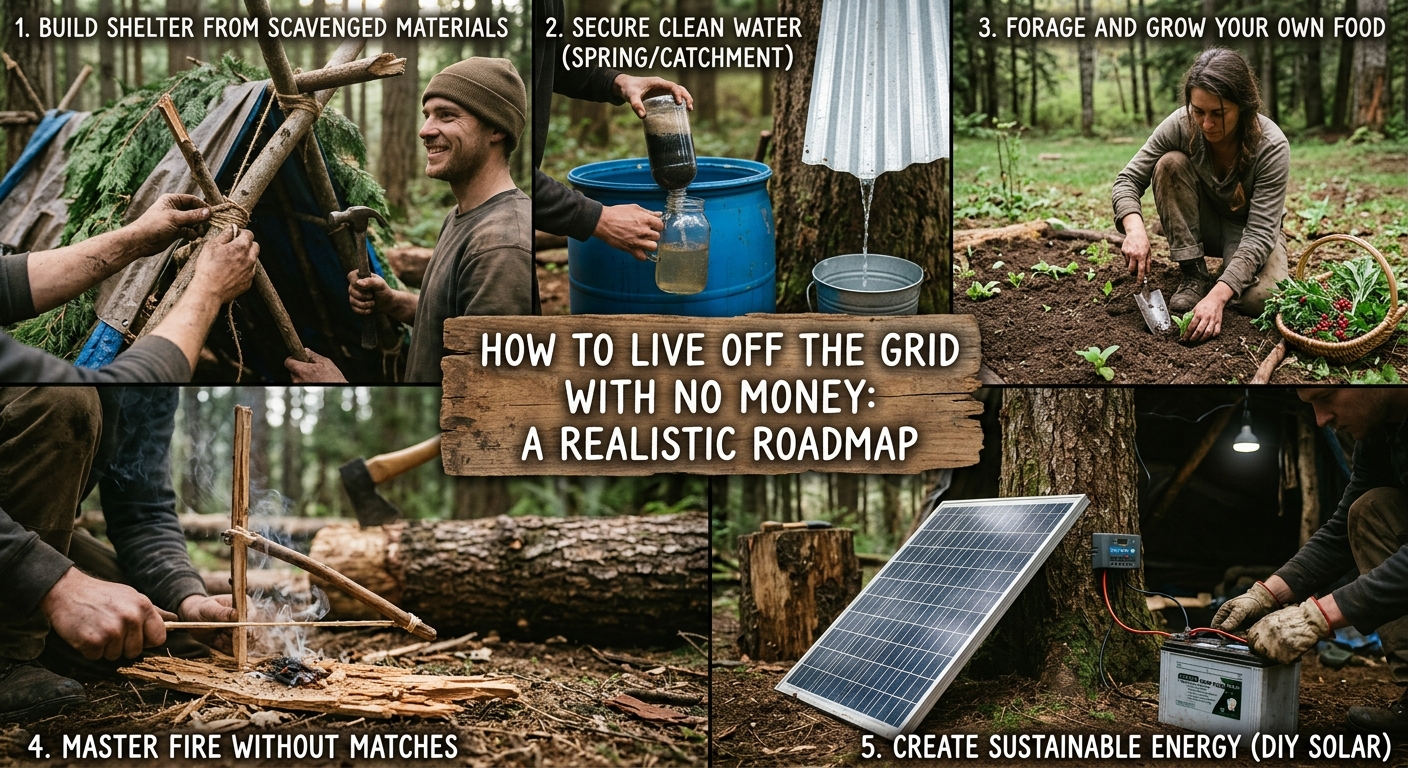
This guide covers exactly what the process looks like from zero: how to find land without buying it outright, how to build shelter from salvaged and natural materials, how to source free water and grow food from saved seed, and how to generate just enough income to keep momentum going. At the end you will find a realistic 12-month roadmap that maps all of it into a sequence you can actually follow.
Quick Answer: Can You Actually Go Off-Grid With No Money?
Yes — but « no money » really means « very little money and a lot of time and labor. » The honest tradeoffs are these:
- Land: You do not need to own it. Caretaker arrangements, land partnerships, and owner-financed rural parcels can get you legal access for $0–$200/month or less.
- Shelter: A debris hut or tarp camp costs under $50 and buys time to build something permanent from salvaged lumber and cob.
- Water: A basic rainwater collection system with a 275-gallon IBC tote runs $60–$120 used. Spring development on suitable land costs labor, not cash.
- Food: A first garden from seed-saving and foraging is essentially free after basic hand tools ($30–$60 total).
- Energy: Wood fires handle heat and cooking at zero cost. A $150–$200 solar starter kit covers lighting and phone charging.
- Income: Seasonal farm work, remote gig work, and selling firewood or eggs can generate $500–$2,000/month from a rural base.
The real currency is sweat equity and time. If you have both, the money requirement drops dramatically.
Reality Check: What « No Money » Actually Means in Off-Grid Terms
The Land-Tools-Time Triangle
Every off-grid setup involves three inputs: land access, tools, and time. When money is short, you compensate with more time and creative land arrangements. A person with $500 and six months free time is in a better starting position than someone with $5,000 and only weekends. Understanding this triangle prevents the single biggest mistake beginners make — spending limited cash on the wrong things first (solar panels before shelter, for example).
What You Actually Need Money For
Even in the leanest setup, certain costs are nearly unavoidable early on: a basic tool kit (ax, hand saw, shovel, hoe — around $60–$100 used from estate sales or Facebook Marketplace), water containers ($20–$60 for food-grade buckets), and some form of weather-rated sleeping setup ($50–$150 for a quality military surplus sleeping bag). Budget roughly $300–$500 as a true floor before your first harvest, and plan to generate more through work before winter.
Finding Free or Nearly Free Land
Caretaker Positions
Property owners — especially those with large rural acreage, seasonal cabins, or remote homesteads — regularly need someone on site to maintain fences, deter theft, water animals, or simply keep an eye on things. In exchange, caretakers often receive free housing and sometimes a small monthly stipend of $100–$500. Sites like Caretaker Gazette (caretaker.org) list hundreds of these positions. A 6–18 month caretaker arrangement gives you time to save money, learn land skills, and scout your next move without paying rent.
Rural County Land Auctions
In many US counties, small parcels — often 1–5 acres of raw, landlocked, or tax-delinquent land — go to auction for $200–$2,000. States like Tennessee, Missouri, Arkansas, West Virginia, and Michigan regularly see these sales. Search « [your target county] delinquent tax land auction » to find upcoming listings. A $500 parcel of rocky Tennessee hillside is not a farm, but it is a legal address for a camp while you build skills and income.
Owner Financing
Many rural landowners, especially older sellers without a mortgage, will finance the sale themselves. Terms like $100/month with zero interest on a $5,000 parcel are negotiable when you deal directly. Look for « owner will finance » or « seller financing » tags on LandWatch, LandFlip, and Facebook Marketplace land listings. A $500–$1,000 down payment is often enough to secure a deal.
Land Partnerships
Find someone who owns land but lacks time or labor to work it. You provide the presence and sweat equity; they provide legal access. A handshake deal works short-term, but always get a written lease — even a one-page agreement specifying your right to erect temporary structures protects both parties. Homesteading Facebook groups and forums like Reddit’s r/homestead frequently have posts from landowners looking for exactly this arrangement.
Building Shelter With No Money
Starting With a Tarp Camp
A 10×12 ft heavy-duty poly tarp ($20–$35 at Harbor Freight or Tractor Supply) rigged as an A-frame over a raised sleeping platform gives weather protection for the first weeks while you assess the land and gather materials. Add a wool blanket or surplus sleeping bag rated to 0°F and you have a functional basecamp. This is not a long-term solution, but it buys time without requiring cash you do not have.
The Debris Hut
A debris hut is the most underrated emergency and transitional shelter in survival building. It requires zero tools and zero money. The construction method: drive a ridgepole 9 feet into a fork or prop it between two trees at roughly hip height, lean sticks and branches along both sides at a 45-degree angle, then pile 3–4 feet of dry leaves, pine needles, or grass over the entire frame. Inside, pack more leaves 2 feet deep as bedding. A well-built debris hut holds body heat at temperatures well below freezing. Tom Brown Jr.’s book Tom Brown’s Field Guide to Wilderness Survival covers the technique in full detail and is worth reading from a library copy.
Salvaged Material Cabin
Craigslist « free » sections, Facebook Marketplace, Habitat for Humanity ReStores, and demolition sites are constant sources of free and near-free lumber, windows, metal roofing, and insulation. A 12×16 ft single-room cabin — enough for one or two people with a wood stove — can be framed with salvaged 2×6 lumber and roofed with used metal panels for under $300 in purchased fasteners and hardware. Search for « barn deconstruction free lumber » and « demolition salvage » in your county. Many contractors pay to haul debris; if you take it yourself, they will often load your truck for nothing.
Cob and Earthbag Building
Cob (subsoil clay mixed with sand and straw) and earthbag construction (polypropylene sandbags filled with local soil) are the oldest building traditions in the world and require almost no purchased materials if your land has suitable soil. Cob walls 12–18 inches thick are naturally insulating and fire-resistant. Earthbag structures can be built in rounds or rectangles and are earthquake-resistant. Both methods require significant labor — plan 3–6 months to build a single-room structure solo — but the material cost is often under $200 for bags, barbed wire, and a basic door frame.
Free Water Sources and Collection
Rainwater Collection
A metal or plastic roof draining into a used 275-gallon IBC tote (available used for $60–$100 on Craigslist or from food distributors) gives you meaningful water storage. One inch of rain on 1,000 square feet of roof yields approximately 600 gallons. In most of the eastern US, annual rainfall is 35–60 inches — more than enough to supply a solo household of 20–30 gallons per day. Add a $20 mesh screen to exclude debris and a $30–$50 Big Berkey-style gravity filter for potable water, or boil over the fire for free.
Spring Development
If your land has a seep or hillside spring, you can develop it into a reliable gravity-fed water supply for under $50 in materials. The basic method involves digging out the spring eye, surrounding it with gravel and a perforated collection pipe, covering with clay to exclude surface water, and running a black poly pipe downhill to a storage tank or tap. A developed spring producing 1 gallon per minute supplies 1,440 gallons per day — far more than most households need. YouTube channels like « Just a Few Acres Farm » show the process clearly.
Free Food: Foraging, Hunting, and Gardening
5 Beginner Foraging Plants in the US
Learning even a handful of wild edibles dramatically reduces food costs. Start with these five, all of which are widespread across most of the continental US and easy to identify with confidence:
- Dandelion (Taraxacum officinale): Entire plant edible — leaves, flowers, and roots. Nutritionally dense. Spring through fall.
- Wood Sorrel (Oxalis spp.): Clover-like plant with a tart lemon flavor. Excellent in salads. Found in disturbed soil and shaded areas.
- Lamb’s Quarters (Chenopodium album): One of the most nutritious wild greens available. Cooks like spinach. Common in garden edges and roadsides.
- Cattail (Typha spp.): Found near water. Pollen, young shoots, and starchy roots all edible. One of the most calorie-dense wild foods in North America.
- Blackberries and Wild Raspberries (Rubus spp.): Widespread across the eastern and western US. Pick and dry or ferment for winter storage.
Use the free iNaturalist app for photo-based identification and always cross-reference with a printed guide like Edible Wild Plants by Lee Allen Peterson.
Hunting and Fishing on the Cheap
A basic fishing license in most US states runs $15–$25 per year. A resident hunting license with a deer tag adds another $20–$40 in states like Arkansas, Missouri, and West Virginia. A single whitetail deer yields 50–80 lbs of dressed meat — enough protein for a solo person for several months when combined with foraging and gardening. A used .22 rifle or a recurve bow (check Facebook Marketplace, $50–$150) handles small game year-round.
Starting a Garden From Seed Saving
Seed Savers Exchange (seedsavers.org) and local seed library programs — available through many county libraries for free — provide open-pollinated seeds you can save and replant indefinitely. Prioritize calorie-dense, low-maintenance crops: dried beans, winter squash, sweet potatoes, garlic, and kale. A 400 sq ft hand-dug garden with saved seed and kitchen compost can produce 200–400 lbs of food in its first season. Basic hand tools — a garden hoe, digging fork, and trowel — are all you need and run $30–$60 used.
Free and Low-Cost Energy
Wood Fire for Heat and Cooking
A simple rocket stove built from salvaged cinder blocks or clay costs nothing and burns small-diameter wood (1–2 inch sticks) extremely efficiently — far more efficiently than an open fire. For heating a small cabin, a basic wood stove can be fabricated from a 55-gallon steel drum ($20–$40 used) with a stovepipe and simple door. Scavenged and cut firewood from downed trees on your property (or with a permit from national forest lands) is entirely free. A hand-sharpened ax and a $15 splitting wedge are the only tools needed.
Candles and Oil Lamps
Rendered animal fat (tallow) from hunting or butchering produces excellent candles and lamp oil at no cost. Commercial candle wax runs about $2/lb. A simple oil lamp with a cotton wick burns olive oil, vegetable oil, or rendered fat for steady reading light. These are not primary solutions but fill gaps and eliminate battery drain on lighting circuits.
Solar Starter Kits Under $200
A basic lighting and phone-charging setup needs only a small solar array. The Renogy 100W Starter Kit (roughly $100–$130 on Amazon) paired with a used Group 27 deep-cycle battery ($40–$60 from auto parts stores) and a simple PWM charge controller gives you enough power to run 4–6 LED lights for 4–6 hours per night and keep a phone or tablet charged. This is the minimum viable off-grid electrical system and it handles the highest-impact daily needs first: light after dark and communication.
Income While Living Off-Grid
Seasonal Farm Work
WWOOF (World Wide Opportunities on Organic Farms) membership ($40/year) connects volunteers with farms that provide room and board in exchange for 4–6 hours of daily work. It is not cash income, but it eliminates all living expenses while you build skills. For actual cash, harvest seasons in the apple orchards of Washington state, the tobacco farms of North Carolina, or the vegetable operations of California and Florida pay $12–$18/hour with free or cheap housing. A single 3-month harvest season can generate $3,000–$5,000 in cash savings.
Remote Online Work
A $150–$180 prepaid hotspot plan from Visible or US Mobile (using Verizon or T-Mobile towers) provides enough data for remote work even in rural areas with basic cell coverage. Freelance writing, data entry, virtual assistance, and transcription work on platforms like Upwork, Rev, and Fiverr pay $10–$30/hour and require nothing but a laptop and connectivity. Even 10–15 hours of remote work per week generates $400–$1,800/month — enough to cover the modest cash needs of an off-grid setup.
Selling What You Produce
Once your operation is producing surplus, direct sales generate steady income. Firewood cords sell for $150–$350 in rural markets. Dozen eggs from a small flock of six hens bring $4–$7 at farm stands. Handmade goods — beeswax candles, wood-carved utensils, woven baskets — sell well at farmers markets and on Etsy. A small homestead with a few laying hens, a half-cord of firewood per week, and a 10-item Etsy shop can generate $600–$1,200/month in supplemental income without leaving the property.
12-Month Roadmap: From No Money to Sustainable Off-Grid Life
| Month | Priority | Key Actions | Target Budget |
|---|---|---|---|
| 1–2 | Land Access + Basecamp | Secure caretaker position or land partnership; set up tarp camp; acquire basic hand tools | $50–$200 |
| 2–3 | Water + Sanitation | Install IBC tote rainwater collection; build composting outhouse; source gravity filter | $100–$200 |
| 3–5 | Permanent Shelter Start | Gather salvaged lumber/materials; begin cabin frame or earthbag walls; install wood stove | $100–$300 |
| 4–6 | Food Production | Dig and plant first garden; begin foraging practice; get fishing license; plant perennials | $30–$80 |
| 5–7 | Income Generation | Start remote gig work or WWOOF season; sell first firewood or produce; build cash buffer | Generates $500–$2,000 |
| 6–8 | Shelter Completion | Finish roof and walls; insulate with salvaged materials; weatherproof before fall | $100–$200 in hardware |
| 7–9 | Food Preservation | Harvest and dry/ferment/can garden produce; smoke or cure any hunted meat; fill root cellar | $30–$60 in jars and supplies |
| 8–10 | Basic Electrical | Install Renogy 100W solar kit + deep cycle battery; wire LED lights; charge station for devices | $150–$200 |
| 10–12 | Winter Readiness | Stack 3–4 cords of firewood; insulate water lines; stockpile dried staples; review and repair shelter | $50–$100 |
| 12+ | Evaluate and Expand | Assess what worked; add chickens or bees; explore land purchase options; expand garden to 800+ sq ft | $200–$500 |
Common Mistakes and What to Do Instead
Buying Solar Before Shelter Is Finished
Solar panels do not keep you warm. If you spend $800 on a solar system in month two while sleeping in an uninsulated structure, you will not survive winter comfortably. Follow the priority order: shelter and water first, food production second, energy third. The wood fire handles the first winter; solar is a second-year upgrade.
Picking Land Without Water
Before committing to any land arrangement, confirm the water situation. Does it have a spring, creek, or sufficient rainfall for collection? Hauling water by truck costs $0.03–$0.05 per gallon in rural areas and gets old fast. A site with a reliable water source is worth more than a site with electricity in every off-grid calculation.
Going Alone Without a Network
Solo off-grid beginners burn out at a much higher rate than those with even one partner or nearby neighbor. Before you make the move, connect with local homesteading groups, attend a few rural farmers markets, and introduce yourself to whoever lives on adjacent land. A neighbor who will help you pull a truck out of mud or spot you $20 in lumber during a hard week is worth more than most gear you could buy.
Underestimating Food Storage
Going into your first winter with less than a 3-month food supply is the most common mistake new off-gridders make. Your garden will not produce year-round, foraging is limited in winter, and hunting is not guaranteed. Aim to have 90 days of dry staples — dried beans, rice, oats, cornmeal, and dried or canned vegetables — before the first hard frost. Bought in bulk from a restaurant supply store or Costco, this costs $150–$250 for one person.
No Legal Protection on the Land
If you are on someone else’s land without a written agreement, you are one bad conversation away from losing everything you built. Even a simple one-page lease that grants you the right to erect temporary structures and maintain a garden protects your investment of time. Get it signed before you drive a single post into the ground.
The Bottom Line
Learning how to live off the grid with no money is not about magic or wilderness survival heroics — it is about sequencing correctly. Land access comes first, through caretaker positions, land partnerships, or cheap county auction parcels. Shelter follows, built from salvaged materials, cob, or debris construction. Water and food production fill in behind those, and a simple wood fire plus a $150 solar kit handle energy needs for the first year. Income through seasonal farm work, remote gigs, and small-scale selling keeps the whole system funded without requiring a traditional job or a city address.
The 12-month roadmap above is realistic for a single adult with basic physical fitness and a willingness to work hard. It is not comfortable, and the first winter will test you. But by month 12, you will have legal land access, a weatherproof shelter, a producing garden, a water system, and enough stored food and income to keep going — all built on a starting budget most people spend on a single month of rent.
Have questions about your specific situation? Drop them in the comments below — we read every one. If this guide helped you, share it with someone planning their off-grid setup.
Marcus Reid
Founder & Editor, OffGridSage
Marcus founded OffGridSage to bring practical off-grid knowledge together in one place. Guides are built from official and expert sources (NREL, the EPA, the USDA and university extension services), manufacturer documentation and reader feedback, and are updated when information changes.