Best Solar Batteries for Off-Grid Living in 2026 (Lithium vs AGM)
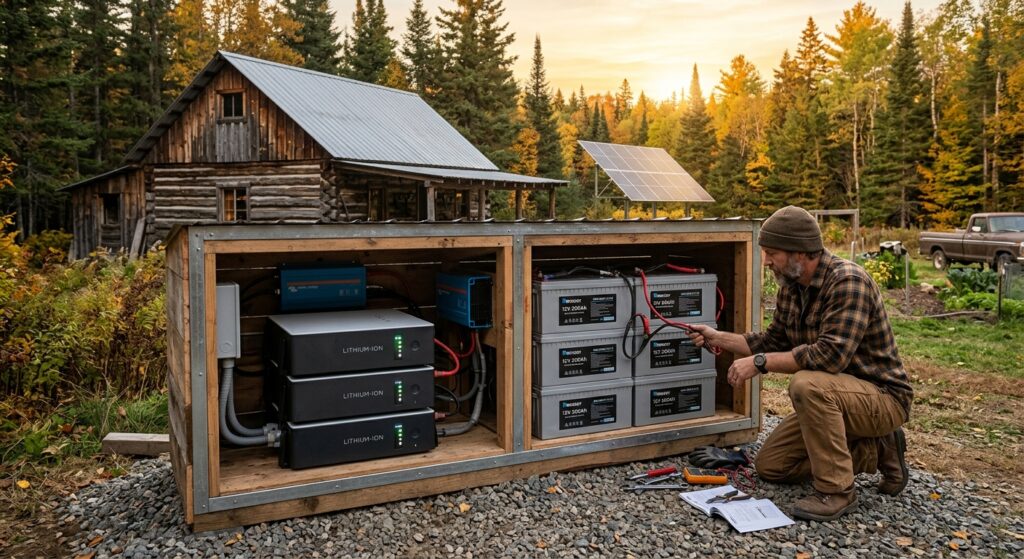
Your battery bank stores every watt-hour your solar panels produce, so choosing the right batteries is one of the biggest decisions in an off-grid system. The two main options in 2026 are lithium iron phosphate (LiFePO4) and absorbed glass mat (AGM) lead-acid. This guide compares them side by side, covers well-known brands and models with approximate prices, and explains how to size, install and look after a battery bank so it lasts.
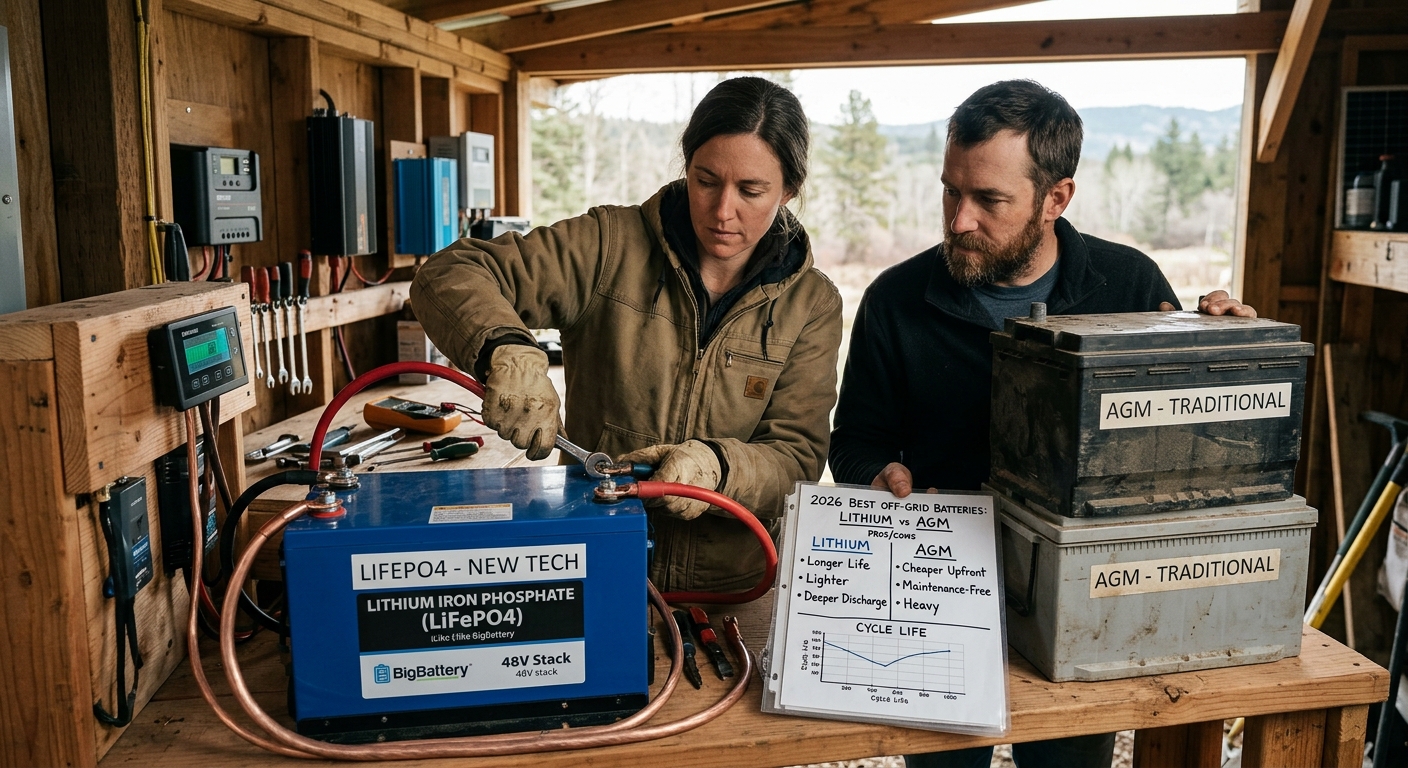
LiFePO4 vs AGM: Comparison Table
| Feature | LiFePO4 (Lithium Iron Phosphate) | AGM (Absorbed Glass Mat) | Bottom Line |
|---|---|---|---|
| Usable capacity | 80–100% depth of discharge (DoD) | 30–50% DoD for longevity | LiFePO4 delivers far more usable energy per rated amp-hour. |
| Cycle life (at recommended DoD) | 3,000–8,000+ cycles | 400–800 cycles | LiFePO4 lasts much longer and needs replacing far less often. |
| Round-trip efficiency | 90–99% | 80–85% | LiFePO4 wastes less solar energy. |
| Voltage stability | Very stable throughout discharge | Drops gradually as it discharges (voltage sag) | LiFePO4 supplies more consistent power to appliances. |
| Weight (12V 100Ah) | ~28–32 lbs (13–14.5 kg) | ~60–70 lbs (27–32 kg) | LiFePO4 is roughly half the weight and easier to handle. |
| Charging speed | Very fast (accepts high charge rates) | Slow (limited charge acceptance) | LiFePO4 recharges more quickly from solar or a generator. |
| Cold weather | Cannot charge below 32°F (0°C) without heating; discharges to -4°F (-20°C) | Discharges to -20°F (-29°C); charging less affected but less efficient in cold | In cold climates, choose heated LiFePO4 or accept AGM’s simpler cold charging. |
| Maintenance | None; internal BMS manages protection | None (sealed), but needs careful charging | Both are maintenance-free in normal use. |
| Safety | Very safe (thermal stability plus BMS protection) | Safe (sealed, no off-gassing under normal use) | Both are safe; the BMS adds extra protection to LiFePO4. |
| Total cost of ownership | Lower over 10+ years thanks to longevity | Higher over 10+ years due to replacements | LiFePO4 costs more upfront but usually less over time. |
| Key brands | Battle Born, Renogy, SOK, Victron | Trojan, Crown, Fullriver | See product details below. |
When comparing batteries, always look at usable capacity, not just the advertised amp-hour rating. With LiFePO4 you can use most or all of the rating; with AGM, plan on using about 50% to protect battery life. This difference is critical for both system sizing and budgeting.
Best Off-Grid Batteries in 2026 (Approximate Prices)
The off-grid battery market moves quickly, particularly for LiFePO4, where competition continues to push performance up and prices down. The brands below have strong reputations for quality and support. Prices are approximate 2026 estimates and vary with promotions and distributors.
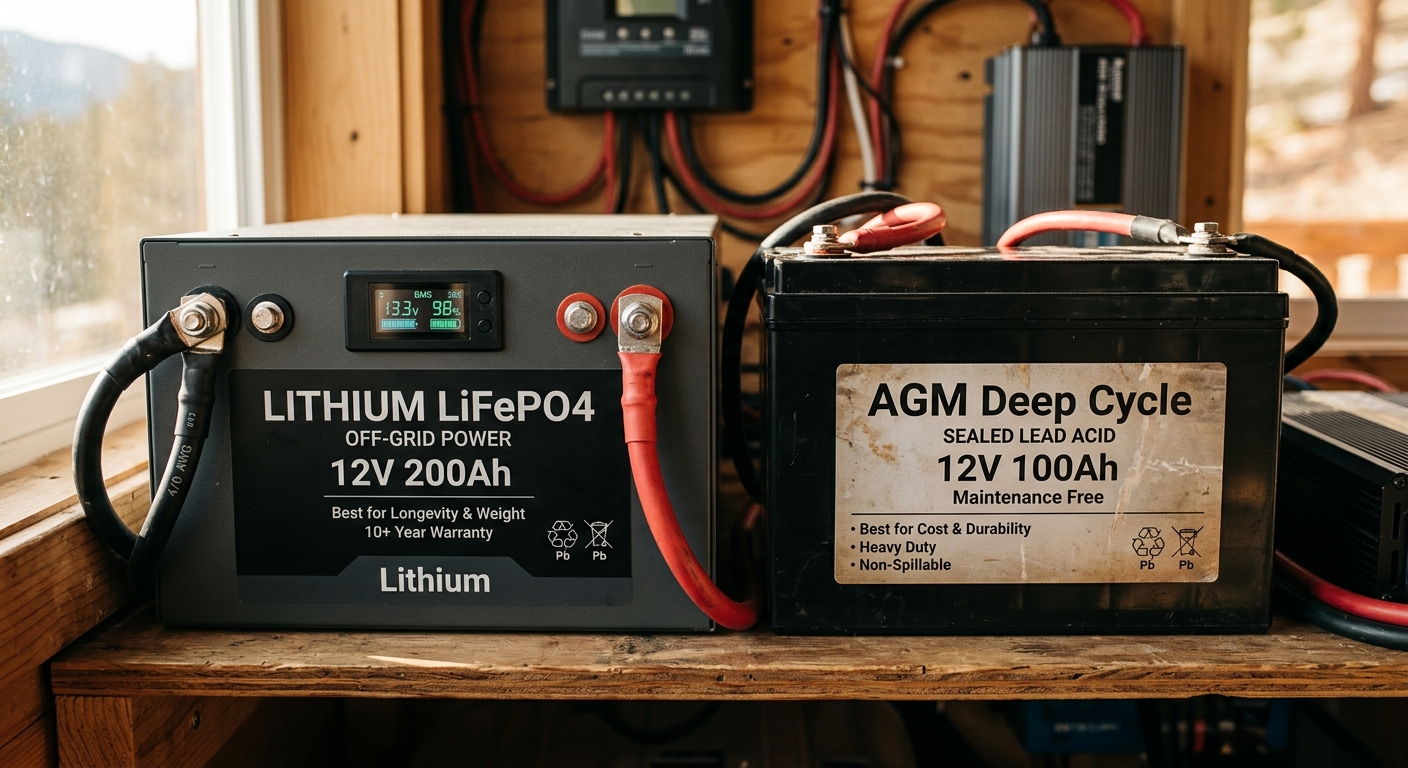
LiFePO4 Batteries
- Battle Born Batteries:
- Strengths: Known for build quality, a robust internal BMS and strong customer support, backed by a 10-year warranty. A heated series is available for cold climates.
- Battle Born 100Ah 12V LiFePO4 Deep Cycle (BB10012): approx. $850–$950 per battery.
- Battle Born 270Ah 12V LiFePO4 Heated (BB27012H): designed for cold climates, with charging down to -20°F (-29°C) using its internal heating. Approx. $2,200–$2,400 per battery.
- Best for: Premium long-term off-grid homes, RVs and marine use where reliability and warranty matter most.
- Renogy LiFePO4 Batteries:
- Strengths: A good balance of performance and price. The Smart series includes Bluetooth monitoring.
- Renogy 200Ah 12V Smart Lithium Iron Phosphate (RBT200LFP12S-US): advanced BMS and Bluetooth app monitoring. Approx. $1,100–$1,300 per battery.
- Renogy 100Ah 48V LiFePO4 (RBT100LFP48S): for higher-voltage systems, 5.12 kWh of energy. Approx. $2,500–$2,800 per battery.
- Best for: Mid-range to high-end cabins, RVs and DIY builders who want good value and smart features.
- SOK Batteries:
- Strengths: A repairable design that lets users replace individual cells or the BMS, extending service life. Many models include internal heating.
- SOK 206Ah 12V LiFePO4 (SK12V206AHV4): often includes low-temperature cut-off and internal heating. Approx. $900–$1,100 per battery.
- Best for: Off-gridders who value repairability, value and cold-weather performance.
- Victron Energy Lithium Smart Batteries:
- Strengths: Seamless communication and monitoring through Victron GX devices (Cerbo GX, Color Control GX) in an all-Victron system.
- Victron Smart Lithium 200Ah 12.8V: BMS not included; requires an external Victron BMS. Approx. $1,800–$2,100 per battery plus BMS components.
- Best for: High-end, professionally integrated installations where remote monitoring is critical.
AGM Batteries
LiFePO4 dominates new installations, but AGM remains a lower-cost entry point for some situations, such as backup systems or cabins that are not deeply cycled every day.
- Trojan Battery Company:
- Strengths: A long-standing deep-cycle leader with consistent performance.
- Trojan Reliant AGM 225Ah 6V (TRG 6V-AGM): usually wired in series for 12V, 24V or 48V systems. Approx. $420–$480 per 6V battery; a 12V 225Ah bank needs two, about $840–$960.
- Best for: Budget-conscious buyers, backup power or small cabins where upfront cost is the priority and frequent deep cycling isn’t expected.
- Crown Battery:
- Strengths: An established American manufacturer of robust deep-cycle AGM batteries.
- Crown 12V 200Ah AGM Deep Cycle (CRN-AGM-12V-200): approx. $550–$650 per battery.
- Best for: Similar to Trojan, for those who prefer AGM.
- Fullriver Battery:
- Strengths: A good reputation for long-lasting AGM batteries that perform well in solar applications.
- Fullriver DC220-12 220Ah 12V AGM: approx. $500–$600 per battery.
- Best for: Small to medium off-grid systems where initial cost is a major concern.
Pro Tips for an Off-Grid Battery Bank
- Install a quality battery monitor: A shunt-based monitor such as the Victron BMV-712 or SmartShunt accurately tracks state of charge, voltage, current and history. For LiFePO4, it guards against over-discharge if the BMS fails or is bypassed. For AGM, it helps you avoid going below 50% DoD, which sharply shortens lifespan. Checking it daily, and more often during cloudy stretches, helps you avoid unnecessary generator starts.
- Size for autonomy, not just daily use: Plan for “days of autonomy,” the number of days the system can run without solar input. In a temperate climate with variable winter sun, 3–5 days is a sensible target. For example, if you use 10 kWh/day, you need 30–50 kWh of usable storage. With AGM, usable capacity is roughly half the rating, so the bank must be much larger than a LiFePO4 bank for the same autonomy.
- Ventilate the battery space: AGM batteries don’t off-gas like flooded lead-acid under normal operation, but both AGM and LiFePO4 produce heat while charging and discharging. An enclosed, unventilated space can overheat and shorten battery life. A small inline exhaust fan (such as the Suncourt TD-100) on a thermostat set to around 80°F (27°C) is a simple fix.
- Set charge parameters for your chemistry: Your charge controller and inverter/charger must match the battery type. For 12V LiFePO4, typical settings are 14.2–14.6V bulk/absorption and about 13.6V float, with equalization disabled. For AGM, follow the manufacturer’s bulk, absorption, float and (if applicable) equalization values. Incorrect settings can seriously damage either type.
- Use a higher system voltage for larger banks: Moving to 24V or, ideally, 48V cuts current, which means smaller and cheaper cables, less voltage drop and better efficiency. For 10 kWh or more of usable storage, 48V is strongly recommended. Delivering 5,000W at 12V takes over 400A and very heavy 4/0 cable; at 48V it is just over 100A.
- Plan for expansion: If you start small, buy LiFePO4 batteries from the same manufacturer, and ideally the same production batch, when you expand, since mixing old and new or different brands can cause imbalance. With AGM this is even more important: never mix old and new batteries or different capacities in one bank. Leave physical space and conduit for future batteries and panels.
- Check cell voltages on larger LiFePO4 banks: The BMS handles most balancing, but occasionally checking individual cell voltages (many batteries now show them over Bluetooth) gives early warning of a cell drifting out of balance.
Pro Tip: Don’t buy on price alone. Compare usable capacity, cycle life, warranty and cold-weather charging capability, then work out the cost per usable kWh over the battery’s expected life.
Conclusion
For most off-grid homes in 2026, LiFePO4 is the better long-term choice: more usable capacity, many times the cycle life, higher efficiency and half the weight, at a lower total cost of ownership. AGM still makes sense when upfront budget is tight, for lightly cycled backup systems, or where charging in freezing temperatures without heated lithium is a concern. Whichever you choose, size the bank for several days of autonomy, match your charge settings to the chemistry, and monitor it closely.
Marcus Reid
Founder & Editor, OffGridSage
Marcus founded OffGridSage to bring practical off-grid knowledge together in one place. Guides are built from official and expert sources (NREL, the EPA, the USDA and university extension services), manufacturer documentation and reader feedback, and are updated when information changes.