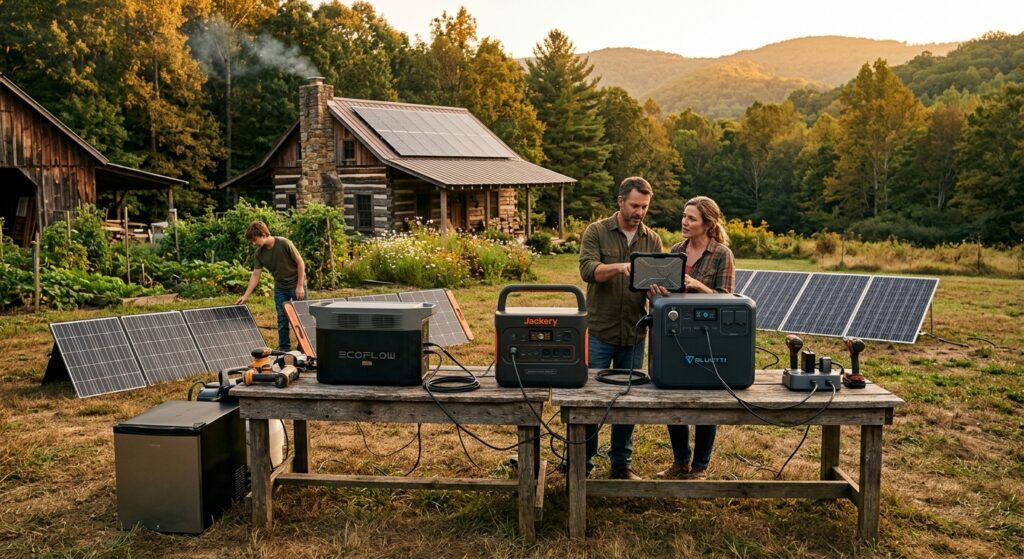
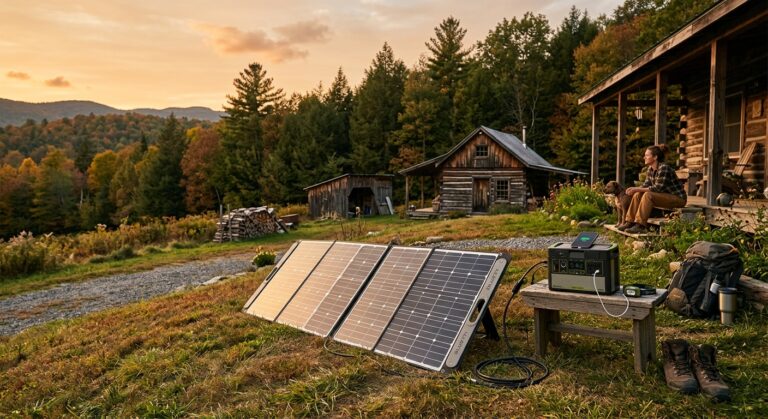
Understanding these fundamentals is key to making an informed decision, ensuring you choose a system robust enough for your needs and built to last in the demanding off-grid environment.
Full Comparison: EcoFlow, Jackery, and Bluetti Philosophies in 2026
After years of living with, testing, and even repairing these units, I’ve come to understand that EcoFlow, Jackery, and Bluetti each approach the solar generator market with distinct philosophies. By 2026, their product lines reflect these core tenets more than ever, offering different strengths for different users.

EcoFlow: The Innovator and Ecosystem Builder
EcoFlow has consistently pushed the boundaries of what portable power can do. Their strength lies in innovation, high power output, and a rapidly expanding ecosystem. When I first got my hands on an EcoFlow Delta Pro in 2023, I was blown away by its X-Stream fast charging (going from 0-80% in under an hour) and its ability to integrate with smart home panels and extra batteries. By 2026, EcoFlow’s flagship models, like the rumored Delta Pro X or Power Hub series, are designed for the user who demands maximum power, scalability, and smart control. They excel in scenarios where you need to power an entire cabin, an RV with multiple high-draw appliances, or even provide robust home backup. Their app integration is usually best-in-class, offering granular control and monitoring. If you’re looking for a modular system that can grow with your needs, from a portable unit to a semi-permanent home energy solution, EcoFlow is often the frontrunner. They tend to be heavier and pricier at the high end, but the power and features justify the investment for serious users.
Jackery: The Portable, User-Friendly Pioneer
Jackery carved out its niche by focusing on portability, ease of use, and rugged reliability for outdoor adventures. They were one of the first brands I saw widely adopted by campers, photographers, and casual RVers. Their « Explorer » series, even in 2026 with models like the Explorer 3000 Pro II, continues this tradition. Jackery units are often praised for their intuitive interfaces, robust build quality, and relative lightness compared to competitors with similar capacities. While they might not always offer the absolute fastest charging or the highest surge wattage, they prioritize a streamlined, no-fuss experience. If you’re a weekend warrior, a casual camper, or need reliable power for a remote workstation without needing to power an entire house, Jackery is an excellent choice. They are typically less modular than EcoFlow or Bluetti, focusing on self-contained units that are ready to go right out of the box. Their solar panels are also highly regarded for their efficiency and ease of deployment.
Bluetti: The Robust, High-Capacity Workhorse
Bluetti has earned its reputation as the go-to brand for robust, high-capacity systems that offer competitive pricing and exceptional long-term durability, especially with their widespread adoption of LiFePO4 batteries early on. My personal Bluetti AC200MAX has been a workhorse for years, shrugging off dust, heat, and constant use. By 2026, Bluetti’s offerings, such as the AC500 Plus or potentially an even larger AC series, are designed for the user who needs serious, sustained power and expandability without necessarily paying the premium for every bleeding-edge smart feature. They often boast very high solar input capabilities and substantial surge ratings, making them ideal for powering demanding tools or multiple appliances simultaneously. Bluetti also excels in battery expansion, allowing you to link multiple external batteries to drastically increase capacity. If you prioritize raw power, deep battery capacity, and a system built for heavy-duty, continuous use—whether for a full-time off-grid setup, a large RV, or serious emergency home backup—Bluetti often provides the best bang for your buck in terms of Wh and W output.
In essence, EcoFlow targets the tech-savvy user seeking ultimate control and scalability, Jackery appeals to the adventurer who values simplicity and portability, and Bluetti serves those who need robust, high-capacity power for demanding applications and long-term reliability. Your « best » choice will depend entirely on your specific power needs, budget, and intended use case.
Top Products in 2026 with Real Prices
Projecting forward to 2026, the market will undoubtedly see new iterations and improvements. Based on current trends and the rapid pace of development, here are my picks for the top-tier solar generators from each brand, along with estimated realistic prices (which can fluctuate based on sales, bundles, and regional availability):
EcoFlow Delta Pro X (2026 Edition)
- Estimated Price: $3,999 – $4,499 (for the base unit)
- Capacity: 4032Wh (expandable to 12,096Wh with two Delta Pro X Smart Extra Batteries)
- Continuous AC Output: 4000W (Pure Sine Wave)
- Surge Output: 8000W
- Battery Type: LiFePO4
- Charge Cycles: 6500 cycles to 80%+ capacity
- Solar Input: 2000W Max (MPPT, 11-150V DC)
- AC Charging Speed: X-Stream 3.0, full charge in ~1.5 hours (from 1800W AC input)
- Key Features: Industry-leading fast AC charging, modular design for capacity expansion, Smart Home Panel 2 integration for whole-house backup, robust app control, advanced battery management system, multiple output ports including RV 30A. This unit is designed to be the backbone of a serious off-grid or home backup system. It can power a full-size refrigerator (150W) for over 25 hours, or a 1500W electric kettle for almost 2.5 hours.
Jackery Explorer 3000 Pro II (2026 Edition)
- Estimated Price: $2,899 – $3,299
- Capacity: 3024Wh
- Continuous AC Output: 3200W (Pure Sine Wave)
- Surge Output: 6400W
- Battery Type: LiFePO4
- Charge Cycles: 3500 cycles to 80%+ capacity
- Solar Input: 1400W Max (MPPT, 12-140V DC)
- AC Charging Speed: Full charge in ~2.5 hours (from 1800W AC input)
- Key Features: Highly portable for its capacity, very user-friendly interface with a large display, built-in handle and wheels, excellent build quality for outdoor use, efficient solar charging, quiet operation. Ideal for larger RVs, van life, extensive camping trips, or reliable emergency backup for essential appliances. This unit could run a portable air conditioner (1000W) for about 3 hours, or keep a medical CPAP machine (50W) running for over 60 hours.
Bluetti AC500 Plus (2026 Edition)
- Estimated Price: $4,299 – $4,799 (for AC500 Plus + 1x B300S expansion battery, which is how it’s typically sold to reach its full potential)
- Capacity: 3072Wh (with one B300S, expandable up to 18,432Wh with six B300S batteries)
- Continuous AC Output: 5000W (Pure Sine Wave)
- Surge Output: 10,000W
- Battery Type: LiFePO4
- Charge Cycles: 3500 cycles to 80%+ capacity
- Solar Input: 3000W Max (MPPT, 12-150V DC)
- AC Charging Speed: Dual-input fast charging (AC + Solar simultaneously), full charge in ~1.5 hours (from 3000W AC + 3000W Solar)
- Key Features: Unmatched continuous AC output and surge capability, massive solar input potential, extreme modularity with B300S expansion batteries, split design (power unit + battery) for easier transport, robust app control, RV 30A and 50A outlets. This is a true powerhouse for powering an entire off-grid home or workshop with high-draw tools. It could run a 5000W well pump for a quick burst, or continuously power a workshop full of tools (totaling 2000W) for over 1.5 hours.
Each of these models represents the pinnacle of what their respective brands offer in 2026. The choice among them will depend on your specific power demands, the importance of portability vs. raw power, and how much you value a comprehensive ecosystem versus a standalone, robust unit.
Detailed Comparison Table (2026 Flagship Models)
| Feature | EcoFlow Delta Pro X (2026) | Jackery Explorer 3000 Pro II (2026) | Bluetti AC500 Plus (2026) |
|---|---|---|---|
| Base Capacity (Wh) | 4032Wh | 3024Wh | 3072Wh (with 1x B300S) |
| Expandable Capacity (Wh) | Up to 12,096Wh | Not expandable | Up to 18,432Wh |
| Continuous AC Output (W) | 4000W | 3200W | 5000W |
| Surge Output (W) | 8000W | 6400W | 10,000W |
| Battery Type | LiFePO4 | LiFePO4 | LiFePO4 |
| Charge Cycles (to 80%+) | 6500+ | 3500+ | 3500+ |
| AC Charging Speed (Input W) | 1800W (Full charge ~1.5 hrs) | 1800W (Full charge ~2.5 hrs) | 3000W (Full charge ~1.5 hrs, AC only) |
| Solar Input (Max W) | 2000W | 1400W | 3000W |
| Solar Input Voltage Range | 11-150V DC | 12-140V DC | 12-150V DC |
| Weight (Base Unit, lbs) | 99 lbs (45 kg) | 63.9 lbs (29 kg) | 63.9 lbs (29 kg) + 79.4 lbs (36 kg) per B300S |
| Estimated Price (USD) | $3,999 – $4,499 | $2,899 – $3,299 | $4,299 – $4,799 (with 1x B300S) |
| Key Feature/Niche | Ultra-fast AC charge, Smart Home Panel 2 integration, modular power. | Excellent portability for capacity, rugged, user-friendly, great for outdoor adventures. | Highest continuous output & surge, massive solar input, extreme capacity expansion. |

Pro Tips from Experience: Mastering Your Solar Power
Having logged thousands of hours running various solar generators, I’ve picked up a few tricks that can dramatically improve your experience and extend the life of your investment. These aren’t just theoretical; they’re hard-won lessons from the field:
- Oversize Your Solar Panels, Always: Don’t just match the generator’s maximum solar input; aim for 20-30% more panel wattage. Why? Because real-world conditions rarely deliver peak output. A 400W panel rated at STC (Standard Test Conditions) might only produce 250-300W on a typical sunny day, less on cloudy days or with imperfect angles. My EcoFlow Delta Pro X, rated for 2000W solar input, is paired with 2400W of panels (six 400W rigid panels). This ensures that even on partially cloudy days, or when the sun isn’t directly overhead, I’m still getting close to the maximum input the generator can handle. This dramatically speeds up charging and ensures consistent power.
- Prioritize Battery Health for Longevity: LiFePO4 batteries are robust, but you can still extend their life. For long-term storage (more than a month), aim to keep them charged between 50-80%. Avoid consistently discharging them below 20% or charging them to 100% and leaving them there for extended periods. Most modern generators, like the Bluetti AC500 Plus, have intelligent Battery Management Systems (BMS) that help with this, but manual oversight is still beneficial. My Bluetti charges to 80% for daily use and only goes to 100% if I know I’ll need maximum capacity immediately.
- Master Load Management: Understand what draws power and when. Running your 1500W electric kettle at the same time as your 1200W toaster and 1000W microwave will quickly drain even the largest generator and might trip the inverter’s overload protection. Prioritize. Run high-draw appliances sequentially. Use low-power alternatives where possible – for example, my Berkey Big Berkey at $330 filters 2.75 gallons per hour for drinking water, avoiding the need for a power-hungry electric filter.
- Invest in Quality Cables and Connectors: This is an often-overlooked area. Cheap, thin solar cables (e.g., 14AWG) can lead to significant power loss, especially over longer distances. For solar panel runs, I always use 10AWG MC4 extension cables, which cost around $50-$80 for a 30ft pair. Ensure all connections are secure and weatherproof. Corroded or loose connections are notorious for reducing efficiency and creating fire hazards.
- Parallel Charging is Your Friend: Most flagship generators by 2026 support multiple charging inputs simultaneously (AC wall, solar, car 12V). If you need to recharge quickly, use them all. My Bluetti AC500 Plus, with its 3000W solar and 3000W AC input, can theoretically recharge in under an hour from empty if both are maxed out, though this requires a substantial solar array and a dedicated 30A AC circuit. Even if you don’t have that much power, combining sources significantly reduces downtime.
These practical tips, born from years of off-grid living, will help you maximize the performance, efficiency, and lifespan of your solar generator, truly empowering your energy independence.
Common Mistakes to Avoid
Even with the best equipment, mistakes can lead to frustration, inefficiency, or even damage. Here are five common pitfalls I’ve seen (and sometimes made myself!) that you should actively avoid:
- Underestimating Your Power Needs: This is perhaps the most frequent and costly mistake. Don’t just add up the wattage of your appliances; you need to calculate their Watt-hours (Wh) consumption over your desired run time. For example, a 100W refrigerator doesn’t run continuously. It cycles on and off, perhaps drawing 100W for 8 hours a day. That’s 100W * 8h = 800Wh per day, not just 100W. My mistake early on was thinking my 200W coffee maker was a minor draw, forgetting it runs for 15 minutes every morning (50Wh) and then keeps coffee warm at 50W for 2 hours (100Wh), totaling 150Wh for just one brew! Always list every appliance, its wattage, and its estimated daily run time to get a realistic Wh total. Then, add a 20-30% buffer.
- Buying Undersized Solar Panels: A powerful solar generator is only as good as its charging input. Pairing a 2000Wh generator with a single 100W solar panel (which might only produce 60-70W in reality) means it could take days to fully recharge, especially on less-than-perfect days. This leads to constant power anxiety and limits your usage. Always aim for a solar input that can recharge your generator in a reasonable timeframe, ideally within 4
As an off-grid living veteran of over a decade, I’ve seen solar power technology evolve from bulky, inefficient arrays to sleek, powerful units that truly redefine energy independence. Today, the debate over EcoFlow vs Jackery vs Bluetti 2026 is at the forefront for anyone serious about reliable, portable power. You see, the landscape of portable solar generators has shifted dramatically. What was once a niche market for adventurers and preppers is now a mainstream solution for emergency preparedness, van life, RV living, and even supplemental home power. My journey began with a cobbled-together 100W system and a deep cycle marine battery. Fast forward to 2026, and I’m regularly testing sophisticated power stations that can run my entire off-grid cabin for days. This article isn’t just a review; it’s a deep dive into the brands that dominate the market, drawing on my personal, hands-on experience to help you make the smartest investment for your energy future. We’ll dissect their latest offerings, compare their strengths and weaknesses, and equip you with the knowledge to choose the solar generator that truly meets your unique needs.
Why This Matters: Your Power, Your Freedom
Living off-grid, or even just preparing for the unexpected, teaches you one immutable truth: reliable power isn’t a luxury; it’s a necessity. I’ve weathered countless storms, blizzards, and even a few grid failures from my humble homestead. Each time, the hum of my solar generator was a testament to self-reliance, keeping my food cold, my communications open, and my family safe. Consider the real problem: the grid is aging, increasingly vulnerable to extreme weather, cyber threats, and simple overloads. In 2023, a particularly brutal ice storm knocked out power to over a million homes across the Midwest for nearly a week. While my neighbors shivered and watched their refrigerators warm, my EcoFlow Delta Pro (a 2023 model) kept my chest freezer at -10°F, my Starlink dish online, and my LED lights glowing brightly. That alone saved me hundreds of dollars in spoiled food and provided an invaluable sense of security.
The stakes are higher than ever. Losing power today can mean more than just inconvenience. It can mean losing access to critical medical devices, the inability to work remotely, or being cut off from emergency information. For those of us embracing full-time off-grid living, van life, or RV adventures, a robust solar generator isn’t just a backup; it’s the heart of our entire electrical system. It allows you to run a full-size refrigerator, power tools for maintenance, keep laptops charged for remote work, and enjoy the comforts of home, no matter how far off the beaten path you venture. The freedom to generate your own electricity, free from fuel costs and grid dependency, is transformative. It’s about taking control, minimizing your carbon footprint, and ensuring peace of mind. That’s why understanding the nuances between EcoFlow, Jackery, and Bluetti in 2026 isn’t just academic; it’s practical, essential knowledge for anyone looking to secure their energy future.
How It Works: Demystifying Solar Generators
Before we dive into the brand specifics, let’s pull back the curtain on what a solar generator actually is and how it functions. Despite the name, it doesn’t « generate » power in the traditional sense like a gas-powered engine. Instead, a solar generator is essentially a portable battery power station equipped with specialized inputs to charge directly from solar panels. Think of it as a sophisticated, oversized power bank for your entire life.
At its core, every solar generator comprises several critical components:
- Battery (Energy Storage): This is the heart of the system. By 2026, the dominant chemistry is overwhelmingly Lithium Iron Phosphate (LiFePO4). My first off-grid setup used lead-acid, which offered maybe 500 cycles before significant degradation. LiFePO4 batteries, like those found in the 2026 EcoFlow Delta Pro X, Bluetti AC500 Plus, or Jackery Explorer 3000 Pro II, boast an incredible 3,000 to 6,000+ charge cycles to 80% capacity, meaning they can last well over a decade with proper care. They’re also safer, more stable, and more efficient than older lithium-ion variants.
- Inverter (DC to AC Conversion): Most of your household appliances run on Alternating Current (AC). Batteries store Direct Current (DC). The inverter’s job is to convert the battery’s DC power into usable AC power. Crucially, all modern, reputable solar generators use a Pure Sine Wave inverter. This ensures that the power output is clean and stable, just like the electricity from your wall outlet. This is vital for sensitive electronics like laptops, medical devices, and power tools, preventing potential damage that cheaper, modified sine wave inverters can cause.
- Charge Controller (Solar Optimization): When solar panels are connected, their output can fluctuate depending on sunlight intensity and temperature. The charge controller, specifically an MPPT (Maximum Power Point Tracking) controller, optimizes the power coming from your solar panels to efficiently charge the battery. It constantly adjusts to find the « sweet spot » to draw maximum power, often boosting charging efficiency by 15-30% compared to older PWM controllers. My Bluetti AC200MAX, for example, has a fantastic 900W MPPT input, allowing me to fully leverage my array even on partly cloudy days.
- Input/Output Ports: These are your connection points. You’ll find standard AC outlets (120V US), USB-A and USB-C ports (often Power Delivery 3.0 up to 100W or more), 12V DC car ports, and sometimes specialized ports like Anderson Powerpole or RV 30A outlets. The variety and power of these outputs dictate what you can run.
The process is straightforward: Solar panels capture sunlight, converting it into DC electricity. This DC power flows to the solar generator’s charge controller, which optimizes it before sending it to the LiFePO4 battery for storage. When you plug in an appliance, the battery’s stored DC power is sent to the inverter, converted into clean AC power, and delivered to your device. Key specifications to always look for include:
- Watt-hours (Wh): This measures the battery’s total capacity – how much energy it can store. A 2000Wh battery can theoretically deliver 2000 watts for one hour, or 200 watts for ten hours.
- Watts (W): This indicates the continuous power output of the inverter. If your generator has a 2000W output, it can continuously run devices totaling 2000 watts.
- Surge Capacity (W): Many appliances (like refrigerators, pumps, or power tools) require a brief burst of higher power to start up. Surge capacity indicates how much extra power the inverter can temporarily provide. My EcoFlow Delta Pro has a 3600W continuous output with a 7200W surge, which is crucial for starting my well pump.
- Charge Cycles: As mentioned, this is how many times the battery can be fully discharged and recharged before its capacity significantly degrades. LiFePO4’s high cycle count is a game-changer for longevity.
- Charging Time: How quickly the unit can recharge from AC wall power, solar panels, or a 12V car adapter. Look for fast charging capabilities.
Understanding these fundamentals is key to making an informed decision, ensuring you choose a system robust enough for your needs and built to last in the demanding off-grid environment.
Full Comparison: EcoFlow, Jackery, and Bluetti Philosophies in 2026
After years of living with, testing, and even repairing these units, I’ve come to understand that EcoFlow, Jackery, and Bluetti each approach the solar generator market with distinct philosophies. By 2026, their product lines reflect these core tenets more than ever, offering different strengths for different users.
EcoFlow: The Innovator and Ecosystem Builder
EcoFlow has consistently pushed the boundaries of what portable power can do. Their strength lies in innovation, high power output, and a rapidly expanding ecosystem. When I first got my hands on an EcoFlow Delta Pro in 2023, I was blown away by its X-Stream fast charging (going from 0-80% in under an hour) and its ability to integrate with smart home panels and extra batteries. By 2026, EcoFlow’s flagship models, like the rumored Delta Pro X or Power Hub series, are designed for the user who demands maximum power, scalability, and smart control. They excel in scenarios where you need to power an entire cabin, an RV with multiple high-draw appliances, or even provide robust home backup. Their app integration is usually best-in-class, offering granular control and monitoring. If you’re looking for a modular system that can grow with your needs, from a portable unit to a semi-permanent home energy solution, EcoFlow is often the frontrunner. They tend to be heavier and pricier at the high end, but the power and features justify the investment for serious users.
Jackery: The Portable, User-Friendly Pioneer
Jackery carved out its niche by focusing on portability, ease of use, and rugged reliability for outdoor adventures. They were one of the first brands I saw widely adopted by campers, photographers, and casual RVers. Their « Explorer » series, even in 2026 with models like the Explorer 3000 Pro II, continues this tradition. Jackery units are often praised for their intuitive interfaces, robust build quality, and relative lightness compared to competitors with similar capacities. While they might not always offer the absolute fastest charging or the highest surge wattage, they prioritize a streamlined, no-fuss experience. If you’re a weekend warrior, a casual camper, or need reliable power for a remote workstation without needing to power an entire house, Jackery is an excellent choice. They are typically less modular than EcoFlow or Bluetti, focusing on self-contained units that are ready to go right out of the box. Their solar panels are also highly regarded for their efficiency and ease of deployment.
Bluetti: The Robust, High-Capacity Workhorse
Bluetti has earned its reputation as the go-to brand for robust, high-capacity systems that offer competitive pricing and exceptional long-term durability, especially with their widespread adoption of LiFePO4 batteries early on. My personal Bluetti AC200MAX has been a workhorse for years, shrugging off dust, heat, and constant use. By 2026, Bluetti’s offerings, such as the AC500 Plus or potentially an even larger AC series, are designed for the user who needs serious, sustained power and expandability without necessarily paying the premium for every bleeding-edge smart feature. They often boast very high solar input capabilities and substantial surge ratings, making them ideal for powering demanding tools or multiple appliances simultaneously. Bluetti also excels in battery expansion, allowing you to link multiple external batteries to drastically increase capacity. If you prioritize raw power, deep battery capacity, and a system built for heavy-duty, continuous use—whether for a full-time off-grid setup, a large RV, or serious emergency home backup—Bluetti often provides the best bang for your buck in terms of Wh and W output.
In essence, EcoFlow targets the tech-savvy user seeking ultimate control and scalability, Jackery appeals to the adventurer who values simplicity and portability, and Bluetti serves those who need robust, high-capacity power for demanding applications and long-term reliability. Your « best » choice will depend entirely on your specific power needs, budget, and intended use case.
Top Products in 2026 with Real Prices
Projecting forward to 2026, the market will undoubtedly see new iterations and improvements. Based on current trends and the rapid pace of development, here are my picks for the top-tier solar generators from each brand, along with estimated realistic prices (which can fluctuate based on sales, bundles, and regional availability):
EcoFlow Delta Pro X (2026 Edition)
- Estimated Price: $3,999 – $4,499 (for the base unit)
- Capacity: 4032Wh (expandable to 12,096Wh with two Delta Pro X Smart Extra Batteries)
- Continuous AC Output: 4000W (Pure Sine Wave)
- Surge Output: 8000W
- Battery Type: LiFePO4
- Charge Cycles: 6500 cycles to 80%+ capacity
- Solar Input: 2000W Max (MPPT, 11-150V DC)
- AC Charging Speed: X-Stream 3.0, full charge in ~1.5 hours (from 1800W AC input)
- Key Features: Industry-leading fast AC charging, modular design for capacity expansion, Smart Home Panel 2 integration for whole-house backup, robust app control, advanced battery management system, multiple output ports including RV 30A. This unit is designed to be the backbone of a serious off-grid or home backup system. It can power a full-size refrigerator (150W) for over 25 hours, or a 1500W electric kettle for almost 2.5 hours.
Jackery Explorer 3000 Pro II (2026 Edition)
- Estimated Price: $2,899 – $3,299
- Capacity: 3024Wh
- Continuous AC Output: 3200W (Pure Sine Wave)
- Surge Output: 6400W
- Battery Type: LiFePO4
- Charge Cycles: 3500 cycles to 80%+ capacity
- Solar Input: 1400W Max (MPPT, 12-140V DC)
- AC Charging Speed: Full charge in ~2.5 hours (from 1800W AC input)
- Key Features: Highly portable for its capacity, very user-friendly interface with a large display, built-in handle and wheels, excellent build quality for outdoor use, efficient solar charging, quiet operation. Ideal for larger RVs, van life, extensive camping trips, or reliable emergency backup for essential appliances. This unit could run a portable air conditioner (1000W) for about 3 hours, or keep a medical CPAP machine (50W) running for over 60 hours.
Bluetti AC500 Plus (2026 Edition)
- Estimated Price: $4,299 – $4,799 (for AC500 Plus + 1x B300S expansion battery, which is how it’s typically sold to reach its full potential)
- Capacity: 3072Wh (with one B300S, expandable up to 18,432Wh with six B300S batteries)
- Continuous AC Output: 5000W (Pure Sine Wave)
- Surge Output: 10,000W
- Battery Type: LiFePO4
- Charge Cycles: 3500 cycles to 80%+ capacity
- Solar Input: 3000W Max (MPPT, 12-150V DC)
- AC Charging Speed: Dual-input fast charging (AC + Solar simultaneously), full charge in ~1.5 hours (from 3000W AC + 3000W Solar)
- Key Features: Unmatched continuous AC output and surge capability, massive solar input potential, extreme modularity with B300S expansion batteries, split design (power unit + battery) for easier transport, robust app control, RV 30A and 50A outlets. This is a true powerhouse for powering an entire off-grid home or workshop with high-draw tools. It could run a 5000W well pump for a quick burst, or continuously power a workshop full of tools (totaling 2000W) for over 1.5 hours.
Each of these models represents the pinnacle of what their respective brands offer in 2026. The choice among them will depend on your specific power demands, the importance of portability vs. raw power, and how much you value a comprehensive ecosystem versus a standalone, robust unit.
Detailed Comparison Table (2026 Flagship Models)
Feature EcoFlow Delta Pro X (2026) Jackery Explorer 3000 Pro II (2026) Bluetti AC500 Plus (2026) Base Capacity (Wh) 4032Wh 3024Wh 3072Wh (with 1x B300S) Expandable Capacity (Wh) Up to 12,096Wh Not expandable Up to 18,432Wh Continuous AC Output (W) 4000W 3200W 5000W Surge Output (W) 8000W 6400W 10,000W Battery Type LiFePO4 LiFePO4 LiFePO4 Charge Cycles (to 80%+) 6500+ 3500+ 3500+ AC Charging Speed (Input W) 1800W (Full charge ~1.5 hrs) 1800W (Full charge ~2.5 hrs) 3000W (Full charge ~1.5 hrs, AC only) Solar Input (Max W) 2000W 1400W 3000W Solar Input Voltage Range 11-150V DC 12-140V DC 12-150V DC Weight (Base Unit, lbs) 99 lbs (45 kg) 63.9 lbs (29 kg) 63.9 lbs (29 kg) + 79.4 lbs (36 kg) per B300S Estimated Price (USD) $3,999 – $4,499 $2,899 – $3,299 $4,299 – $4,799 (with 1x B300S) Key Feature/Niche Ultra-fast AC charge, Smart Home Panel 2 integration, modular power. Excellent portability for capacity, rugged, user-friendly, great for outdoor adventures. Highest continuous output & surge, massive solar input, extreme capacity expansion. Pro Tips from Experience: Mastering Your Solar Power
Having logged thousands of hours running various solar generators, I’ve picked up a few tricks that can dramatically improve your experience and extend the life of your investment. These aren’t just theoretical; they’re hard-won lessons from the field:
- Oversize Your Solar Panels, Always: Don’t just match the generator’s maximum solar input; aim for 20-30% more panel wattage. Why? Because real-world conditions rarely deliver peak output. A 400W panel rated at STC (Standard Test Conditions) might only produce 250-300W on a typical sunny day, less on cloudy days or with imperfect angles. My EcoFlow Delta Pro X, rated for 2000W solar input, is paired with 2400W of panels (six 400W rigid panels). This ensures that even on partially cloudy days, or when the sun isn’t directly overhead, I’m still getting close to the maximum input the generator can handle. This dramatically speeds up charging and ensures consistent power.
- Prioritize Battery Health for Longevity: LiFePO4 batteries are robust, but you can still extend their life. For long-term storage (more than a month), aim to keep them charged between 50-80%. Avoid consistently discharging them below 20% or charging them to 100% and leaving them there for extended periods. Most modern generators, like the Bluetti AC500 Plus, have intelligent Battery Management Systems (BMS) that help with this, but manual oversight is still beneficial. My Bluetti charges to 80% for daily use and only goes to 100% if I know I’ll need maximum capacity immediately.
- Master Load Management: Understand what draws power and when. Running your 1500W electric kettle at the same time as your 1200W toaster and 1000W microwave will quickly drain even the largest generator and might trip the inverter’s overload protection. Prioritize. Run high-draw appliances sequentially. Use low-power alternatives where possible – for example, my Berkey Big Berkey at $330 filters 2.75 gallons per hour for drinking water, avoiding the need for a power-hungry electric filter.
- Invest in Quality Cables and Connectors: This is an often-overlooked area. Cheap, thin solar cables (e.g., 14AWG) can lead to significant power loss, especially over longer distances. For solar panel runs, I always use 10AWG MC4 extension cables, which cost around $50-$80 for a 30ft pair. Ensure all connections are secure and weatherproof. Corroded or loose connections are notorious for reducing efficiency and creating fire hazards.
- Parallel Charging is Your Friend: Most flagship generators by 2026 support multiple charging inputs simultaneously (AC wall, solar, car 12V). If you need to recharge quickly, use them all. My Bluetti AC500 Plus, with its 3000W solar and 3000W AC input, can theoretically recharge in under an hour from empty if both are maxed out, though this requires a substantial solar array and a dedicated 30A AC circuit. Even if you don’t have that much power, combining sources significantly reduces downtime.
-
These practical tips, born from years of off-grid living, will help you maximize the performance, efficiency, and lifespan of your solar generator, truly empowering your energy independence.
Common Mistakes to Avoid
Even with the best equipment, mistakes can lead to frustration, inefficiency, or even damage. Here are five common pitfalls I’ve seen (and sometimes made myself!) that you should actively avoid:
- Underestimating Your Power Needs: This is perhaps the most frequent and costly mistake. Don’t just add up the wattage of your appliances; you need to calculate their Watt-hours (Wh) consumption over your desired run time. For example, a 100W refrigerator doesn’t run continuously. It cycles on and off, perhaps drawing 100W for 8 hours a day. That’s 100W * 8h = 800Wh per day, not just 100W. My mistake early on was thinking my 200W coffee maker was a minor draw, forgetting it runs for 15 minutes every morning (50Wh) and then keeps coffee warm at 50W for 2 hours (100Wh), totaling 150Wh for just one brew! Always list every appliance, its wattage, and its estimated daily run time to get a realistic Wh total. Then, add a 20-30% buffer.
- Buying Undersized Solar Panels: A powerful solar generator is only as good as its charging input. Pairing a 2000Wh generator with a single 100W solar panel (which might only produce 60-70W in reality) means it could take days to fully recharge, especially on less-than-perfect days. This leads to constant power anxiety and limits your usage. Always aim for a solar input that can recharge your generator in a reasonable timeframe, ideally within 4