Off-Grid Communication: Best Radios and Satellite Options in 2026
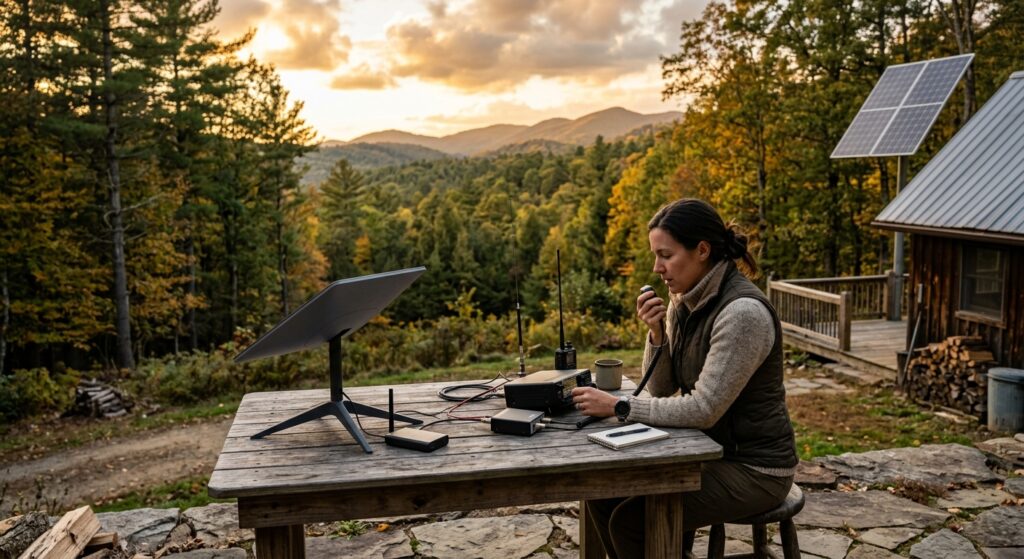
Living off-grid brings independence, quiet and a close connection to the land, but independence shouldn’t mean isolation. When you’re miles from the nearest cell tower, a reliable way to call for help, coordinate with family and get weather warnings is as important as your power or water system. This guide explains how the main off-grid communication options work, from simple handheld radios to satellite messengers and phones, compares specific models with approximate prices, and shows how to combine them into a layered plan.
Why Off-Grid Communication Matters
Off-grid living is built on self-reliance: you generate your own power, collect your own water and often grow your own food. Communication is the essential resource that people tend to overlook until they need it. A minor problem can become a crisis when you can’t reach anyone. Consider a bad fall on a remote property with no cell signal and a dead radio: it can take hours for anyone to notice you’re missing, and longer for help to arrive. In a medical emergency such as a severe allergic reaction, that delay can be life-threatening.
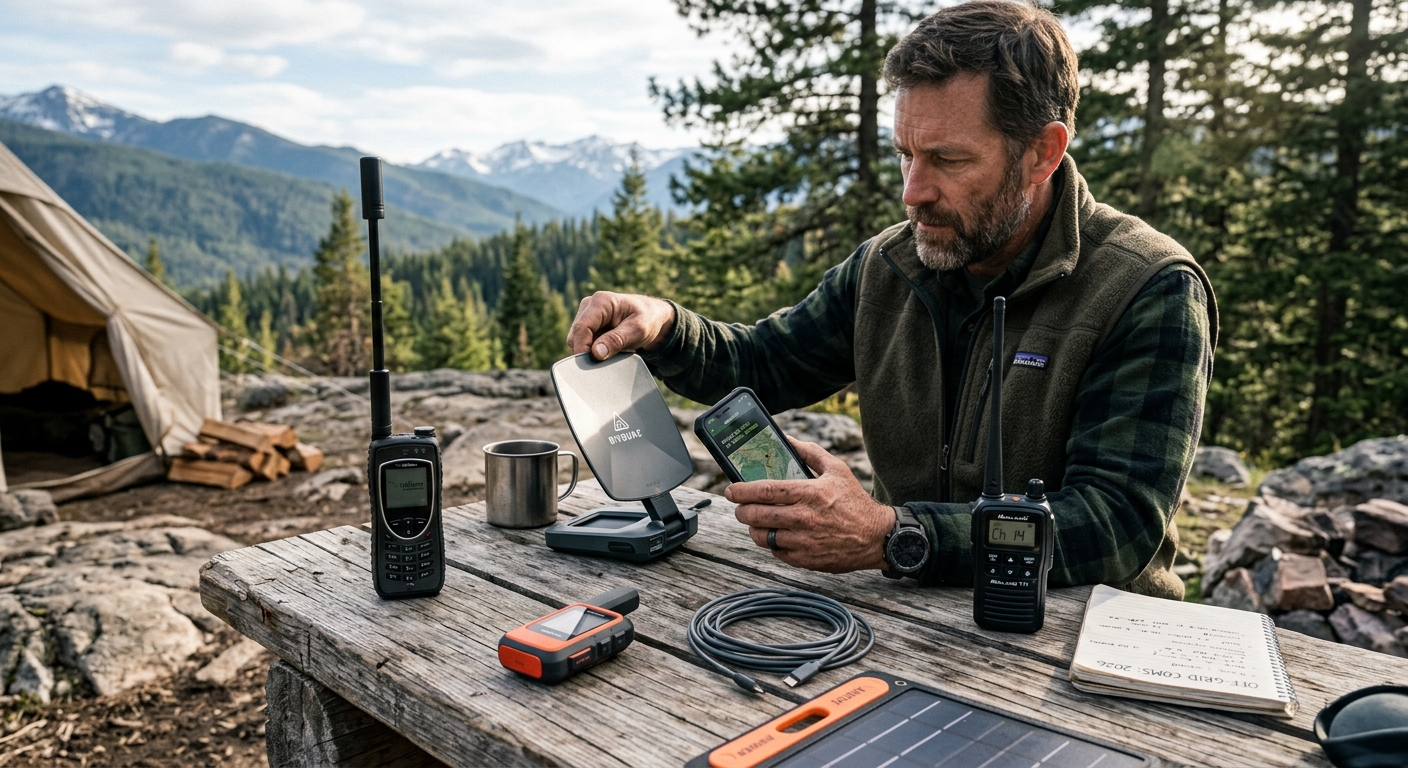
Communication also matters day to day. You may need to coordinate with family members working in different parts of the property, check in with relatives in town, or receive warnings when a storm is about to cut off your road. Many rural communities also run local radio networks (GMRS or amateur “ham” radio) where neighbors share information and resources. A solid communication plan is as fundamental as your solar array or well.
How Off-Grid Communication Works
Each technology has distinct strengths and limits. Understanding them makes it much easier to choose the right mix.
VHF/UHF Radios (FRS, GMRS, Ham)
These radios use Very High Frequency (VHF) and Ultra High Frequency (UHF) bands and are essentially line-of-sight: hills, mountains and even dense foliage block or weaken the signal. Handhelds typically reach 1–5 miles (1.6–8 km), while base stations with external antennas and more power can reach 20–50 miles (32–80 km) in ideal conditions. Beyond line of sight, you depend on reflections or repeaters.
- FRS (Family Radio Service): Low power (0.5–2 watts), license-free, short range (up to about 2 miles in open terrain). Good for close-range family use.
- GMRS (General Mobile Radio Service): Higher power (up to 50 watts for base stations, 5 watts for handhelds) and longer range, with access to repeaters. In the US it requires an inexpensive FCC license (around $35 for 10 years) that covers your immediate family.
- Ham (Amateur Radio): The most versatile option. You must pass an exam (Technician, General or Extra class). Licensed operators can use far higher power (up to 1,500 watts), many more frequencies, and extensive repeater networks.
HF Radios (High Frequency / Shortwave)
HF signals reflect off the ionosphere (“skip”), so they can reach hundreds or thousands of miles without line of sight. Transmitting on most HF ham bands requires a General class license or higher. Base stations typically run around 100 watts, and advanced setups go up to 1,500 watts. The trade-offs: propagation varies with solar activity and time of day, antennas are much larger, and HF is less dependable for instant short-range contact than VHF/UHF.
Satellite Communicators (Satellite Messengers)
These devices use satellite networks such as Iridium or Globalstar to send and receive text messages, share your location, and trigger an SOS to an emergency response center. Most don’t support voice calls, but they are compact, battery-efficient and work wherever you can see the sky. A monthly or annual subscription is required.
Satellite Phones
Satellite phones provide full voice calls through networks such as Iridium, Inmarsat or Globalstar. Iridium offers pole-to-pole global coverage; Globalstar and Inmarsat coverage is more regional. Devices and airtime cost more than messengers, but a sat phone is the most certain way to make a voice call from anywhere. Many also support slow data for email.
Mesh Networks (e.g., goTenna)
Mesh devices pair with your smartphone over Bluetooth and use radio to send texts and GPS locations to other users nearby, with no cell towers or satellites involved. Each device can relay messages for others, so the network extends beyond direct line of sight. Typical range is 1–4 miles (1.6–6.4 km) per hop, and no subscription is needed.
Choosing Your Strategy: A Layered Approach
The right answer is rarely a single device. A layered setup, where each technology covers a different distance and scenario, gives the best balance of range, reliability and cost.
Local: FRS, GMRS and VHF/UHF Ham
For talking across your property, with close neighbors or between family members, these radios are inexpensive, simple and low-power. FRS is license-free and suits children or short-range tasks. GMRS adds power and repeater access, making it a strong choice for property-wide communication and neighbors within roughly 5–10 miles (8–16 km), especially if a local repeater exists. VHF/UHF ham radios add more flexibility but require a license and more know-how. Terrain is the main limitation: you might get 2 miles (3.2 km) in dense woods but 10 miles (16 km) across an open valley. Handhelds transmit at around 5W, so they’re easy to keep charged with solar.
Long Range Without Satellites: HF Ham Radio
To reach people hundreds or thousands of miles away using only your own equipment, HF ham radio is the answer. It requires a General class license and investment in a radio and antenna system. Range depends on solar conditions, time of day and band, and transmit power draw is much higher (100W+), so you need a robust off-grid power system. HF is best for general long-distance contact, community nets and information gathering (including shortwave broadcasts) rather than guaranteed emergency contact.
Emergency Backup: Satellite Messengers and Phones
When everything else fails, satellite devices provide the most dependable link. A messenger such as the Garmin inReach Mini 2 can send an SOS, share your location and exchange short texts from almost anywhere, with low power draw and weeks of standby. A satellite phone costs more and uses more power, but it lets you speak directly with emergency services, a doctor or family. Iridium-based devices have truly global coverage and don’t depend on local infrastructure. Both need subscriptions. Carrying a messenger whenever you head beyond terrestrial radio range is a sensible habit.
Local Groups: Mesh Network Devices
Mesh devices work well for small groups spread across an area without cell service: hiking, hunting, or working on a large property. They’re affordable, private, subscription-free and low-power, and they complement radios rather than replacing them.
A practical layered setup: GMRS for daily property tasks and nearby neighbors; a VHF/UHF ham radio for reaching repeaters in town; an HF radio for long-distance contact and monitoring; and a satellite messenger for emergencies and tracking beyond radio range.
Recommended Off-Grid Communication Devices
These widely used models cover each layer. Prices are approximate and change frequently.
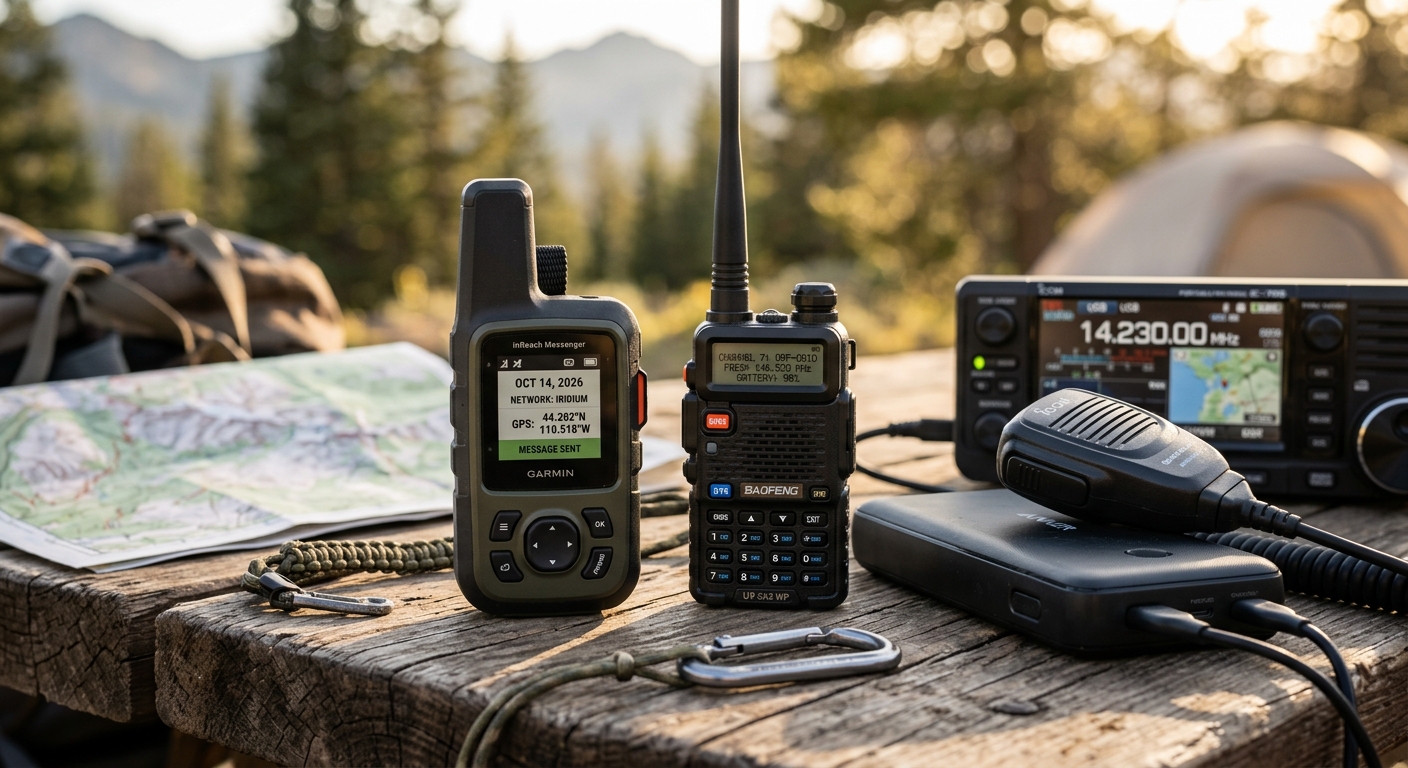
1. Best Value: Baofeng UV-5R (and Successors)
- Type: Dual-band VHF/UHF handheld
- Models: Baofeng UV-5R, or newer models such as the UV-S9 Plus and UV-17 Pro
- Approximate price: $25–$45
- Details: Transmits at 5 watts on VHF (136–174 MHz) and UHF (400–520 MHz). Its low cost makes it easy to equip several family members and to monitor a wide range of frequencies. It is often controversial because it can easily transmit on frequencies you may not be licensed or permitted to use: you need a ham license for ham bands, and you should check FCC rules on which radios are approved for GMRS and FRS before transmitting on those services. The 1,800mAh battery typically gives 8–12 hours of standby. Upgrading the stock antenna to a Nagoya NA-771 (around $20) noticeably improves range and clarity.
2. Best Ham Handheld: Yaesu FT-60R
- Type: Dual-band VHF/UHF ham handheld
- Models: Yaesu FT-60R, or the FT-70DR for digital modes
- Approximate price: $160–$200
- Details: A rugged, reliable radio for Technician-licensed operators. It transmits at 5 watts on 144–148 MHz and 430–450 MHz, has excellent receive sensitivity, and receives a wide range of other frequencies (108–999 MHz). The 1,400mAh NiMH battery gives solid operating time, with many aftermarket battery options. It is well suited to local repeaters and emergency nets.
3. Best HF Base Station: Icom IC-7300
- Type: HF/50 MHz all-mode transceiver (ham)
- Model: Icom IC-7300
- Approximate price: $1,100–$1,300
- Details: A widely respected software-defined radio (SDR) that transmits up to 100 watts on HF bands from 1.8 MHz to 50 MHz. Its built-in automatic antenna tuner makes it easier to use simple wire antennas, and it is relatively user-friendly for an HF rig. It requires a General or Extra class license and a stable 13.8V DC supply, typically from a solar battery bank.
4. Best Satellite Messenger: Garmin inReach Mini 2 / inReach Messenger
- Type: Satellite messenger with SOS
- Models: Garmin inReach Mini 2, or the inReach Messenger
- Approximate price: Mini 2 around $350–$400; Messenger around $300
- Details: The Mini 2 is very compact (about 4 × 2 × 1 inches, 3.5 oz) and offers two-way texting, location tracking and an SOS button connected to Garmin’s International Emergency Response Coordination Center (IERCC). It uses the Iridium network for global coverage. The inReach Messenger is slightly larger, with longer battery life (up to 28 days versus 14 days for the Mini 2 at 10-minute tracking) and tighter smartphone integration. Both need a subscription, starting around $15/month for basic safety plans.
5. Best Satellite Phone: Iridium 9575 Extreme
- Type: Global satellite phone
- Model: Iridium 9575 Extreme
- Approximate price: $1,200–$1,500
- Details: Rugged, water-resistant (IP65) and GPS-equipped, with pole-to-pole Iridium coverage. Battery life is up to about 4 hours of talk time and 30 hours of standby. Airtime is the main ongoing cost, around $50–$100/month for basic plans with limited minutes, but it is the right tool when a text message isn’t enough.
6. Best Local Mesh Network: goTenna Mesh
- Type: Off-grid mesh networking device
- Model: goTenna Mesh (pair)
- Approximate price: $150–$180 per pair
- Details: Creates a peer-to-peer network for texts and GPS locations, connecting to your phone via Bluetooth and transmitting on MURS frequencies (151–154 MHz). Each unit is small (about 4.2 × 1 × 0.5 inches, 1.7 oz) and relays messages for others. No subscription is required. Check current availability, as models in this category change frequently.
Comparison Table
| Device Type | Example Model | Typical Range | Approx. Initial Cost (USD) | Approx. Subscription (USD/month) | Power Source | Key Features |
|---|---|---|---|---|---|---|
| Dual-band VHF/UHF handheld | Baofeng UV-5R | 1–5 miles (1.6–8 km) | $25–$45 | None (license required for ham; GMRS license ~$35/10 yrs) | Rechargeable Li-ion (1,800mAh) | Versatile, cheap, local comms |
| Ham VHF/UHF handheld | Yaesu FT-60R | 5–50 miles (8–80 km) with repeater | $160–$200 | None (ham license required) | Rechargeable NiMH (1,400mAh) | Rugged, reliable, repeater access |
| Ham HF base station | Icom IC-7300 | Hundreds to thousands of miles | $1,100–$1,300 | None (ham license required) | 13.8V DC (100W TX) | Long-distance, conditions-dependent |
| Satellite messenger | Garmin inReach Mini 2 | Global | $350–$400 | $15–$65 | Rechargeable Li-ion (up to 14 days) | SOS, two-way text, tracking |
| Satellite phone | Iridium 9575 Extreme | Global | $1,200–$1,500 | $50–$100+ | Rechargeable Li-ion (4 hr talk, 30 hr standby) | Voice calls, global coverage, rugged |
| Mesh network | goTenna Mesh (pair) | 1–4 miles (1.6–6.4 km), extended by mesh | $150–$180 | None | Rechargeable Li-ion (24 hr standby) | Private local text/GPS, no infrastructure |
Pro Tips for Reliable Off-Grid Communication
- Plan for power redundancy. A radio is useless with a dead battery. Keep spare batteries for handhelds and a solar charging option. A common setup pairs a small panel such as the Goal Zero Nomad 20 (around $180) for charging devices directly with a power station such as the Goal Zero Yeti 400 (around $500) for larger loads. A compact power bank like the Anker PowerCore 10000mAh (around $25) adds a few extra charges for a satellite messenger. Know your power draw: a Baofeng UV-5R uses roughly 0.5–1A on transmit, while an Icom IC-7300 can pull 20–25A, so size your battery bank accordingly.
- Optimize your antennas. A radio is only as good as its antenna. Replace the stock “rubber ducky” on handhelds with a higher-gain option like the Nagoya NA-771 (around $20). For base stations, height and a clear line of sight matter most; a GMRS antenna on a 30-foot mast (around $150 for mast sections plus about $50 for mounting hardware) performs far better than one at roof level. For HF, a simple 80/40/20 meter wire dipole strung between two trees costs roughly $30 in wire and insulators, fed with RG-8X coax (around $1.50/foot). An external tuner such as the LDG AT-200Pro II (around $350) helps match antennas to your radio.
- Practice regularly. Don’t learn your gear during an emergency. Run communication drills with family or neighbors, test range from different spots, learn to program your radios, connect to repeaters and send satellite messages. Checking into a local GMRS or ham net every week confirms your setup works and keeps you connected to the community.
- Understand propagation and terrain. For VHF/UHF, get to higher ground for better range. HF conditions change with time of day, season and solar activity; free online tools such as HamSCI’s Propagation Dashboard help you predict conditions. Don’t expect HF to work perfectly around the clock.
- Write a communication plan. Decide who to contact in an emergency, which frequencies to monitor, and when to check in. Record call signs, frequencies and contact numbers. A simple plan might list a primary GMRS channel, a backup ham simplex frequency, and the contacts preprogrammed into your satellite messenger.
- Build in redundancy. Never rely on a single method. With local radio, long-range radio and satellite layers in place, one system failing still leaves you with another way to reach help.
Common Mistakes to Avoid
- Relying on a cell phone alone. Remote properties often have weak or no coverage, and towers can fail in storms.
- Transmitting without the right license. GMRS and ham radio require licenses, and not every radio is approved for every service.
- Expecting advertised range. Line-of-sight radios lose a lot of range in hills and forest. Test from the places you actually need to reach.
- Neglecting charging. A satellite messenger or radio with a flat battery is no help in an emergency.
- Buying gear and never practicing. Programming radios or sending a satellite message under stress is much harder if you’ve never done it.
Conclusion
Reliable off-grid communication comes from layers, not a single gadget. Start with inexpensive handheld radios for daily use around the property, add a licensed ham or GMRS setup to reach neighbors and repeaters, and carry a satellite messenger such as the Garmin inReach Mini 2 as your emergency lifeline. If you need long-distance contact or voice calls from anywhere, consider an HF station like the Icom IC-7300 or a satellite phone. Back it all with solar charging, a written plan and regular practice, and you’ll always have a way to be heard.
Marcus Reid
Founder & Editor, OffGridSage
Marcus founded OffGridSage to bring practical off-grid knowledge together in one place. Guides are built from official and expert sources (NREL, the EPA, the USDA and university extension services), manufacturer documentation and reader feedback, and are updated when information changes.