Wind Turbine vs Solar Panels: Which Is Better for Off-Grid?

Choosing between a wind turbine and solar panels is one of the most fundamental decisions in planning an off-grid power system. Neither technology wins everywhere. The right answer depends on your site, your climate, your energy use and your budget, and for many properties the best answer is a combination of both. This guide compares the two side by side, lists representative components with approximate 2026 prices, and walks through sample budgets.
Why the Choice Matters
Off-grid living means generating all of your own power, and your primary energy source shapes everything else: which appliances you can run, how large your battery bank must be, and how much maintenance you commit to. Energy demands range from a modest cabin with lights and a refrigerator to a full home with a workshop.
Generalized advice often falls short because the “best” system is one tailored to your energy profile, location and budget. A sunny valley, a consistently windy ridge and a site with a mix of both call for different solutions. Getting this wrong leads to power shortages, overspending on oversized systems or constant maintenance headaches.
Solar Panels: How They Perform Off-Grid
Solar photovoltaic (PV) panels convert sunlight directly into electricity and are the most common off-grid power source, largely because they are simple and reliable.
- Energy production: Panels produce DC electricity in sunlight. A charge controller manages battery charging and an inverter converts DC to AC for household use. Output peaks around midday and drops to zero at night.
- Efficiency and output: Modern monocrystalline panels are 18–23% efficient. A 400W panel (such as the Renogy 400 Watt 12V Monocrystalline, model RNG-400D) produces about 1.6–2 kWh per day in an area with 4–5 peak sun hours, and closer to 2.4–2.8 kWh on a clear summer day in a place like Arizona. Shading, orientation, tilt and heat (panels lose efficiency as they warm up) all reduce real-world output.
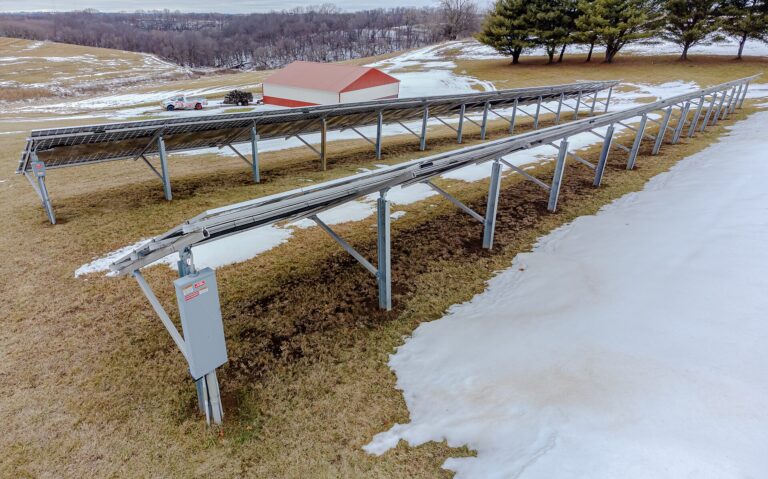
- Site requirements: Unobstructed south-facing exposure in the Northern Hemisphere. Shade from trees, buildings or even utility poles can sharply cut output, since a single shaded cell can cripple a panel’s performance. Roof, ground and pole mounts are all common.
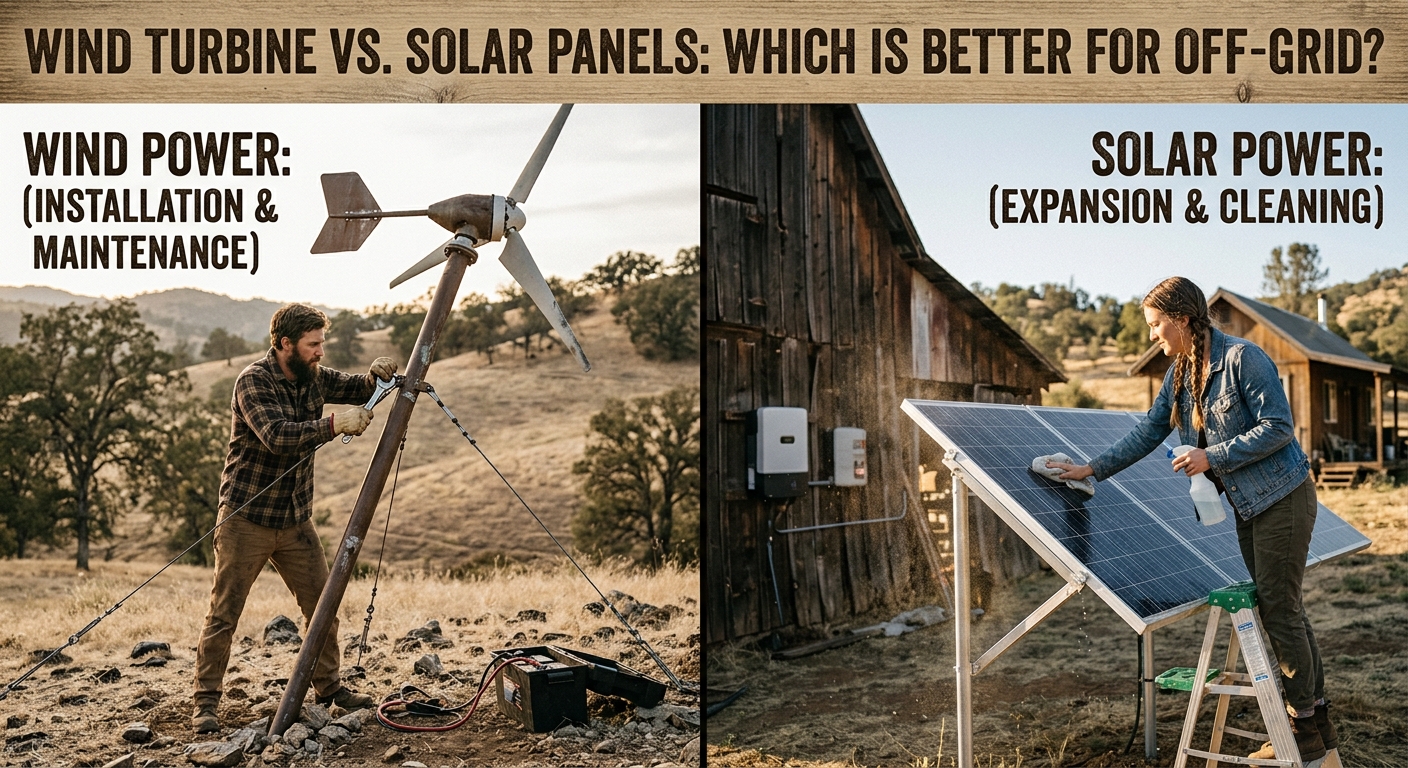
- Maintenance: Low. Keep panels clean of dust, snow and leaves (twice a year is typical, more often in dusty periods or after heavy snow) and check electrical connections periodically.
Wind Turbines: How They Perform Off-Grid
Wind turbines convert the kinetic energy of moving air into electricity. They are less common than solar for residential off-grid systems, but on the right site they can be very effective, especially during cloudy, stormy periods when solar underperforms.
- Energy production: Turbines generate power whenever the wind is strong enough to turn the blades, feeding DC power through a charge controller to the batteries. Unlike solar, wind can produce power 24 hours a day, including at night and on cloudy days.
- Efficiency and output: Power output is proportional to the cube of wind speed, so a small increase in wind speed produces a large increase in power. A 1 kW turbine might produce 100–300 kWh per month at an average wind speed of 5–6 m/s (11–13 mph), but output plummets if the average falls to 3 m/s (6.7 mph). Turbines have a cut-in speed (for example 2.5 m/s or 5.6 mph) below which they produce nothing, and a furling speed (for example 12.5 m/s or 28 mph) at which they limit output to prevent damage. Smaller units such as the Primus Wind Power Air 40 are rated at 400W at 28 mph.
- Site requirements: Consistent, unobstructed wind. Turbines need tall towers (typically 30–100 ft, or 9–30 m) to rise above turbulence from trees, buildings and terrain. A common rule of thumb is that the bottom of the blades should be at least 20 ft (6 m) above any obstacle within 300 ft (90 m). That often means significant tower and engineering costs.
- Maintenance: Higher than solar. Inspect blades, tower stability, guy wires and rotating parts periodically. Bearings and brushes (in some models) wear out and may need replacement every few years, and blades can be damaged by severe ice storms.
Direct Comparison
- Energy availability: Solar follows a predictable daily cycle with zero output at night and varies with season and cloud cover. Wind is intermittent but can produce around the clock, and it often performs best during cloudy weather and at night.
- Footprint and aesthetics: Solar can go on roofs, the ground or poles and is generally unobtrusive. A 5 kW system might need 20–25 panels covering about 400 sq ft (37 sq m). Wind needs a tall, visually prominent tower that may face zoning restrictions; a 1 kW turbine’s blades might span 6–10 ft (1.8–3 m), but the tower dominates.
- Noise: Solar is silent. Turbines can produce an audible hum or whoosh. Modern small turbines are much quieter than older designs but not silent, which matters for neighbors and nearby living spaces.
- Cost: Solar usually costs less per watt of peak capacity, though reliable winter power may require a larger array and more battery storage. Solar’s levelized cost of energy (LCOE) has fallen steadily. Wind has higher upfront costs for the tower, foundation and specialized installation; its LCOE can be competitive on excellent wind sites but becomes very high on marginal ones.
- Environmental impact: Panel manufacturing involves some hazardous materials, but installed panels are clean and recycling programs are improving. Wind has minimal operational impact, with some potential for bird and bat strikes (typically low for small residential turbines) and visual impact.
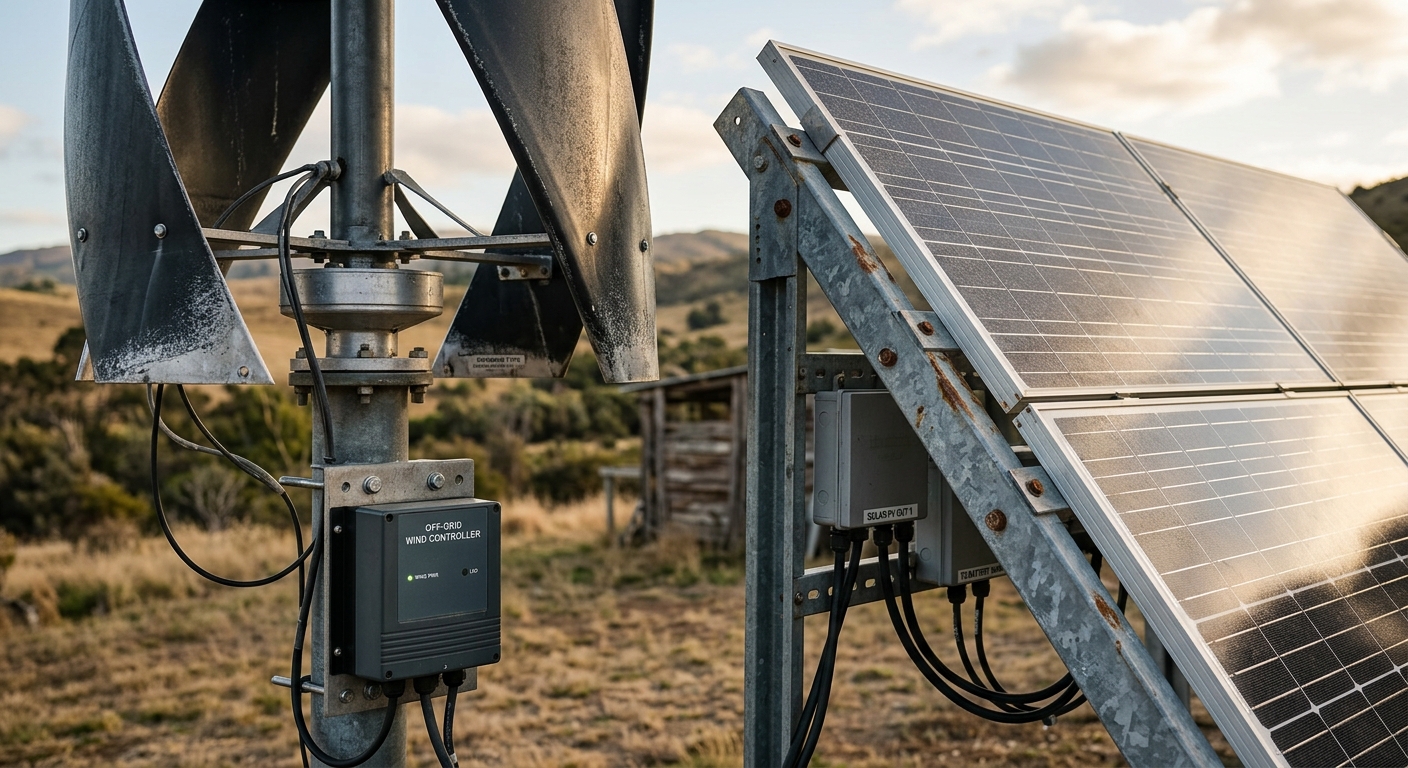
- Synergy: Solar excels during sunny days; wind fills gaps during cloudy periods and at night. Together they provide a more consistent supply, reducing reliance on a very large battery bank or a backup generator.
Comparison Table: Wind vs Solar vs Hybrid
| Feature | Solar Panels (e.g., REC Alpha Pure-R 430W) | Wind Turbines (e.g., Primus Air 40) | Hybrid System (Solar + Wind) | Best Use Case | Considerations in 2026 |
|---|---|---|---|---|---|
| Primary energy source | Sunlight (photovoltaic effect) | Wind (kinetic energy) | Sunlight and wind | Consistent sun exposure, open areas | Panel efficiency rising; costs falling |
| Peak production | Daytime, especially midday | Day and night whenever wind is sufficient | Day and night, using both sources | Consistently windy locations, cloudy climates | Turbine tech improving but still niche |
| Intermittency / reliability | Predictable daily cycle; zero at night; reduced on cloudy days; seasonal variation | Highly dependent on wind speed; inconsistent but can produce 24/7 | More consistent; reduces reliance on large battery banks | Any off-grid site wanting maximum reliability | Integrated smart controllers are important |
| Site requirements | Unobstructed south-facing exposure (N. Hemisphere), minimal shading | Tall tower (30–100 ft) above obstacles; average wind speed above 5 m/s (11 mph) | Good sun exposure and adequate wind | Sites with both strong solar and wind potential | Tower zoning can be an issue |
| Maintenance and lifespan | Low (cleaning); 25–30+ years; degradation about 0.5% per year | Higher (moving parts, bearings, blades); 15–20 years with component replacements | Moderate; both systems need attention | Long-term self-sufficiency | Remote monitoring simplifies management |
| Approx. installed cost per watt (2026 est.) | $2.00–$3.50 (panels, inverter, battery, wiring, labor) | $4.00–$8.00 (turbine, tower, foundation, wiring, labor) | $2.50–$5.00 depending on solar/wind ratio and complexity | Budget projects with good sun | Compare LCOE, not just upfront cost |
| Aesthetics and noise | Minimal visual impact; silent | Prominent tower; possible hum or whoosh | Combines both visual footprints | Rural, unrestricted properties | Tower height and setback rules are common |
Representative Components and Approximate 2026 Prices
The components below are well-known options for solar, wind and hybrid systems. Prices are approximate and fluctuate by retailer and promotion.
Solar Panels
- REC Alpha Pure-R Series 430W (black frame): High efficiency (up to 22.3%), good low-light performance and a strong warranty. Approx. $420–$480 per panel ($0.98–$1.12/W).
- Renogy 400 Watt 12V Monocrystalline (RNG-400D): Slightly lower efficiency but good value. Approx. $350–$400 per panel ($0.87–$1.00/W).
Wind Turbines
- Primus Wind Power Air 40 (400W): A popular small turbine for light loads or as a supplementary source. Turbine approx. $1,100–$1,300; 30 ft (9 m) guyed tower kit $800–$1,200; foundation materials and labor another $500–$1,500.
- Bergey Excel 1 (1 kW): A more substantial, durable turbine for sites with excellent wind and higher demand. Turbine approx. $6,000–$8,000; 50 ft (15 m) freestanding tower $3,000–$5,000; installation and foundation potentially $2,000–$5,000+ with specialized contractors.
System Components (Solar, Wind or Hybrid)
- Batteries (LiFePO4):
- Battle Born LiFePO4 12V 200Ah (BB12200): Rated 3,000–5,000 cycles to 80% depth of discharge. Approx. $850–$950 each; a 400Ah (4.8 kWh) bank runs $1,700–$1,900.
- Sokwe 12V 200Ah LiFePO4 (self-heating, Bluetooth): Integrated BMS and cold-weather charging. Approx. $750–$850 each.
- Inverter/chargers:
- Victron Energy MultiPlus-II 12/3000/120-50 120V (3000W, 120A charger): Integrates well with solar and wind charge controllers. Approx. $1,800–$2,200.
- Schneider Electric Conext SW 4048 (4000W, 48V): For larger systems, with strong surge capability. Approx. $2,800–$3,200.
- Solar charge controller: Victron Energy SmartSolar MPPT 100V 50A (SCC110050210), with Bluetooth monitoring. Approx. $300–$350.
- Wind charge controller: Primus Air Breeze Marine Controller (for Air-series turbines), managing charging and dump loads. Approx. $200–$250.
- Backup generator: Generac GP3500iO Open Frame Inverter Generator (3500W), for long low-sun/low-wind periods and heavy loads. Approx. $900–$1,100.
- Monitoring: Victron Energy Cerbo GX (~$450) with GX Touch 50 display (~$250), monitoring solar, wind, batteries, inverter and generator locally and remotely.
Also budget for wiring (for example 2/0 AWG for main battery runs), fuses, breakers, mounting hardware, conduit, grounding equipment and, often, professional installation for electrical work and tower erection.
Sample Budgets
These approximate 2026 budgets include major components and a rough balance-of-system (BOS) allowance for wiring, mounting and safety gear, but exclude most professional labor, which varies widely.
Small Cabin (about 2 kWh/day)
Solar-focused (about 2.4 kW array):
- 6 x Renogy 400W panels: $2,100–$2,400
- 2 x Battle Born 12V 200Ah LiFePO4 (4.8 kWh usable): $1,700–$1,900
- Victron MultiPlus-II 12/3000 inverter/charger: $1,800–$2,200
- Victron SmartSolar MPPT 100V 50A: $300–$350
- BOS (wiring, fuses, mounts): $800–$1,200
- Estimated total: $6,700–$8,050
Note: on a 12V battery bank, a single 50A controller handles roughly 700W of panels (50A x ~14V), so a 2.4 kW array would need additional controllers or a higher-voltage battery bank. Check controller sizing before you buy.
Wind-focused (400W turbine plus a small solar top-up):
- 1 x Primus Wind Power Air 40: $1,100–$1,300
- 1 x 30 ft guyed tower kit: $800–$1,200
- 1 x Renogy 400W panel: $350–$400
- 2 x Battle Born 12V 200Ah LiFePO4: $1,700–$1,900
- Victron MultiPlus-II 12/3000: $1,800–$2,200
- Primus Air Breeze Marine Controller: $200–$250
- Victron SmartSolar MPPT 100V 30A: $200–$250
- BOS: $1,000–$1,500
- Estimated total: $7,150–$9,000 (higher mainly because of tower costs)
Medium Home (about 5 kWh/day)
Hybrid (about 3.4 kW solar + 1 kW wind):
- 8 x REC Alpha Pure-R 430W panels (3.44 kW): $3,360–$3,840
- 1 x Bergey Excel 1 (1 kW): $6,000–$8,000
- 1 x 50 ft freestanding tower: $3,000–$5,000
- 4 x Battle Born 12V 200Ah LiFePO4 (9.6 kWh usable): $3,400–$3,800
- Schneider Electric Conext SW 4048 inverter/charger: $2,800–$3,200
- Victron SmartSolar MPPT 250V 60A: $650–$700
- Bergey wind controller: $800–$1,000
- Victron Cerbo GX and GX Touch 50: $700–$750
- BOS: $2,000 and up
- Estimated total: roughly $22,700–$28,300+ before professional installation
Pro Tips
- Measure your load first: Use a plug-in meter such as a Kill-A-Watt (about $25–$30) on every appliance for a week. What matters is watt-hours per day; knowing your daily kWh (for example 5 kWh/day for a small household) is the most important first step.
- Measure your wind before buying a turbine: Don’t rely on general weather reports. Use an anemometer (a handheld Kestrel 2000 is about $130; data-logging models run $500+) and collect data at the proposed hub height for at least a month, ideally a year. Local terrain can leave a turbine rarely spinning above cut-in speed.
- Consider a hybrid: Combining solar and wind reduces the battery capacity needed to bridge gaps. A setup such as a 6 kW solar array with a 1 kW turbine can greatly reduce generator run time on a site with a decent wind resource.
- Give charge controllers headroom: Size solar and wind controllers about 20–25% above your theoretical maximum input to allow for cold-weather voltage rise on panels and strong gusts on turbines. If your array’s voltage approaches a controller’s limit, step up to a 150V or 250V model such as the Victron SmartSolar MPPT 250V 60A (about $650).
- Invest in batteries and monitoring: LiFePO4 batteries justify their cost through longevity, depth of discharge and efficiency. A monitoring system like the Victron Cerbo GX lets you track performance, troubleshoot remotely and optimize usage.
- Plan maintenance access: Leave a clear path around ground-mounted arrays, and for wind towers plan for safety harnesses and a clear area for lowering the tower.
Common Mistakes to Avoid
- Underestimating consumption: Count run time, not just wattage. A 100W bulb left on for 10 hours uses 1 kWh, while a 1500W coffee maker used for 10 minutes uses only 0.25 kWh. Measure for a week and add a 20–30% buffer for growth and unexpected loads.
- Ignoring site conditions: Solar in heavy shade or a turbine in a sheltered valley or behind a hill will disappoint. Do a sun-path and shade analysis for solar and an anemometer study plus topographic review for wind before buying equipment.
- Skimping on batteries: Cheap or undersized banks fail early. Aim for 2–3 days of autonomy: at 5 kWh/day, that means 10–15 kWh of usable storage. One 12V 200Ah Battle Born battery provides about 2.4 kWh usable.
- Inadequate wiring and fusing: Undersized wire causes voltage drop and power loss; improper fusing is a fire hazard. Follow the National Electrical Code (NEC), use appropriate wire gauges and size fuses and breakers for every circuit using proper wiring charts.
- Neglecting grounding and lightning protection: Tall wind towers in particular attract lightning. Use grounding rods, heavy-gauge grounding wire and surge suppressors on all incoming and outgoing AC and DC lines.
- Poor monitoring: Without monitoring you won’t know if panels underperform, batteries are over-discharged or a controller is misbehaving.
- No backup plan: Extended periods of low sun and no wind will happen, and equipment fails. A properly sized backup generator, such as a 3500W inverter generator, should be able to run critical loads and recharge your batteries efficiently.
Conclusion: Which Is Better for Off-Grid?
For most off-grid properties, solar is the better primary source: it is cheaper per watt, silent, low-maintenance and predictable. Wind earns its place on sites with a measured average wind speed above about 5 m/s and good tower clearance, especially in cloudy climates or where winter sun is weak. Where both resources are good, a hybrid system delivers the most consistent power and lets you use a smaller battery bank. Measure your loads, measure your sun and wind, and size your system from real data rather than guesses.
Marcus Reid
Founder & Editor, OffGridSage
Marcus founded OffGridSage to bring practical off-grid knowledge together in one place. Guides are built from official and expert sources (NREL, the EPA, the USDA and university extension services), manufacturer documentation and reader feedback, and are updated when information changes.