Best Survival Food Kits Compared (2026 Honest Review)
Best Survival Food Kits Compared (2026 Honest Review)
Picture this: a major winter storm knocks out power for two weeks, roads are impassable, and your pantry holds three days of food. Or maybe you are building an off-grid homestead from scratch and need a reliable food reserve while your garden matures. Either way, you find yourself staring at a crowded market of survival food kits — all of them promising 25-year shelf lives, restaurant-quality meals, and complete nutrition. Most of those claims are stretched at best, and shopping blind can mean spending $1,500 on buckets of sodium-loaded slop your family will refuse to eat after day two.
The stakes are higher than most people realize. A bad survival food kit is not just a wasted investment — it is a false sense of security. Buy the wrong one and you will face food fatigue within a week, dangerous sodium overload if water is scarce, or a calorie gap that leaves you exhausted when you need energy most. Millions of Americans have bought preparedness kits that are still sitting unopened in garages, never tested, never rotated, slowly ticking toward expiration while the buyer assumes they are covered.
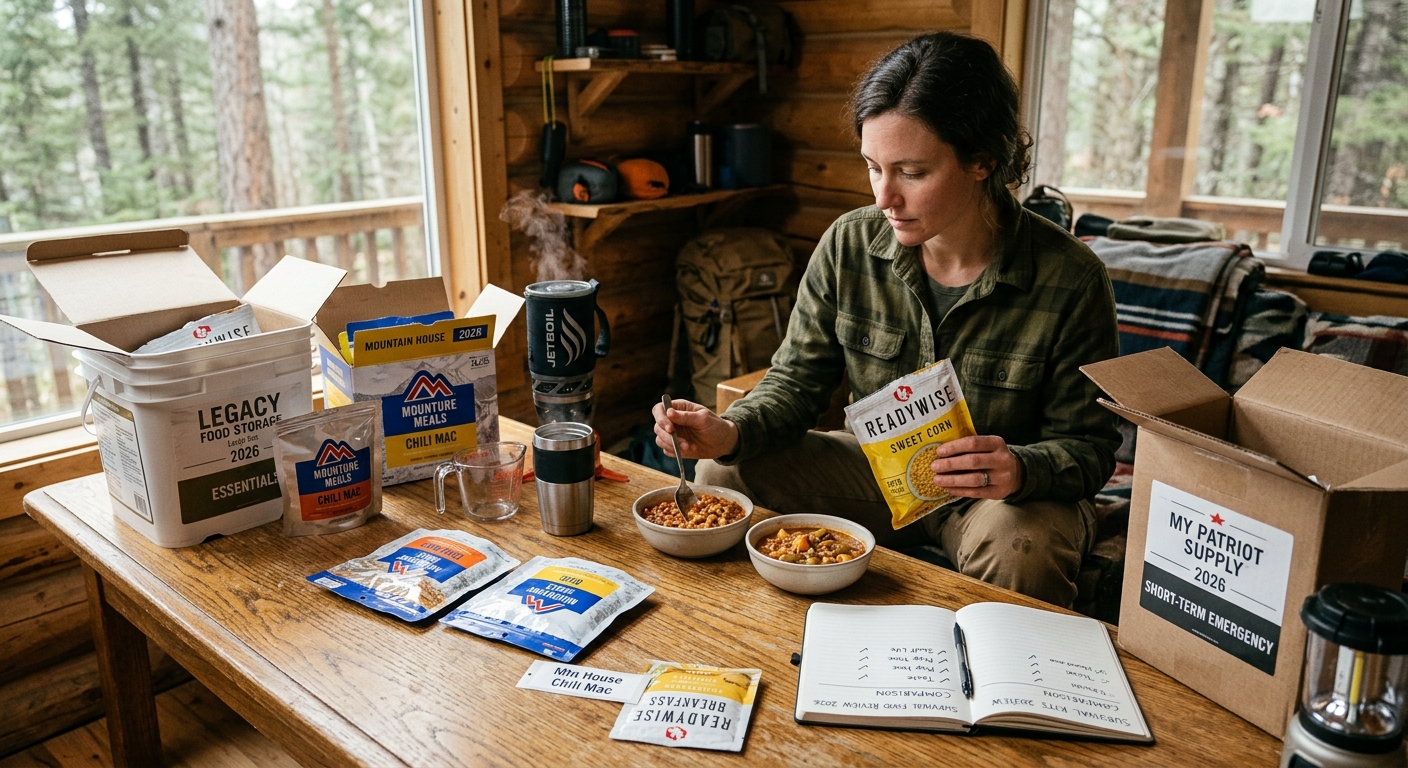
This guide cuts through the marketing noise. We break down exactly how to evaluate any survival food kit, then give you an honest, side-by-side review of the five best options available in 2026 — from the gold-standard Mountain House supply to the budget-friendly ReadyWise starter kit. We also cover the most common buying mistakes, a comparison table with real numbers, and how to build your own three-month supply for a fraction of the packaged price. By the end, you will know exactly which kit fits your situation, your budget, and your taste buds.
Quick Answer: Top Picks at a Glance
If you are short on time, here are the best survival food kits in 2026, organized by use case. Each pick is backed by the full review below.
- Best overall taste: Mountain House 3-Month Supply — 2,500 cal/day, 30-year shelf life, $1,800
- Best budget: Augason Farms 1-Year Supply — $1,200, mix of freeze-dried and dehydrated
- Best for beginners: ReadyWise 4-Week Emergency Kit — $200, easy entry point, good variety
- Best value per calorie: Legacy Food Storage — non-GMO, competitive price-per-serving
- Best nutrition: Nutrient Survival — macro-focused, military-grade formulation
How to Evaluate Any Survival Food Kit
Before looking at individual brands, you need a framework. Marketing language like « feeds a family of four » and « complete nutrition » is almost always misleading. Here is what actually matters.
Calories Per Day — The Number That Matters Most
Most survival food kits advertise serving counts, not calorie totals. A kit boasting « 2,000 servings » might deliver only 1,200 calories per day per person — barely enough to keep an average adult sedentary, and nowhere near enough if you are doing physical labor, homesteading, or bugging out on foot. Adults doing moderate activity need 2,000 to 2,500 calories daily. Anyone doing heavy outdoor work needs 2,800 or more. Always divide the total calorie count by the number of days and number of people the kit claims to serve. The math often reveals a significant gap.
Sodium Levels
Freeze-dried and dehydrated foods are notoriously high in sodium because salt is a preservative and a flavor enhancer. Many survival meals clock in at 800 to 1,400mg of sodium per serving — and if you are eating three servings per day, you can hit 4,000mg easily. The American Heart Association recommends under 2,300mg daily. High sodium is manageable if you have plenty of clean water, but in a grid-down scenario where water is scarce, excessive sodium can cause serious dehydration. Always check the per-serving sodium before buying.
Taste Test Reality
There is a reason experienced preppers say « eat what you store and store what you eat. » Survival food that tastes terrible will go uneaten when stress is high and morale is already low. The best brands invest in real flavor development — genuine herbs, spice profiles that hold up after reconstitution, and variety that prevents meal monotony. The worst offenders taste like seasoned cardboard. If at all possible, buy a single sample pouch or a smaller starter kit before committing to a large supply.
Shelf Life Claims vs. Reality
Almost every major brand advertises a 25-to-30-year shelf life. That number applies under ideal conditions: stored at 55 to 70 degrees Fahrenheit, low humidity, away from light. A garage in Texas or a basement that floods regularly will dramatically shorten real-world shelf life. Freeze-dried foods genuinely hold up longer than dehydrated foods. Oxygen absorbers and mylar packaging are must-haves for the longest storage. Be skeptical of any kit storing food in simple cardboard boxes or unsealed pouches.
Price Per Calorie
The honest way to compare survival food kits is to calculate cost-per-calorie or cost-per-day. A $200 kit sounds affordable until you realize it only covers 28 days at 1,000 calories per day for one adult. Divide the total price by the total number of calories, then multiply by 2,000 (your daily target) to get a daily cost. Anything under $3 per day at 2,000 calories is competitive. Most premium brands run $4 to $6 per day.
The 5 Best Survival Food Kits Reviewed for 2026
1. Mountain House 3-Month Supply — Best Taste
Mountain House has been producing freeze-dried food since 1969, and their 3-month supply is the gold standard for taste and reliability. At $1,800 retail, it is a significant investment, but the calorie density is honest — you get a genuine 2,500 calories per day for one adult, covering 90 days of nutritional coverage. Their freeze-drying process locks in flavor better than almost any competitor, and popular meals like beef stroganoff, lasagna with meat sauce, and granola with blueberries consistently earn high ratings from actual testers, not just marketing copy.
Shelf life is rated at 30 years, and Mountain House backs this with real accelerated aging tests — they are one of the few brands that has published independent verification. Sodium runs moderate to high, averaging around 900mg per serving, so factor in water requirements. The main drawback is cost: at roughly $1,800, this is a premium purchase. But for taste-sensitive households, for families with children who will resist eating unfamiliar food under stress, and for off-gridders who want the most reliable product, Mountain House earns its price tag.
2. Augason Farms 1-Year Supply — Best Budget Option
Augason Farms built its reputation as the Costco-era survival food brand, and their 1-year supply at approximately $1,200 is the most popular budget option on the market. The kit combines both freeze-dried and dehydrated foods — a cost-saving measure that slightly reduces shelf life for some components (dehydrated items typically last 15 to 25 years versus 30 years for freeze-dried) but keeps the overall price competitive. Calorie density is lower than Mountain House, typically averaging around 1,800 to 2,000 calories per day, which means some buyers will want to supplement.
Variety is a genuine strength here — the supply includes grains, legumes, freeze-dried meats, vegetables, dairy alternatives, and baking staples, which gives you real cooking flexibility rather than just heat-and-eat pouches. The sodium levels are on the higher end. Taste is adequate but not exciting — expect functional, filling meals rather than anything memorable. For apartment dwellers building their first serious food reserve, or homesteaders supplementing a growing pantry, Augason Farms delivers solid value.
3. ReadyWise 4-Week Emergency Kit — Best for Beginners
At around $200, the ReadyWise 4-week kit is the lowest barrier to entry among reputable brands. It covers one adult for 28 days with a mix of breakfast, lunch, and dinner options — around 1,500 calories per day, which is on the lean side but workable for a sedentary adult. The real value here is psychological: this kit gets a family from zero preparedness to a month’s cushion without a large upfront cost, and it fits easily in an apartment closet or under a bed.
ReadyWise packages are straightforward to use — just add water, wait 12 to 15 minutes, eat from the pouch. The taste is passable and the variety is reasonable for a starter kit. Shelf life is 25 years under proper storage. This is an excellent first purchase for someone who is new to preparedness, skeptical of survival food, or working with a tight budget. It is not a long-term solution on its own, but as a foundation or a short-term buffer, ReadyWise delivers honest value for the price.
4. Legacy Food Storage — Best Value Per Calorie
Legacy Food Storage targets the non-GMO, clean-ingredient segment of the market and delivers surprisingly competitive price-per-calorie numbers for a premium-positioned brand. Their meals are made with non-GMO ingredients, gluten-free options are available, and they are notably transparent about calorie counts per serving — which are higher than many competitors. Legacy’s pricing typically runs 10 to 20 percent below Mountain House for equivalent calorie coverage, making them the best value pick for buyers who care about ingredient sourcing.
Taste ratings are consistently strong, and the variety — pasta primavera, potato soup, granola, chicken noodle, and others — holds up well over multiple consecutive days of eating. Shelf life is rated at 25 years. One real advantage: Legacy frequently runs promotional pricing and bundle deals that make large purchases even more cost-effective. For off-gridders, homesteaders, and preppers who want non-GMO sourcing without paying the Mountain House premium, Legacy Food Storage is the strongest value proposition available.
5. Nutrient Survival — Best Nutrition
Nutrient Survival takes a fundamentally different approach from every other brand on this list. Rather than starting with taste or calorie count, they start with micronutrient density — building meals that deliver complete macro and micronutrient coverage even when you are living entirely off the supply. Their formulations are influenced by military performance nutrition research, and the result is food that sustains cognitive performance and physical stamina, not just basic caloric needs.
This matters more than most people realize during a prolonged crisis. Cognitive fog, fatigue, and immune decline during extended grid-down scenarios are often caused by micronutrient deficiencies, not just calorie gaps. Nutrient Survival is the most expensive option on this list — expect to pay a premium over comparable serving counts — but for individuals with health conditions, families with children in critical developmental stages, or anyone planning for genuinely long-term grid-down scenarios, the nutritional completeness is worth the cost.
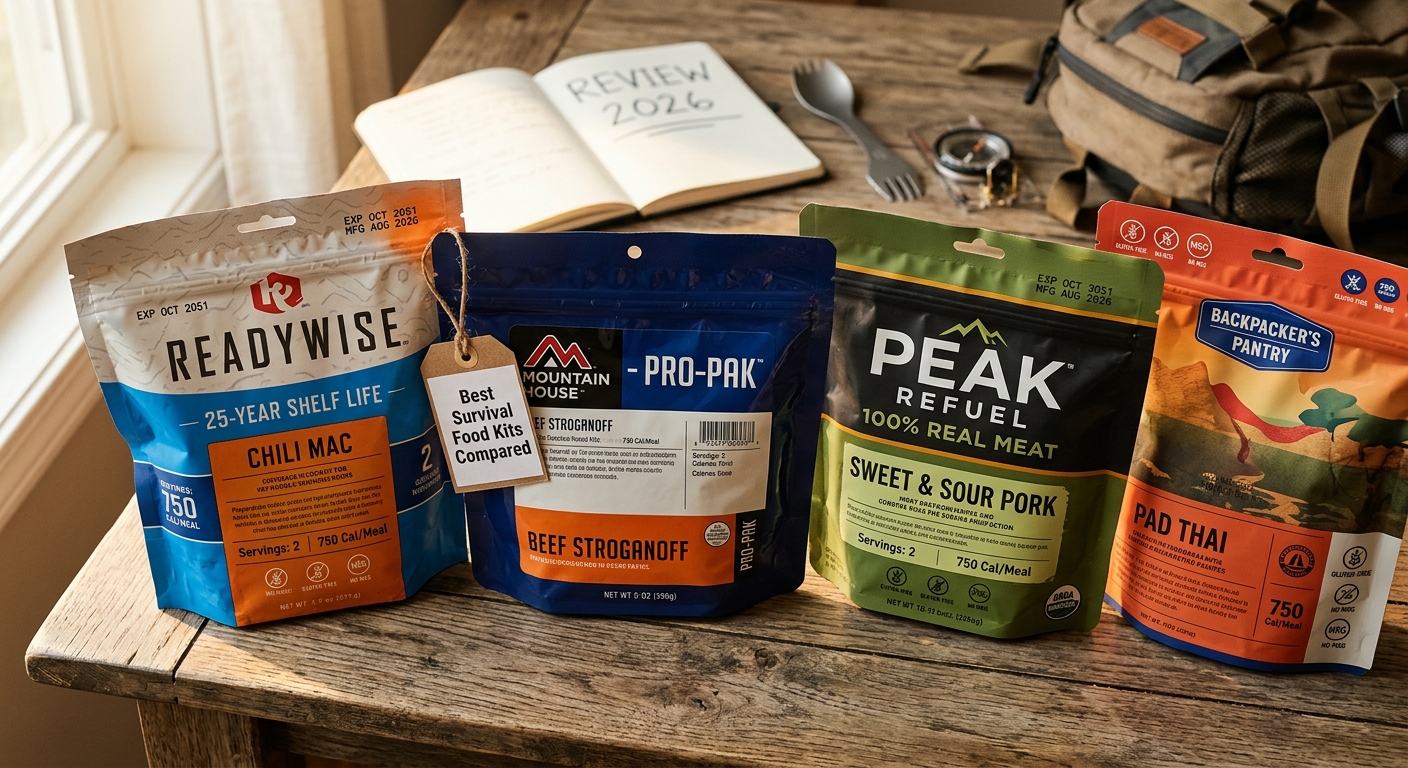
Side-by-Side Comparison Table
| Brand | Duration | Cal/Day | Servings | Avg Sodium/Serving | Price | Shelf Life | Taste Rating |
|---|---|---|---|---|---|---|---|
| Mountain House | 3 months | 2,500 | ~720 | 900mg | $1,800 | 30 years | 9/10 |
| Augason Farms | 1 year | 1,800–2,000 | ~4,320 | 1,050mg | $1,200 | 15–30 years | 6/10 |
| ReadyWise | 4 weeks | 1,500 | ~84 | 780mg | $200 | 25 years | 6.5/10 |
| Legacy Food Storage | 3 months | 2,000–2,200 | ~540 | 820mg | ~$1,400 | 25 years | 7.5/10 |
| Nutrient Survival | 1 month | 2,000 | ~90 | 700mg | ~$350 | 25 years | 7/10 |
Common Mistakes When Buying Survival Food Kits
Mistake 1: Ignoring the Calorie Math
This is the single most common error. A « 1-year supply for a family of four » that delivers 1,200 calories per person per day is not a year supply — it is a slow-starvation diet. Always do the math yourself. Total calories divided by days divided by people. If the number is below 2,000 for adults doing any physical activity, you will need to supplement. Many buyers discover this only after opening the boxes and actually counting servings.
Mistake 2: Buying All Your Calories from One Category
A common prep mistake is buying five identical buckets of the same product — say, five buckets of freeze-dried rice. You save money, but you condemn yourself to eating the same meal every day. Food fatigue is real and psychologically devastating under stress. After seven to ten days of identical meals, many people will simply stop eating adequately. Variety is not a luxury — it is a psychological necessity for sustained function during a crisis. Build in at minimum three to four distinct breakfast options, three to four lunch-style options, and four to five dinner varieties.
Mistake 3: Not Accounting for Water
Every freeze-dried and most dehydrated foods require significant water for reconstitution — typically one to two cups of water per serving. A three-month supply for one adult may require 50 to 100 gallons of water just for meal preparation, completely separate from your drinking water needs. If you are in a water-scarce scenario, high-sodium freeze-dried food without adequate rehydration water is a genuine health risk. Factor water storage into your total prep plan before buying a large food kit.
Mistake 4: Skipping the Rotation and Testing Phase
Survival food stored and never eaten creates a false safety net. Regularly cooking with your stored food — even just one meal per month — serves three critical purposes: you confirm the food tastes acceptable to your household, you maintain rotation so nothing expires unnoticed, and you build real familiarity with preparation methods before a crisis forces you to learn under pressure.
Building Your Own 3-Month Supply from Scratch
For budget-conscious preppers and homesteaders, buying commercial kits is not the only path. A well-organized DIY supply built from bulk grocery purchases and properly packaged home storage can cover three months for one adult for as little as $300 to $400 — roughly half the cost of a comparable commercial kit. The foundation is bulk dry goods: 50 pounds of white rice (~$25), 25 pounds of rolled oats (~$20), 20 pounds of dried lentils (~$18), 20 pounds of pinto beans (~$16), and assorted pasta, canned proteins, and shelf-stable fats. Packaged with oxygen absorbers in mylar bags inside 5-gallon buckets, white rice and dried legumes will reliably last 20 to 30 years. Add a small collection of spices, bouillon, and comfort foods, and you have a functional, taste-varied supply at a fraction of the commercial price.
The trade-off is time and organizational effort. You will need to source containers, oxygen absorbers, and mylar bags separately, and you will need to dedicate a few weekends to proper packaging and labeling. For many homesteaders already comfortable with food preservation, this is a natural extension of existing skills. For urban apartment dwellers who want a turnkey solution, commercial kits offer convenience worth paying for.
Traditional Food Preservation as a Long-Term Strategy
Commercial kits and bulk dry goods are excellent short-to-medium term solutions, but the most resilient long-term food security comes from mastering traditional preservation methods — the same techniques that kept families fed through hard winters long before freeze-drying existed. Root cellaring, lacto-fermentation, smoking, salt-curing, and old-school canning extend garden harvests for months without electricity, specialized equipment, or ongoing purchase costs.
The Bottom Line
The best survival food kits in 2026 are not one-size-fits-all. For pure taste and reliability, Mountain House is worth every dollar of its $1,800 price tag. For maximum coverage on a budget, Augason Farms delivers more days per dollar than any competitor. Beginners who want to start immediately without a large investment should start with a ReadyWise 4-week kit and expand from there. Nutrition-first buyers will find Nutrient Survival’s macro and micronutrient approach worth the premium, while non-GMO shoppers who want the best value per calorie will land on Legacy Food Storage. Whatever you choose, run the calorie math yourself, test the food before you need it, and do not forget the water.
Have questions about your specific situation? Drop them in the comments below — we read every one. If this guide helped you, share it with someone planning their off-grid setup.
Marcus Reid
Founder & Editor, OffGridSage
Marcus founded OffGridSage to bring practical off-grid knowledge together in one place. Guides are built from official and expert sources (NREL, the EPA, the USDA and university extension services), manufacturer documentation and reader feedback, and are updated when information changes.