How to Wash Clothes Without Electricity: The Complete Off-Grid Laundry Guide
How to Wash Clothes Without Electricity: The Complete Off-Grid Laundry Guide
The power goes out for a week — or you move to a homestead with no grid connection — and suddenly a pile of dirty laundry becomes a real problem. Most people have never washed a single item by hand in their adult lives. They rely on a machine that uses 500 watts of electricity per cycle, 20 gallons of water, and a tap that delivers hot water on demand. Strip all of that away and you are left staring at a tub of muddy work pants wondering what people did before 1920.
The good news is that hand-washing clothes without electricity is not difficult once you know the right methods and have the right tools. The bad news is that doing it wrong — using too much soap, skipping the rinse, leaving damp clothes in a pile — leads to stiff fabric, skin irritation, and clothing that smells worse after washing than before. Get the technique right from the start and you will have clean, fresh laundry even 20 miles from the nearest power line.
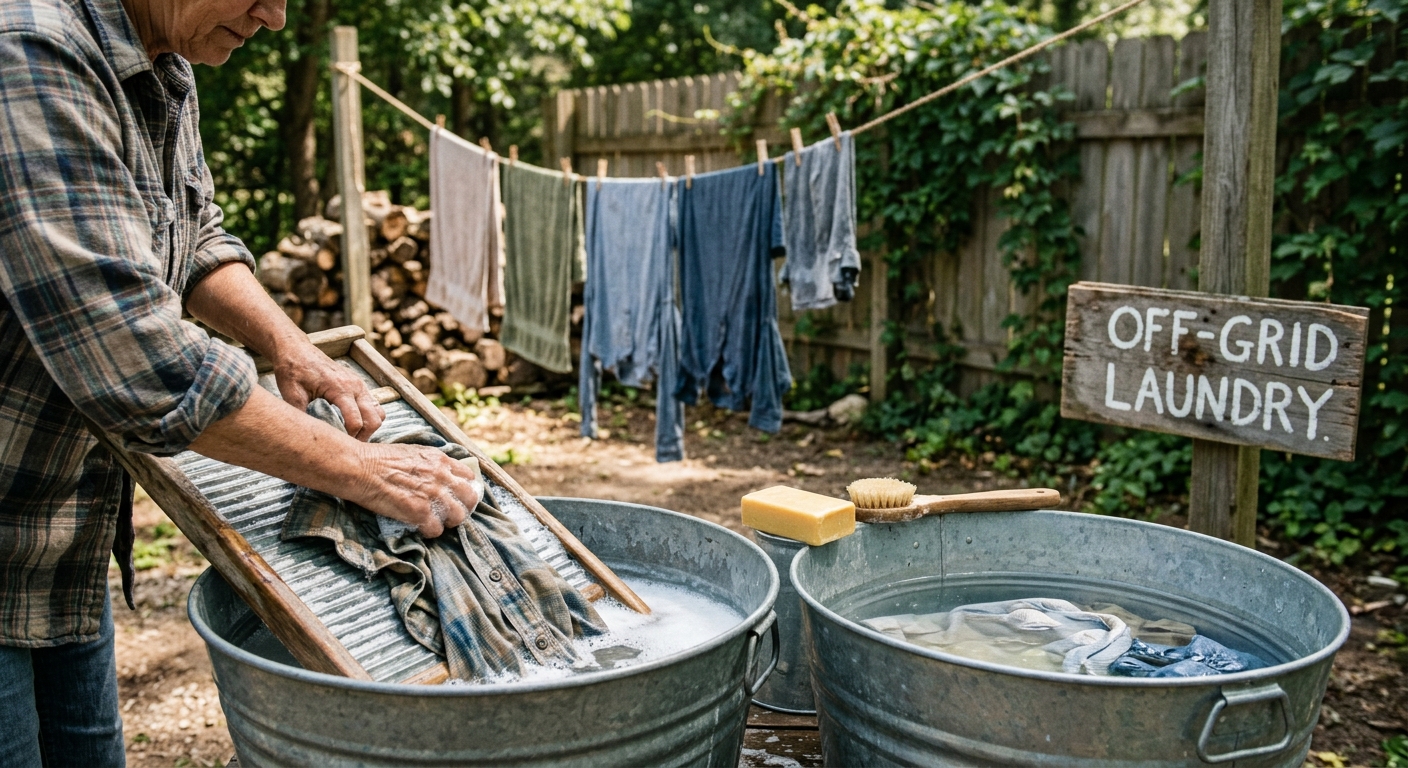
This guide covers every practical method for off-grid laundry: hand-washing in a bucket step by step, the best soaps including Fels-Naptha and castile, hand-crank and plunger-style washers, the classic washboard for heavy stains, a two-bucket rinse system to cut water use, wringer options, line-drying tips to prevent mildew, grey water reuse in the garden, and a full comparison table so you can pick the right method for your situation. By the end you will have a complete, workable laundry system that costs under $60 to set up.
Quick Answer: Off-Grid Laundry at a Glance
You can wash clothes without electricity using four main methods. Each suits a different load size, budget, and physical ability level. Here is the short version:
- Bucket + plunger (Breathing Mobile Washer): Best all-around starter setup — $15–$25, works in any 5-gallon bucket, handles a full outfit per cycle.
- WonderWash hand-crank washer: ~$50, holds about 5 lbs of laundry, fastest hand method for small households.
- Washboard: $20–$35, essential for grease and heavy stains, pairs with any bucket setup.
- James Washer (hand-crank drum): ~$200, largest capacity at 8–10 lbs, best for families.
- Best soap: Fels-Naptha bar for stains, Dr. Bronner’s castile for gentle loads, or homemade lye soap.
- Water savings: A two-bucket rinse system cuts rinse water by 40–50% compared to running-water rinsing.
Hand-Washing in a Bucket: Step-by-Step Method
This is the foundation of off-grid laundry. You need two 5-gallon buckets (about $5 each at any hardware store), a Breathing Mobile Washer or a wooden plunger, and your soap of choice. The whole setup runs under $30.
Step 1 — Sort and Pre-Treat
Sort clothes into light loads (shirts, underwear, socks) and heavy loads (jeans, work clothes, towels). Wash light loads first so you can reuse the wash water for the heavier items. Pre-treat visible stains by rubbing a wet bar of Fels-Naptha directly onto the stain and letting it sit for 5 minutes. Fels-Naptha costs about $2 per bar and lasts months — it cuts grease and grass stains better than most liquid detergents.
Step 2 — Fill the Wash Bucket
Fill one bucket with warm or hot water — the hotter the better for killing bacteria and loosening soil, as long as the fabric tolerates it. Add 1 tablespoon of liquid castile soap or 1 tablespoon of grated bar soap per gallon of water. More soap does not mean cleaner clothes; it means harder rinsing and residue left in the fabric. For a 5-gallon bucket, 2 to 3 tablespoons of soap is plenty.
Step 3 — Agitate with the Breathing Mobile Washer
The Breathing Mobile Washer is a plunger-style tool with a domed rubber head and holes that force water through fabric with each push and pull. It costs $15–$25 on Amazon or from Lehman’s. Push and pull vigorously for 3–5 minutes. The motion mimics what a washing machine drum does — forcing soapy water through the fibers rather than just soaking them. For a shirt or pair of socks, 3 minutes is enough. For jeans, aim for 5–7 minutes.
Step 4 — Rinse with the Two-Bucket System
Move clothes to the second bucket filled with clean water. Agitate for 1–2 minutes, then squeeze out as much water as possible. If you can see suds in the rinse water after wringing, pour it out and refill for a second rinse. The two-bucket system matters because rinse water from the first round can be saved and used again as wash water for the next batch — cutting total water use significantly.
Step 5 — Wring and Dry
Wring by hand in a twisting motion, working from one end of the garment to the other. A manual clothes wringer (like the Lehman’s hand-crank wringer for about $80) removes far more water than hand-wringing and cuts dry time dramatically. If you are wringing by hand, roll the item tightly in a dry towel and press down hard — the towel will absorb another 20–30% of the remaining moisture.
The Best Soaps for Off-Grid Laundry
Fels-Naptha Bar Soap
A laundry bar soap made since 1893, Fels-Naptha is a staple on every homestead. At about $2 per bar, it is unmatched for pre-treating stains. Grate it on a cheese grater and dissolve the flakes in hot water to make a liquid detergent, or use the bar directly on problem areas. One bar lasts a family of four about 2–3 weeks of regular use.
Dr. Bronner’s Pure Castile Soap
Castile soap is made from plant oils — typically coconut and olive — and is fully biodegradable, making it ideal for grey water reuse in the garden. The unscented Baby version is gentlest on skin and fabric. Use 1–2 tablespoons per 5-gallon bucket. A 32 oz bottle costs about $18 and handles 30–40 small loads. It works poorly in very hard water, where it leaves a grayish residue — add a tablespoon of baking soda to the wash water to counteract this.
Homemade Lye Soap
Making your own laundry soap from lye (sodium hydroxide) and lard or coconut oil gives you the most self-sufficient option. The basic cold-process recipe is 6.6 oz of lye, 16 oz of water, and 32 oz of lard or coconut oil. Always add lye to water — never water to lye — and wear gloves and eye protection. The cured soap (after 4–6 weeks) creates a hard bar that cleans effectively and costs pennies per load. Lye is available at hardware stores or online for about $10 per 2 lbs.
Hand-Crank and Mechanical Washer Options
WonderWash Hand-Crank Washer (~$50)
The WonderWash is a small drum washer that uses a hand crank and pressure to clean clothes. Load up to 5 lbs of laundry (roughly 2–3 outfits), add water and soap, crank for 2–3 minutes, drain, refill with rinse water, crank again, drain. The whole process takes about 10 minutes. It is ideal for solo travelers, van lifers, or couples doing small loads frequently. The plastic drum is durable but not indestructible — avoid rocks, heavy hardware, or abrasive items. At $50, it pays for itself after a few months of avoided laundromat trips.
The Breathing Mobile Washer (~$15–$25)
As described in the bucket method above, this tool works in any 5-gallon bucket and is the most versatile low-cost option. It handles jeans, towels, and bulkier items that the WonderWash cannot fit. Buy two — one for wash, one for rinse — and you have a complete system for under $50.
James Washer (~$200)
The James Washer is a hand-crank drum washer built for serious homestead use. It handles 8–10 lbs per load — enough for a family of four’s daily wear. The hand crank is easier on the arms than plunger-style agitation for large loads. It is made in the USA by Lehman’s and built to last decades. At $200, it is the premium option, but for a permanent off-grid household it is worth every dollar.
Washboard (~$20–$35)
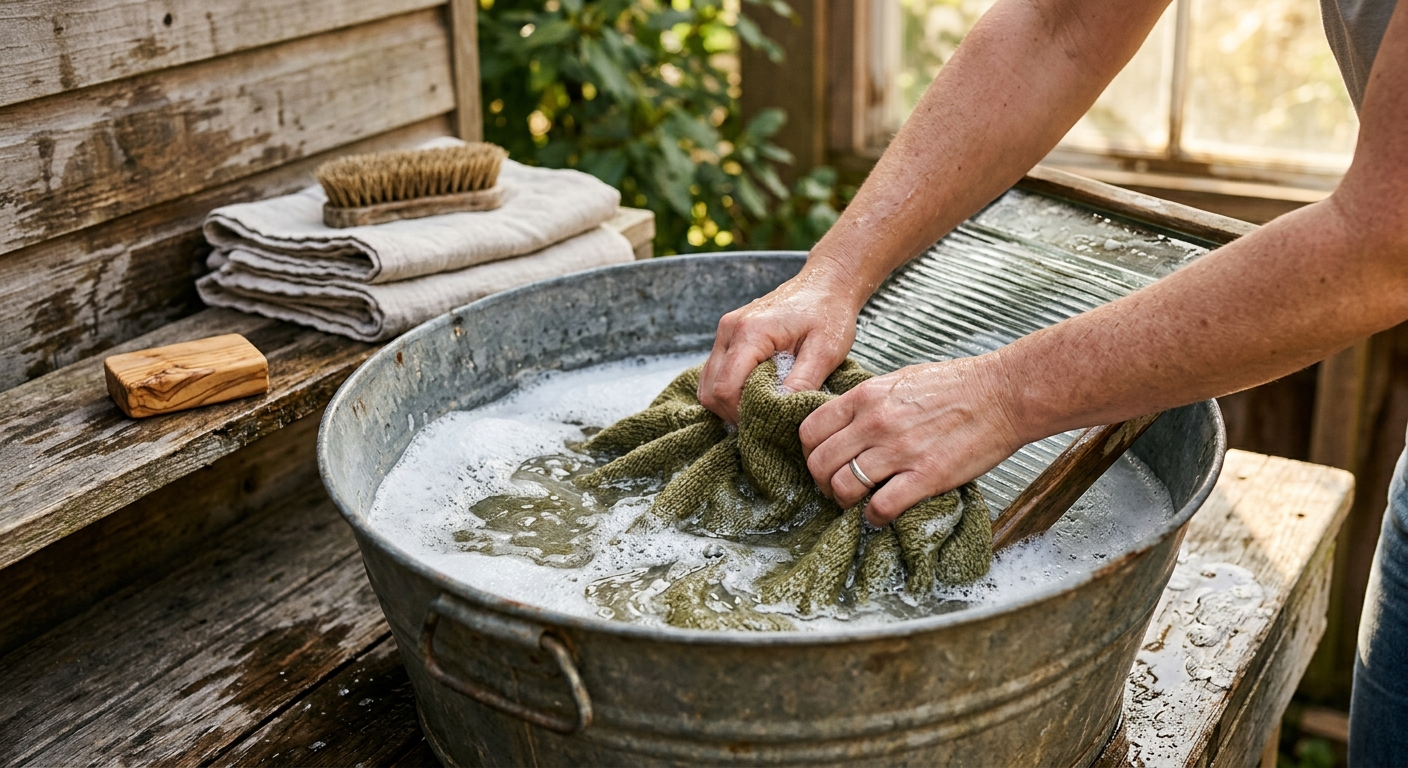
The classic corrugated washboard is not the main cleaning method — it is the finishing tool. Use it after initial agitation to scrub out stubborn stains on knees, collars, and cuffs. A glass or zinc-surface washboard (around $25) lasts a lifetime. Rub the stained area against the corrugations with firm downward pressure while holding the board at a 45-degree angle in the bucket. Thirty seconds of scrubbing removes what 10 minutes of soaking cannot.
Comparison Table: Off-Grid Laundry Methods
| Method | Cost | Effort Level | Capacity per Load | Best For |
|---|---|---|---|---|
| Bucket + Breathing Mobile Washer | $20–$30 | Moderate | 1–2 outfits (3–4 lbs) | Beginners, small daily loads, tight budgets |
| WonderWash Hand-Crank | ~$50 | Low–Moderate | ~5 lbs (2–3 outfits) | Solo/couples, frequent small loads, van life |
| James Washer | ~$200 | Low (crank) | 8–10 lbs | Families, permanent homesteads, heavy use |
| Washboard Only | $20–$35 | High | 1–2 items at a time | Stain removal, supplementing other methods |
Line Drying Tips to Prevent Mildew
How you dry clothes without electricity matters just as much as how you wash them. Clothes left damp for more than 4–6 hours in warm weather will develop mildew — a smell that is almost impossible to remove without rewashing.
- Hang shirts and dresses vertically by the hem, not the shoulders. This allows air to circulate through the garment rather than pooling at the bottom.
- Hang jeans and pants by the waistband on two clothespins. Open fly buttons to allow the crotch area — the thickest part — to dry fully.
- Spread socks and underwear flat on a rack or fence rail rather than folding them over a line. Folded items stay damp at the fold.
- Face the line into the wind whenever possible. Wind is more important than sun for fast drying.
- In humid climates, hang laundry inside near an open window or door if outdoor humidity exceeds 80%. High outdoor humidity actually slows drying and invites mildew.
- If rain catches your laundry before it is dry, wring it again and re-hang. Do not leave soaked laundry bundled up — it mildews within hours in warm weather.
- Drying time reference: A thin cotton t-shirt dries in 1–2 hours in sun and wind. Jeans take 3–5 hours. Heavy towels can take 6–8 hours on a calm day.
Grey Water Reuse for the Garden
Laundry grey water — the used wash and rinse water — is too valuable on an off-grid property to dump. Castile soap and Fels-Naptha are both biodegradable and safe for most garden soils when diluted by rain and soil microbes. Here is how to do it right:
- Use only biodegradable soaps. Avoid bleach, borax, or enzyme-based detergents in any water you plan to reuse in the garden.
- Apply grey water directly to the base of fruit trees and large shrubs — not to vegetable leaves, and not near root vegetables you will eat raw.
- Do not store grey water. Use it the same day or it begins to smell and breed bacteria within 24 hours.
- In dry climates, a single wash load (10–15 gallons) can water 3–4 mature fruit trees. Over a season, that adds up to hundreds of gallons saved.
- Avoid grey water reuse if anyone in the household has a skin infection or gastrointestinal illness — pathogens can persist in the water.
Common Mistakes and How to Avoid Them
Learning how to wash clothes without electricity is mostly about avoiding a handful of errors that turn a manageable chore into a frustrating one.
- Using too much soap: The most common mistake. Excess soap requires multiple extra rinse cycles to remove, wasting time and water. Stick to 1–2 tablespoons per 5-gallon bucket.
- Skipping the pre-soak: For moderately dirty clothes, a 10–15 minute soak before agitation loosens dirt and cuts agitation time in half. Add soap to the water before soaking.
- Washing in cold water for greasy items: Cold water does not dissolve grease or body oils. Heat your wash water to at least 100–110°F for work clothes and kitchen items. Solar heating a bucket in direct sun for 2 hours in summer gets water to this temperature easily.
- Not wringing thoroughly enough: Clothes that carry excess water into the drying phase take far longer to dry and are more prone to mildew. Wring each item twice — once immediately after washing, once after the rinse.
- Washing heavy items with light ones: A pair of jeans in a bucket with socks will cause the socks to be clean after 3 minutes and the jeans to still be dirty after 10. Sort loads by weight and soil level.
- Letting wash water go cold: Agitate immediately after filling. Do not walk away and come back 20 minutes later to find lukewarm soapy water that is far less effective.
The Bottom Line
Washing clothes without electricity is a skill that every off-grid household needs, and it is far more manageable than most people expect once they have the right setup. A $20 Breathing Mobile Washer and two 5-gallon buckets give you a functional laundry system today. Add a $25 washboard for stains, a bar of Fels-Naptha, and a bottle of castile soap, and you have everything you need for under $75 total. For families or full-time homesteaders, stepping up to a WonderWash at $50 or a James Washer at $200 significantly reduces the time and effort required per load.
The biggest wins are the small process details — sorting by load weight, using the right amount of soap, the two-bucket rinse system, and hanging clothes in the right orientation for maximum airflow. Get those right and your laundry will come out clean, dry faster, and last longer than clothes run through a machine with harsh commercial detergents. Grey water reuse ties the whole system together, turning what was waste water into a genuine resource for your garden.
Have questions about your specific situation? Drop them in the comments below — we read every one. If this guide helped you, share it with someone planning their off-grid setup.
Marcus Reid
Founder & Editor, OffGridSage
Marcus founded OffGridSage to bring practical off-grid knowledge together in one place. Guides are built from official and expert sources (NREL, the EPA, the USDA and university extension services), manufacturer documentation and reader feedback, and are updated when information changes.