Off-Grid Toilet Options: A Practical Guide to Going Without Plumbing
Off-Grid Toilet Options: A Practical Guide to Going Without Plumbing
You’ve found your land, you’re planning your homestead, and things are coming together — until you realize you have no plumbing and nature is calling. It’s the question every off-grid newcomer faces: where does the waste go? Whether you’re building a cabin in the Montana mountains, setting up a rural retreat in Tennessee, or converting an old farmstead in the Ozarks, figuring out your sanitation system is one of the most critical decisions you’ll make. Get it wrong and you’re dealing with smell, contamination, legal fines, or worse — a failed health inspection that shuts down your whole operation.
Most people default to « just dig a hole » and quickly learn why that’s a bad idea. Improper human waste disposal contaminates groundwater, breeds pathogens, and attracts pests. Neighbors complain, county inspectors cite you, and if you’re near a well, you’re drinking what you buried six months ago. The stakes are real, and the learning curve is steep for anyone coming from a house with running water and a flush toilet.
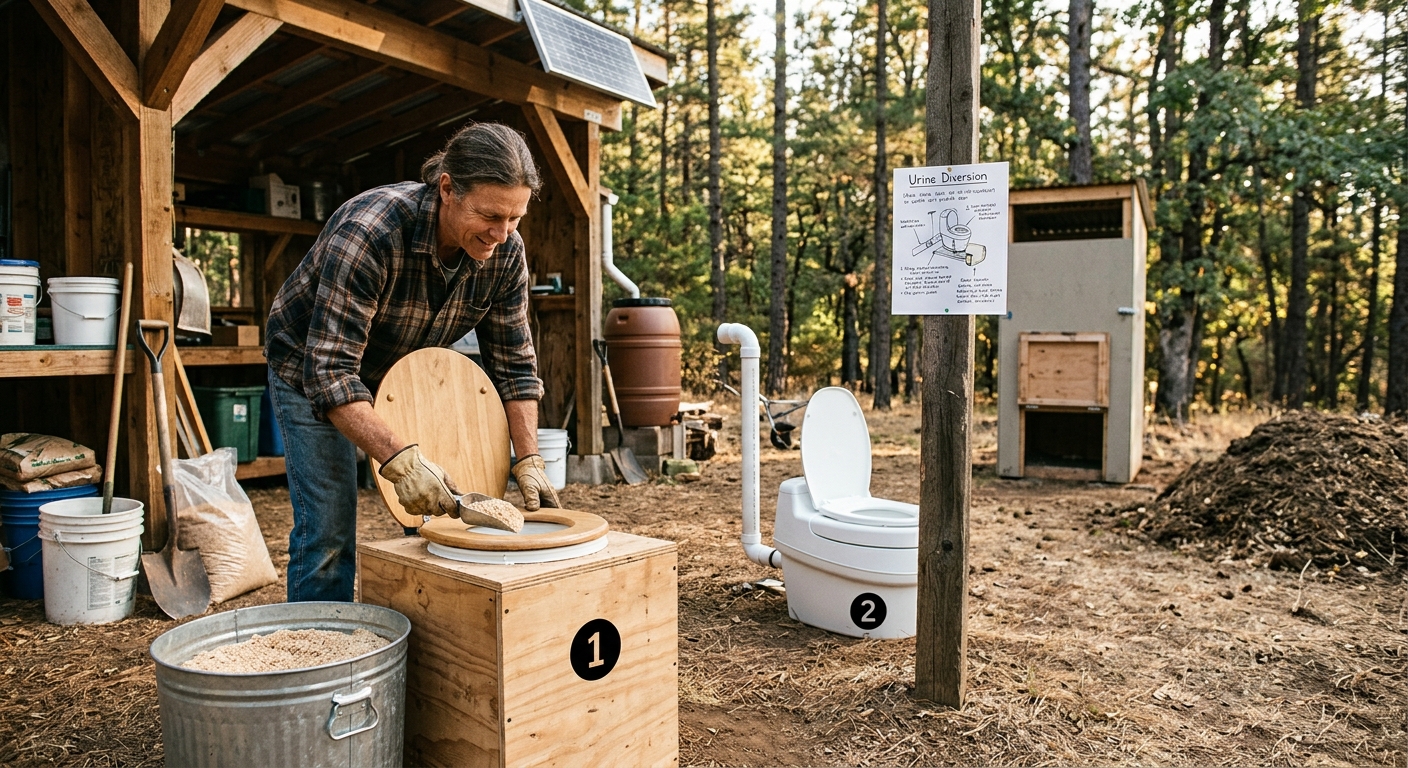
This guide covers every practical off grid toilet option available to American homesteaders in 2026 — from composting toilets and incinerating units to old-fashioned outhouses and emergency bucket methods. You’ll get real costs, honest maintenance requirements, smell ratings, and the legal considerations that can make or break your setup. By the end, you’ll know exactly which system fits your land, budget, and lifestyle.
Quick Answer: What Are Your Main Off-Grid Toilet Options?
There are six primary no-plumbing toilet solutions used on American off-grid properties. Each works best in different situations based on budget, land size, local regulations, and how many people will be using the system.
- Composting toilets — $900–$2,500, low water use, requires maintenance, legal in most states
- Incinerating toilets — $3,000–$4,500, no water needed, burns waste to ash, high operating cost
- Pit latrines / outhouses — $200–$800 DIY, low tech, requires proper placement and permits
- Bucket toilet with sawdust (humanure) — $30–$80, lowest cost, requires careful composting management
- Portable camping toilets — $30–$150, short-term only, requires chemical or compostable bags
- Off-grid septic system — $3,000–$15,000+, best for permanent homes, requires permits and soil testing
Composting Toilets: The Most Popular Off-Grid Choice
Composting toilets are the go-to solution for serious off-grid homesteaders across the US. They use aerobic decomposition — the same biological process as a backyard compost pile — to break down human waste into a dry, odorless material that can be used as soil amendment. No water required for flushing, no holding tanks, and when managed properly, almost no smell.
Self-Contained vs. Central System Composting Toilets
Self-contained units like the Nature’s Head ($1,100–$1,200) and the Sun-Mar Excel ($1,300–$1,600) house everything in a single unit that sits in your bathroom. They work well for one to two people on a full-time basis or up to four people part-time. The Nature’s Head is arguably the most popular self-contained unit in the off-grid community — it’s compact, has a spider handle agitator to mix the composting mass, and separates liquid from solid waste to dramatically reduce odor. Expect to empty the solids tray every four to six weeks for one or two full-time users.
Central system composting toilets — brands like Clivus Multrum and BioLet — use a low-profile toilet seat connected by a chute to a larger composting chamber installed below the floor or in a basement. These handle more users and require less frequent emptying (once or twice a year), but installation is more complex and costs run $1,800–$2,500 for the unit alone, plus labor if you hire out the work.
Maintenance and What to Expect
Every composting toilet requires a carbon additive — peat moss, coconut coir, or wood shavings — added after each solid use. This balances the carbon-to-nitrogen ratio and keeps the pile from going anaerobic (which is what causes smell). Most units include a small fan (12V or 120V) that vents odor outside through a 1.5-inch pipe. If your unit smells, it’s almost always a sign that moisture is too high or airflow is inadequate — not a fundamental flaw in the technology.
Finished compost from a properly managed composting toilet is safe to use on fruit trees and non-edible plants. For vegetable gardens, let the finished material cure an additional six months to meet most state guidelines.
Cost Summary
- Nature’s Head self-contained: $1,100–$1,200
- Sun-Mar Excel: $1,300–$1,600
- Central system (Clivus Multrum): $1,800–$2,500
- Annual supplies (peat, coir): $50–$100
Incinerating Toilets: No Water, No Compost, Just Ash
Incinerating toilets burn waste at high temperatures — around 1,000°F — reducing it to a small amount of sterile ash. The Cinderella Freedom (propane) and Cinderella Comfort (electric) are the dominant brands in the US market, retailing at $3,200–$4,200 depending on the model. They require no water, no composting medium, and produce no leachate. Each use requires inserting a paper liner bowl into the toilet; the liner and waste are incinerated together.
The propane version is ideal for remote locations where grid power is unavailable. A standard 20-pound propane tank lasts roughly 60–80 cycles. The electric model draws 1.5–1.8 kWh per incineration cycle, which adds up fast for off-gridders relying on solar. Incineration takes 45–75 minutes after each use, during which the toilet is unavailable — a real inconvenience for families.
The major advantages: truly zero waste stream, zero water, no smell during normal operation, and virtually no maintenance beyond emptying a small ash container every few weeks. The major disadvantages: high upfront cost, ongoing fuel cost, long cycle times, and a distinctive burning odor that vents outside (neighbors may notice). Incinerating toilets make the most sense for remote single-occupant cabins or hunting camps where simplicity matters more than operating cost.
Pit Latrines and Outhouses: Low-Tech, Long-Proven
The pit latrine is one of humanity’s oldest sanitation solutions, and it still works — when done right. A proper outhouse requires a pit at least 3 to 4 feet deep (6 feet is better for longevity), positioned a minimum of 100 feet from any water source, well, creek, or drainage area. Most county health codes specify this setback requirement explicitly; violating it is how rural properties get cited and shut down.
Ventilation is what separates a tolerable outhouse from a miserable one. Install a 4-inch vent pipe rising at least 2 feet above the roof, capped with a mesh screen to keep flies out. Dark interior, light-colored exterior: flies enter through the seat, see light at the vent, and fly out. This passive ventilation system, known as a VIP (Ventilated Improved Pit) design, dramatically reduces both odor and insect problems without electricity or chemicals.
Cost to build a basic outhouse structure runs $200–$800 depending on materials and whether you hire labor. Expect to dig a new pit every 3–10 years depending on usage and soil type. In clay-heavy soils, pits fill faster; sandy soils allow better leaching. Never use chemical toilet treatments in a pit — they kill the bacteria doing the decomposition work.
Permit note: Many rural counties require a permit for a pit latrine, especially as a primary sanitation system. Some states (California, Washington, Florida) have near-blanket restrictions on pit latrines as permanent systems. Always check with your county health department before digging.
Bucket Toilet and the Humanure Method
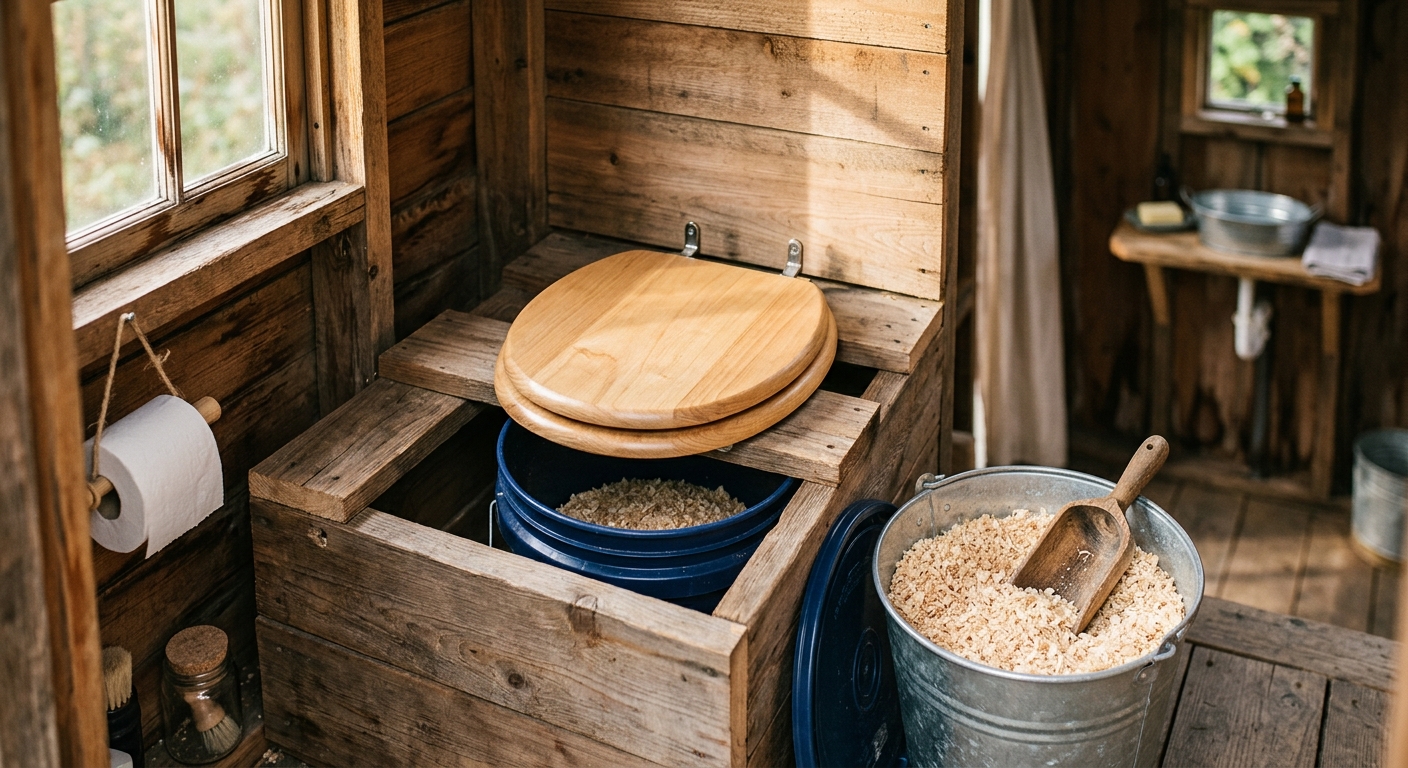
The bucket toilet, popularized by Joseph Jenkins in his book The Humanure Handbook, is the lowest-cost off grid toilet option available. A 5-gallon bucket, a toilet seat lid that clips onto it ($15–$30), and a supply of wood shavings or sawdust are all you need. After each use, cover the waste with a generous handful of sawdust. The carbon material suppresses odor immediately and initiates the composting process.
The collected material is emptied into a dedicated outdoor compost pile — not a garden bed — that reaches thermophilic (hot) composting temperatures of 130–160°F. At these temperatures, pathogens including E. coli and Salmonella are killed within a few days. Jenkins advocates for a two-stage system where material composts for a full year before use, providing a substantial safety buffer.
Safety considerations are real: if you skip the hot composting stage and apply fresh humanure to a garden, you risk pathogen transfer. The system also requires discipline — consistent sawdust use, proper pile management, and temperature monitoring if you plan to use the finished compost. For short-term situations or as a backup system, the bucket toilet is cheap and effective. As a permanent primary system, it demands more commitment than most people expect.
Total startup cost: $30–$80. Ongoing cost: minimal if you have access to free wood shavings from a sawmill or woodworker.
Portable Camping Toilets: Fine for the Short Term
Brands like Reliance Products make self-contained portable toilets in the $30–$150 range. These typically feature a freshwater flush mechanism and a lower holding tank that seals for transport. They’re designed for camping trips, not permanent habitation. For short-term use — while you’re building your permanent system, hosting seasonal visitors, or during a power outage — they work fine.
The holding tank needs emptying at an RV dump station or approved disposal site every few days for regular use. Chemical additives (blue fluid) control odor in the tank but are not compostable and cannot go on garden soil. If you’re committed to a zero-chemical approach, compostable bag inserts are available for basic bucket-style portable units. Reliance’s Hassock Portable Toilet ($45–$55) is a solid budget option for emergency use.
Off-Grid Septic Systems: When Full Infrastructure Makes Sense
If you’re building a permanent home and your county allows it, a conventional septic system is worth serious consideration — even off-grid. A septic system consists of a holding tank (typically 1,000–1,500 gallons) that separates solids from liquids, and a drain field where treated liquid effluent percolates into the soil. It handles all household greywater and blackwater, requires no daily user input, and typically needs pumping every 3–5 years ($300–$500 per pump-out).
Total installed cost ranges from $3,000 for a basic system on good soil to $15,000+ for an engineered mound system on problematic soil (clay, high water table, steep slopes). A perc test (percolation test) is required to determine if your land qualifies, and a permit is mandatory in every US state. This is the highest-cost option upfront, but for a family of four in a permanent home, it’s often the most practical long-term solution — especially if you’re using a rainwater collection system and have water to flush with.
Off-Grid Toilet Comparison Table
| Option | Upfront Cost | Annual Maintenance Cost | Water Use | Smell Rating (1=best, 5=worst) | Permit Required? |
|---|---|---|---|---|---|
| Composting Toilet (self-contained) | $900–$1,600 | $50–$100 | None | 2 | Varies by state |
| Composting Toilet (central system) | $1,800–$2,500 | $75–$150 | None | 1 | Varies by state |
| Incinerating Toilet (Cinderella) | $3,200–$4,200 | $200–$600 (fuel) | None | 2 | Varies by state |
| Pit Latrine / Outhouse | $200–$800 | Minimal | None | 3 | Often yes |
| Bucket Toilet (humanure) | $30–$80 | Near zero | None | 2 (with sawdust) | Rarely regulated |
| Portable Camping Toilet | $30–$150 | $50–$150 (chemicals/bags) | Low | 3 | No |
| Off-Grid Septic System | $3,000–$15,000+ | $100–$200 (pump-outs) | Moderate (flush water) | 1 | Yes (all states) |
Legal Considerations: The Rules You Cannot Ignore
Sanitation law in the US is handled at the county and state level, which means there’s no single national standard. What’s perfectly legal in rural Montana may be prohibited in suburban Tennessee. Here are the key legal realities you need to understand before installing any off grid toilet option.
- Permits are often required even for composting toilets. Many counties require a permit for any alternative sanitation system, and some require that a licensed plumber or contractor install the unit. Call your county health department first — not after the unit arrives.
- Pit latrines are restricted or banned in many coastal and high-density states including California, Florida, New Jersey, and Washington. Even in rural states, the primary-use restriction matters: some counties allow a pit latrine as a temporary or secondary system only.
- Greywater is a separate issue. Even if your composting toilet handles all solid waste, sink, shower, and laundry water (greywater) still needs to be managed — either through a greywater system, a small septic tank, or a constructed wetland. This catches many off-gridders off guard.
- Humanure composting is generally unregulated at the residential level in most states as long as it occurs on your property, but applying the finished compost commercially or selling it is a different story entirely.
- The 100-foot setback rule for pit latrines and outhouse structures from wells and water bodies is standard in most jurisdictions but may be 150 or 200 feet in some states. Measure twice, dig once.
Common Mistakes and How to Avoid Them
- Skipping the permit process. This is the single most common and costly mistake. A $1,200 composting toilet can turn into a $5,000 problem if an inspector orders you to remove a non-permitted system. Do the paperwork first.
- Buying a unit too small for your household. Self-contained composting toilets are generally rated for one to two people full-time. Four adults using a Nature’s Head daily will overwhelm it. Size up or plan to empty very frequently.
- Neglecting the venting system. Every composting toilet and outhouse depends on airflow to control odor. A blocked or undersized vent pipe is the cause of 90% of smell complaints. Use the manufacturer’s recommended pipe diameter and keep the run as straight as possible.
- Using bleach or chemical cleaners near a composting toilet. Bleach kills the microbes doing the composting. Use only enzyme-based or biodegradable cleaners on any surfaces near the unit.
- Not planning for greywater. Greywater from a kitchen sink or shower can be five times the volume of toilet waste. A composting toilet handles blackwater only — you still need a plan for everything else.
- Placing an outhouse uphill from a water source. Rainwater running through or over a pit latrine will carry contaminants downhill. The 100-foot setback rule assumes downhill distance — uphill placement requires even greater separation.
The Bottom Line
There is no single best off grid toilet option — the right choice depends on your budget, how many people will use it, your local regulations, and how hands-on you’re willing to be with maintenance. For most permanent off-grid homesteads with one or two adults, a self-contained composting toilet like the Nature’s Head hits the sweet spot: reasonable upfront cost, no water required, manageable maintenance, and legal in the majority of US states. Families or larger households should look seriously at a central composting system or, if the land supports it, a full septic installation. Outhouses remain a valid low-cost option in rural counties where they’re permitted, and the humanure bucket method is a genuinely effective emergency or supplemental system when managed correctly.
Whatever system you choose, check with your county health department before you spend a dollar on equipment. Sanitation regulations are the unglamorous backbone of off-grid living, and getting them right protects your land, your water, your health, and your ability to stay on that property long-term. The homesteaders who thrive are the ones who do this groundwork early — not the ones scrambling to fix a code violation after the inspector shows up.
Have questions about your specific situation? Drop them in the comments below — we read every one. If this guide helped you, share it with someone planning their off-grid setup.
Marcus Reid
Founder & Editor, OffGridSage
Marcus founded OffGridSage to bring practical off-grid knowledge together in one place. Guides are built from official and expert sources (NREL, the EPA, the USDA and university extension services), manufacturer documentation and reader feedback, and are updated when information changes.