
Best DIY Off-Grid Solar Guides and Courses (2026 Review): Build Your Own Solar System the Right Way
You’ve spent hours on YouTube watching someone wire up a 400-watt solar panel to a battery bank. The video looks straightforward — positive to positive, negative to negative, run it through a charge controller, done. Then you go to replicate it at your own homestead, and nothing quite works out. Your batteries keep dying early. Your inverter trips breakers. You’re not sure if your panels are even sized right for what you’re trying to run. Sound familiar? That’s because most free online tutorials show you the how but skip the why — and in a diy solar power system guide, the « why » is everything.
The gap between watching someone install solar and actually building a system that works reliably for your specific loads is enormous. A YouTube video can show you wire colors and connector types. What it almost never covers is how to calculate your daily amp-hour consumption, how to match panel wattage to battery capacity to charge controller amperage, how to account for your region’s peak sun hours, or what happens when you mix two different battery chemistries. Get any of those wrong and you’re looking at a system that underperforms at best — and at worst, one that starts a fire or leaves you in the dark in January when you need power most.
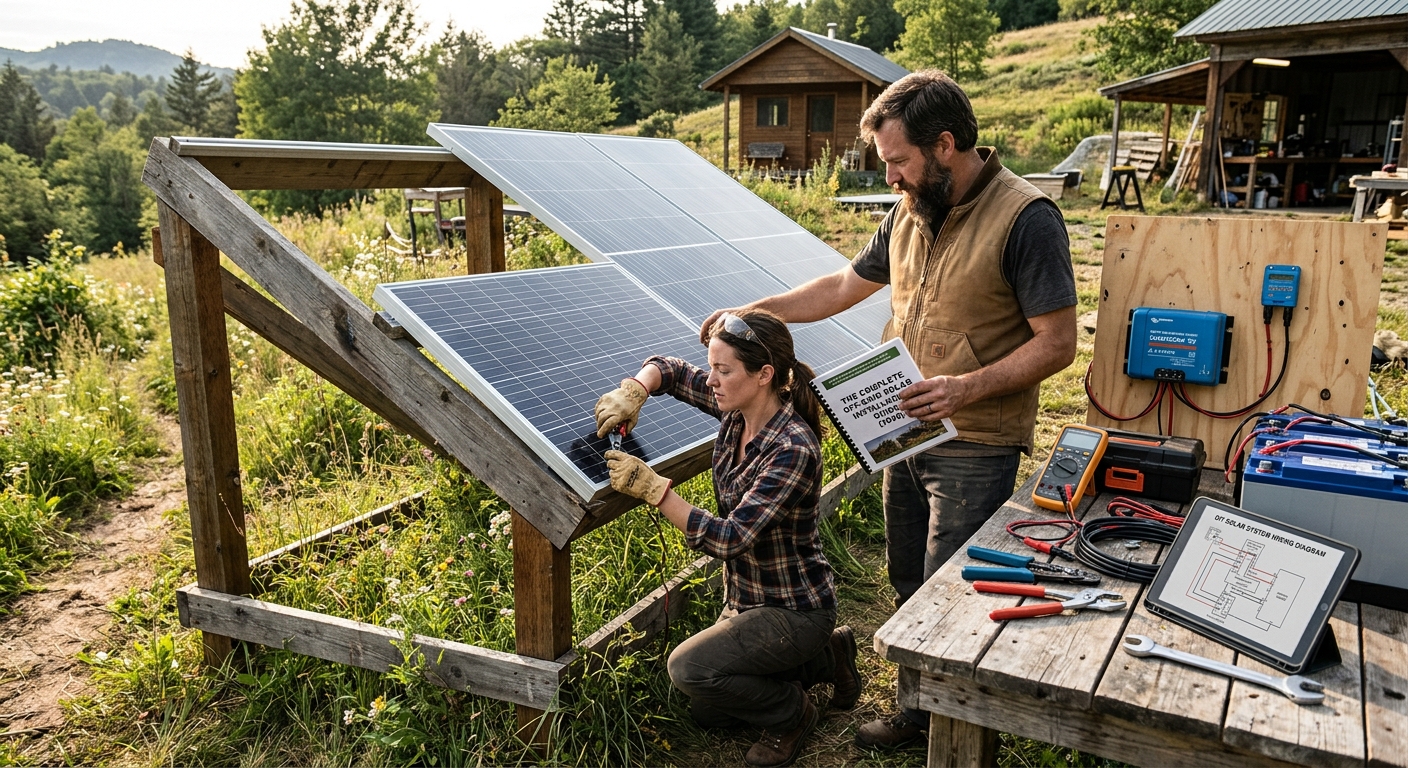
This review covers the best structured DIY off-grid solar courses, guides, and free tools available in 2026. We’ll walk through what separates a genuinely useful guide from marketing fluff, highlight our top-rated course for beginners and intermediates, point you to the best free resources, and give you a step-by-step overview of the actual solar build process so you go in with your eyes open. Whether you’re planning a small cabin system or a full whole-home off-grid setup, this guide gives you the roadmap.
Quick Answer: What Is the Best DIY Solar Power System Guide in 2026?
For most beginners, the Power Grid Generator guide (ClickBank) is the most practical structured course available. For free tools, NREL’s PVWatts calculator and EnergySage’s solar calculator cover sizing fundamentals. For YouTube, Will Prowse’s DIY Solar Power with Will Prowse channel is the gold standard. Here’s the fast breakdown:
- Best paid course: Power Grid Generator — step-by-step, covers sizing, wiring, and battery management
- Best free sizing tool: NREL PVWatts (pvwatts.nrel.gov) — calculates expected output by ZIP code
- Best free YouTube channel: DIY Solar Power with Will Prowse
- Best reference book: Wiring a 12V Electrical System by Kevin Jeffrey
- Typical small off-grid system cost (DIY): $1,200 – $3,500 depending on battery type and load requirements
- Time to complete a basic DIY install: 2–4 weekends with good documentation
What Makes a Good DIY Solar Power System Guide?
Not all solar guides are created equal. The off-grid solar space has exploded with content — some excellent, most mediocre. Before you invest time or money in a course, here’s what to look for.
Load Calculation and Sizing Math
This is the single most important section any guide can have, and most free content skips it entirely. A proper diy solar power system guide walks you through calculating your daily watt-hour consumption by listing every load (lights, refrigerator, pump, laptop, phone chargers), estimating daily runtime, and totaling your energy budget. From that number, you back-calculate panel wattage, battery bank capacity (accounting for depth of discharge limits), and charge controller amperage. Without this, you’re guessing — and guessing in solar is expensive.
Component Compatibility
Panels, charge controllers, batteries, and inverters are not plug-and-play in every combination. A 24V battery bank paired with a 12V charge controller is a wiring disaster. A 3,000-watt inverter on a 100Ah lithium battery will trip protection circuits within minutes under load. Good guides spell out voltage compatibility, wiring gauge requirements (American Wire Gauge standards matter here — undersizing wire is a fire risk), and fuse placement between every component.
Battery Chemistry and Management
Flooded lead-acid, AGM, gel, and lithium iron phosphate (LiFePO4) all behave differently, charge differently, and require different management. LiFePO4 batteries have essentially taken over the DIY off-grid market because of their cycle life (2,000–5,000 cycles vs. 300–500 for lead-acid) and depth of discharge (80–100% vs. 50% for lead-acid). A quality guide explains these trade-offs and tells you how to configure your charge controller’s absorption and float voltages for each chemistry.
Real Worked Examples and Wiring Diagrams
Theory only gets you so far. The guides that actually help beginners succeed include complete system diagrams — labeled wire gauges, fuse ratings, breaker locations, and component specs — for multiple system sizes (400W cabin system, 1,200W homestead system, 3,000W whole-home system). These give you a proven template to start from rather than building from scratch.
Safety Standards
Off-grid solar installations that involve battery storage must comply with NEC Article 690 (Solar Photovoltaic Systems) and NEC Article 706 (Energy Storage Systems). A trustworthy guide references these standards, covers overcurrent protection requirements, and explains ground fault protection. This matters most if you ever want to get a property inspection or insurance coverage.
Top Paid Course: Power Grid Generator — Our #1 Pick for Beginners
After going through every major paid solar course available online, the Power Grid Generator guide consistently stands out as the most beginner-accessible without sacrificing depth. Here’s what it actually covers and why it earned the top spot in our 2026 review of build your own solar system resources.
What the Power Grid Generator Guide Covers
The guide is structured as a complete build-from-scratch walkthrough. It opens with the load calculation worksheet — arguably the most valuable part — that forces you to itemize every electrical load before you spend a single dollar on hardware. That worksheet alone saves most beginners from buying panels or batteries that are wildly undersized or oversized for their needs.
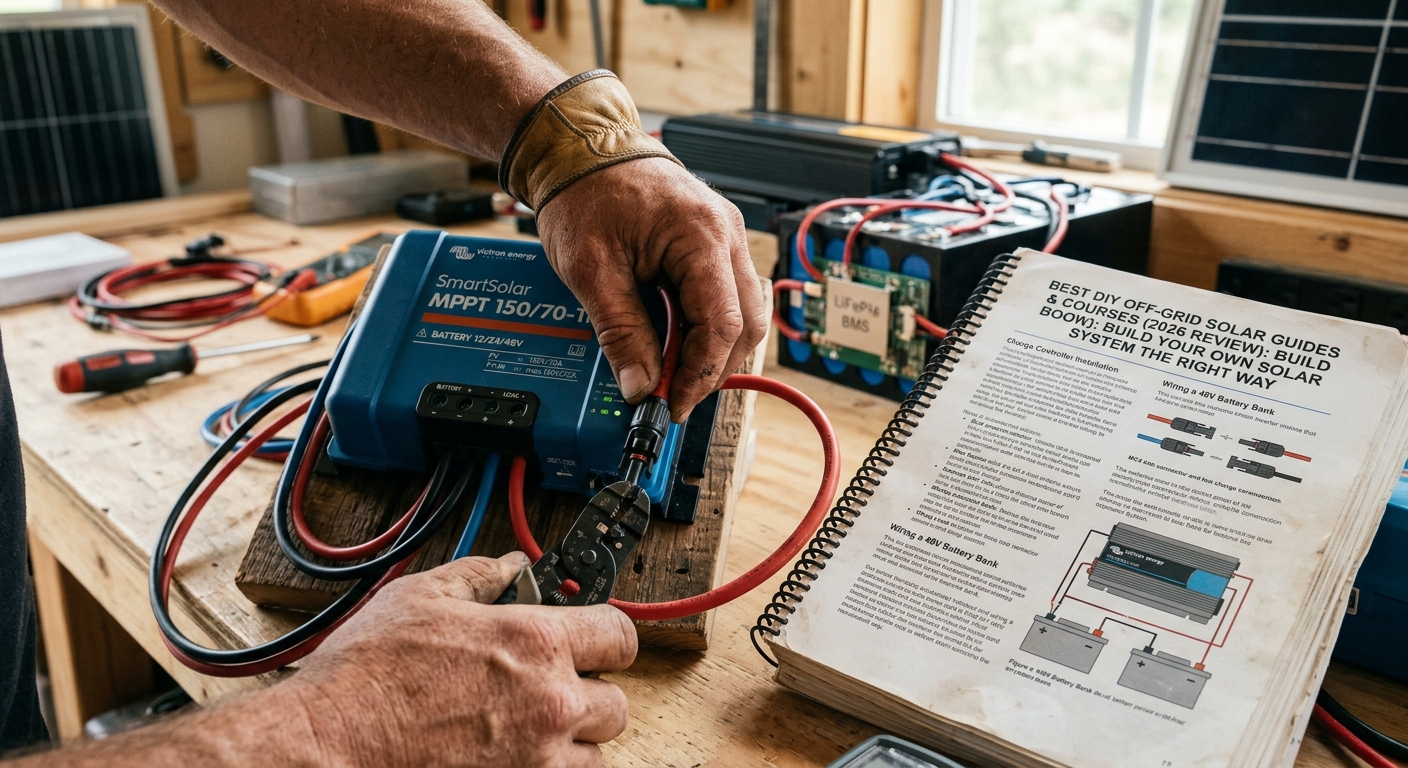
From there, it moves into component selection: how to evaluate panel specifications (Voc, Vmp, Isc, Imp), how to match a MPPT charge controller to your panel array voltage, and how to select an inverter with enough surge capacity for motor loads like well pumps and refrigerators. The wiring section includes full-color diagrams for 12V, 24V, and 48V system configurations — sized and labeled with wire gauge, fuse ratings, and terminal specifications.
The battery section is particularly strong. It covers LiFePO4 battery banks in depth, including how to wire cells in series vs. parallel to achieve your target voltage and capacity, how to program a Battery Management System (BMS), and how to set charge parameters on Victron, Renogy, and EPever charge controllers. It also includes a troubleshooting section that addresses the most common failure points: undercharged batteries, voltage drop issues, charge controller errors, and inverter shutdowns under load.
Real system examples are included for a 600W cabin setup (two 300W panels, 100Ah LiFePO4, 40A MPPT, 1,000W inverter) and a 2,400W homestead setup (eight 300W panels in two strings, 200Ah LiFePO4 at 48V, 60A MPPT, 3,000W hybrid inverter). Both examples come with full component lists and estimated costs at 2025–2026 pricing.
No engineering background required. The math involved is arithmetic — multiplication and division — and every formula is walked through step by step. Thousands of homesteaders have followed this exact blueprint to build working systems.
⚡ Our Top Pick for Beginners
After reviewing every major off-grid solar course available, the Power Grid Generator guide stands out as the most practical for beginners — step-by-step wiring diagrams, real system examples, and no engineering degree required. Thousands of homesteaders have built working systems following this exact blueprint.
*Affiliate link — we may earn a commission at no cost to you.
Best Free Resources for DIY Off-Grid Solar
Paid guides accelerate your learning, but the free tools available in 2026 are genuinely excellent for certain parts of the planning process. Use these alongside a structured course, not as a replacement.
NREL PVWatts Calculator (pvwatts.nrel.gov)
This free tool from the National Renewable Energy Laboratory is the most accurate way to estimate how much electricity a solar array will produce at your specific location. You enter your ZIP code, array size in kilowatts, tilt angle, and azimuth (compass direction the panels face), and PVWatts returns estimated monthly and annual output in kilowatt-hours. This is essential for sizing your system to your actual location’s solar resource — a 1,200W array in Phoenix, Arizona produces dramatically more power than the same array in Seattle, Washington. Use this before you buy a single panel.
EnergySage Solar Calculator (energysage.com)
EnergySage built their calculator primarily for grid-tied systems, but the load and sizing sections work perfectly for off-grid planning. It helps you convert monthly kWh consumption (from your past utility bills or estimated loads) into daily energy budgets and approximate panel and battery requirements. It’s a good sanity check against your own calculations.
DIY Solar Power with Will Prowse (YouTube)
Will Prowse is the most trusted voice in the DIY off-grid solar YouTube space, full stop. His channel has over a million subscribers and his content is technically accurate, regularly updated, and deeply practical. His battery comparison videos — particularly his LiFePO4 discharge testing series — are the best consumer-level battery reviews available anywhere online. His build walkthroughs for van and cabin systems are excellent for visual learners. Watch his « How to Size a Solar System » video before you start planning. It’s free and it covers the fundamentals better than most paid courses.
Kevin Jeffrey — Wiring a 12V Electrical System
This book has been the reference standard for small 12V off-grid electrical systems for years. It’s particularly useful if you’re building a cabin, van conversion, or boat system where 12V DC power is your primary distribution voltage. It covers wire sizing, fuse and breaker selection, connector types, and system layout in clear, practical language. Available through Amazon for around $20–$25. Not a full solar sizing guide on its own, but an excellent companion to a more comprehensive course.
What to Know Before Buying Any Solar Course
The best diy solar power system guide in the world won’t help you if you buy it before you’ve answered a few basic questions about your own situation. Get clear on these before you spend money on courses or hardware.
What Is Your System Size?
Small cabin or weekend retreat systems (400–800W of panels, 100–200Ah of battery storage) have very different requirements than full-time homestead systems (2,000–5,000W of panels, 400–800Ah at 48V). The component selection, wiring complexity, and permitting requirements are all different. Knowing your approximate load target before you start will help you choose the right course and the right system architecture.
AC Loads vs. DC Loads
AC loads (standard household appliances) require an inverter to convert DC battery power to 120V AC. DC loads (12V or 24V lighting, pumps, fans, USB devices) can run directly from the battery bank without conversion losses. An inverter adds cost, complexity, and efficiency losses of 5–15%. Many off-grid builders minimize AC loads to simplify their system. Decide which loads matter most to you before sizing anything.
Battery Chemistry Choice
For new builds in 2026, LiFePO4 is the right choice for most people. The price gap with lead-acid has closed significantly — you can buy a 100Ah 12V LiFePO4 battery for $200–$280 — and the cycle life and depth-of-discharge advantages make it the better long-term value in virtually every scenario. The main exceptions are extremely tight budgets or environments with chronic temperature extremes below 32°F, where lithium charging protection circuits shut down and lead-acid remains more forgiving.
EZ Battery Reconditioning — Extend Your Battery Life
If you already have a flooded lead-acid battery bank or you’re working with older AGM batteries, reconditioning can significantly extend their usable life before replacement. The EZ Battery Reconditioning guide covers the desulfation and equalization processes that can recover capacity in sulfated lead-acid cells — a common problem in systems that have been chronically undercharged. Worth considering if you’re working with existing lead-acid infrastructure rather than starting fresh with lithium.
Step-by-Step DIY Solar System Build Process
Every off-grid solar build follows the same core sequence, regardless of system size. Here’s the process from start to finish — the overview that most courses use as their backbone.
| Step | Task | Key Output |
|---|---|---|
| 1 | Load Calculation | Daily watt-hour budget (e.g., 1,800 Wh/day) |
| 2 | Panel Selection and Sizing | Total panel wattage based on peak sun hours and system losses |
| 3 | Battery Bank Sizing | Amp-hour capacity at target voltage (12V, 24V, or 48V) |
| 4 | Charge Controller Selection | MPPT controller rated for your array Voc and current |
| 5 | Inverter Sizing | Continuous wattage + surge rating covers all AC loads |
| 6 | Wiring and Fusing | Wire gauge chart, fuse sizing, terminal torque specs |
| 7 | System Commissioning | Voltage checks, charge profile programming, load testing |
| 8 | Monitoring Setup | Shunt-based battery monitor (Victron BMV-712 recommended) or BMS app |
Common Beginner Mistakes in DIY Solar Installations
Learning from mistakes is fine when the stakes are low. With a solar build, some mistakes cost hundreds of dollars or create genuine safety hazards. These are the ones beginners make most often.
Undersizing the Battery Bank
The most common error, hands down. Beginners calculate their daily load (say, 1,500 Wh) and buy a battery that holds exactly 1,500 Wh. But with lead-acid you can only use 50% of rated capacity before causing damage — so you actually need 3,000 Wh of rated capacity. Even with LiFePO4 at 80% DoD, you should build in at least 25% buffer for cloudy days and degradation over time. Undersized batteries cycle too deeply, wear out prematurely, and leave you without power on your first overcast week.
Using the Wrong Wire Gauge
Low-voltage DC systems carry high current to deliver the same power as high-voltage AC. A 1,000W load at 12V draws 83 amps. Running 83 amps through 10 AWG wire (rated for ~30A) is a fire waiting to happen. Always use a wire ampacity chart and derate for temperature. The runs between your battery bank and inverter typically require 2/0 AWG or 4/0 AWG cable on 12V systems — much heavier than most beginners expect.
Skipping Fuses Between Components
Every conductor in a DC system needs overcurrent protection as close to the power source as possible. That means a fuse or breaker within 18 inches of every battery terminal connection. Missing this step turns a short circuit into a fire. It is not optional, and it is referenced in NEC 690 and 706 for permitted installations.
Mixing Battery Types or Ages
Wiring two batteries of different ages or different chemistries in parallel forces the newer/stronger battery to constantly compensate for the weaker one. The result is accelerated degradation of the stronger battery and chronic underperformance of the bank. Always build a battery bank from matched cells or matched-spec batteries purchased at the same time.
Ignoring Peak Sun Hours for Your Location
A 400W panel array does not produce 400 watts times 8 hours equals 3,200 Wh per day. It produces 400W times your location’s peak sun hours (typically 3.5–5.5 hours in the continental US) times a system efficiency factor (typically 0.75–0.80). In Oregon in December, you might get 2.5 peak sun hours. In Texas in July, you might get 6.5. Use PVWatts to get accurate numbers for your ZIP code before you finalize any sizing calculation.
No Monitoring After Installation
Installing a system without a battery monitor is like driving without a fuel gauge. You have no idea how depleted your batteries are getting overnight, how much your panels are actually producing, or when something starts behaving abnormally. A Victron BMV-712 shunt monitor costs around $80–$100 and connects via Bluetooth to your phone. It is one of the best investments in a DIY solar build and most beginners skip it entirely.
The Bottom Line
Building a working off-grid solar system is completely achievable for a motivated DIYer — but only with the right information in the right order. The key steps are: calculate your loads before you touch a component, size your battery bank with adequate buffer, match every component in your system for voltage and current compatibility, wire everything with correct gauge and overcurrent protection, and monitor your system after installation so you can catch problems early. Most failures come from skipping one of those steps, not from the technology itself being difficult.
For the best structured walkthrough of that entire process — from load calculation through full system commissioning — the Power Grid Generator guide is the resource we recommend most to beginners. It covers every stage of the build, includes real system examples at multiple scales, and is written in plain language that does not require an electrical engineering background. Pair it with the free PVWatts tool for location-specific sizing data and Will Prowse’s YouTube channel for visual walkthroughs, and you have everything you need to build a reliable off-grid solar system in 2026.
Have questions about your specific situation? Drop them in the comments below — we read every one. If this guide helped you, share it with someone planning their off-grid setup.