Bug-Out Bag Checklist for Beginners: Everything You Actually Need
Bug-Out Bag Checklist for Beginners: Everything You Actually Need
Picture this: a wildfire is six miles away and moving fast, the sheriff’s deputy just knocked on your door with a mandatory evacuation order, and you have twenty minutes to grab what you can and go. Most people freeze. They grab the dog, a phone charger, and maybe a bag of chips — then spend the first night in a shelter cot wishing they had deodorant, a phone battery, and a plan. That moment, right there, is exactly what a bug-out bag is designed to prevent.
A bug-out bag — sometimes called a « go bag » or a 72-hour kit — is a pre-packed backpack that lets you leave your home in minutes and survive comfortably for at least three days without any outside help. The problem is that most beginner guides are either overwhelming survival-fantasy lists full of $800 gear, or dangerously thin lists that skip critical items. Both will fail you in a real emergency.
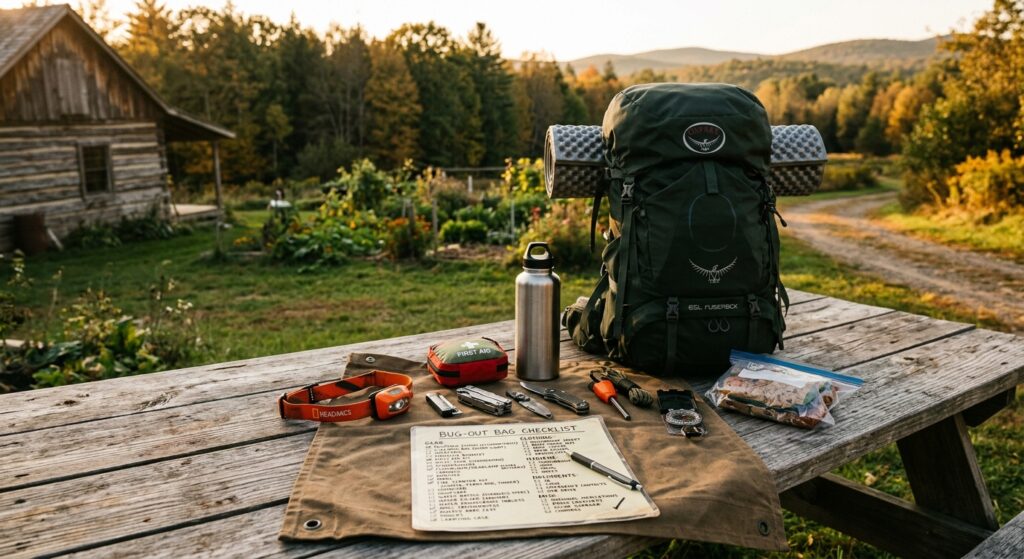
This guide gives you a practical, category-by-category bug-out bag list for beginners grounded in the six survival priorities — water, food, shelter, fire, first aid, and communication. You will learn the right bag weight, how to choose a pack, how to build separate bags for kids, and how to think past the 72-hour window. By the end, you will know exactly what to buy, what to skip, and how to pack it all in one afternoon.
Quick Answer: What Goes in a Bug-Out Bag?
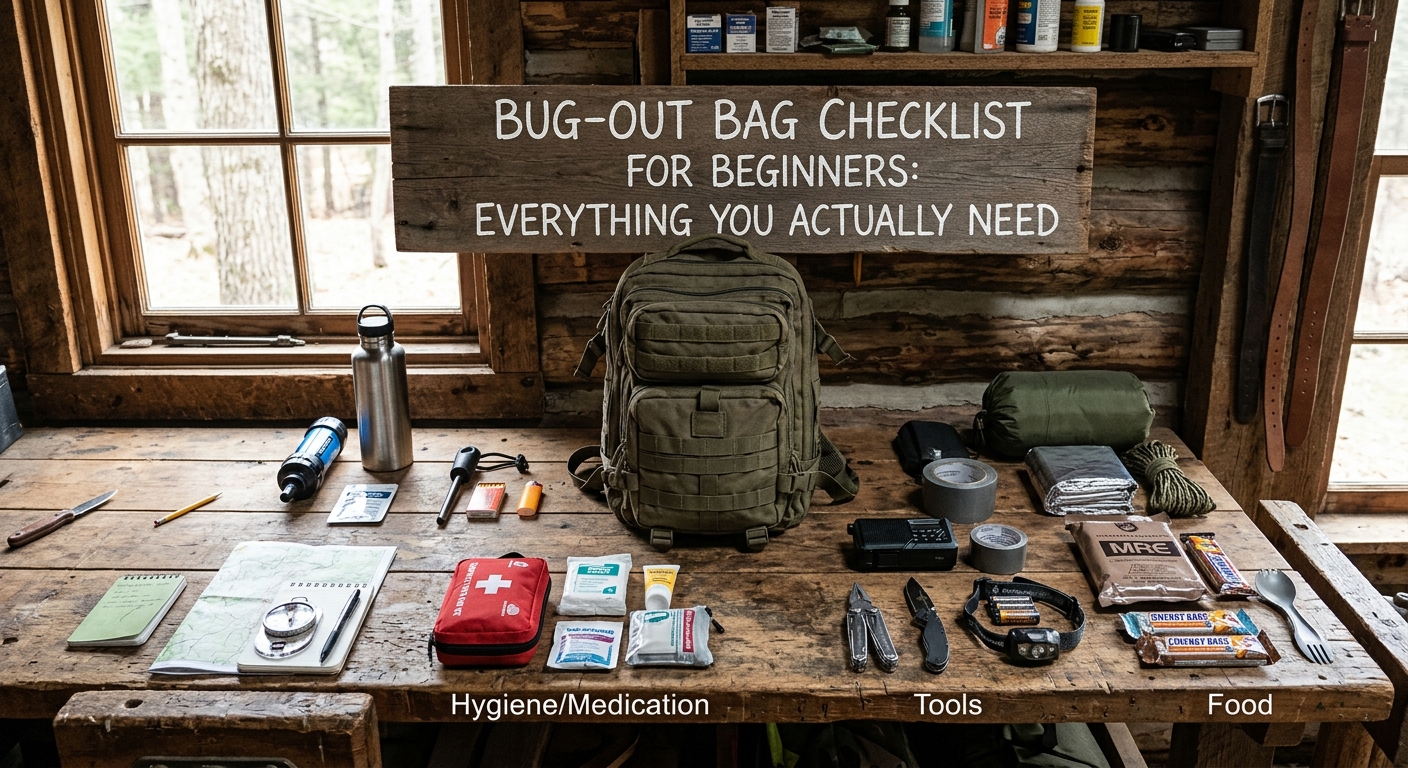
A complete bug-out bag for beginners covers six survival priorities across roughly 20 to 30 core items, kept under 15% of your body weight. For a 160-pound adult, that is 24 pounds maximum. Here is the bird’s-eye view before we go item-by-item:
- Water: filter, purification tablets, 2-liter collapsible bottle
- Food: 3 days of 2,000-calorie emergency bars, metal spork
- Shelter: emergency bivy, compact tarp, 50 feet of 550 paracord
- Fire: lighter, ferro rod, dry tinder kit
- First Aid: stop-the-bleed kit, personal medications, prescription copies
- Navigation: paper map, baseplate compass, phone backup battery
- Communication: hand-crank emergency radio
- Tools: multi-tool, headlamp, extra batteries
- Documents: ID copies, small cash, emergency contact list
What Is a Bug-Out Bag — and What It Is Not
A bug-out bag is built around one specific scenario: you need to leave your home fast and survive on your own for 72 hours. That is it. It is not a long-term survival cache. It is not a camping kit. It is a grab-and-go system designed for speed, weight discipline, and reliability under stress.
72-Hour Bag vs. 2-Week Bag
You will see references to both. The 72-hour kit is the standard recommended by FEMA and the Red Cross — three days covers most natural disaster evacuation windows. A 2-week bag expands food, water filtration capacity, and clothing, but it typically weighs 35 to 50 pounds and is impractical for most people to carry on foot.
Start with a solid 72-hour bag. Once that is dialed in, you can build a secondary vehicle kit with the extra supplies for longer stays. For this guide, everything is scoped to the 72-hour standard, with notes where a vehicle bag can carry heavier alternatives.
Bug-Out Bag vs. Get-Home Bag
A get-home bag lives in your car and contains just enough gear to walk home from work if roads are closed. A bug-out bag lives at home and helps you leave. They serve opposite directions. Many preppers build both, but if you are starting out, build your home bug-out bag first.
The Six Survival Priorities — Your Packing Framework
Every item in a solid bug-out bag list for beginners should serve at least one of six survival priorities. If an item does not fit a priority, it probably does not belong in the bag. Use this framework to evaluate any gear you are considering.
Priority 1: Water
You can survive three weeks without food but only three days without water — and under stress and physical exertion, dehydration hits in hours. Water is the most critical category and also one of the heaviest, so you need to balance storage with treatment capability.
- Sawyer Squeeze or LifeStraw Peak Series filter — filters up to 100,000 gallons, weighs under 3 oz. The Sawyer Squeeze retails around $30 and filters bacteria and protozoa from any freshwater source.
- Aquatabs or Potable Aqua iodine tablets — 30-tablet pack weighs almost nothing and serves as a backup if your filter clogs. About $6 at REI or Amazon.
- 2-liter collapsible water bottle (Platypus or CNOC) — weighs 1.5 oz empty, packs flat, gives you a large reservoir for filtering into. Costs about $12.
- Optional for vehicle bag: Four 1-liter commercial water pouches rated for 5-year shelf life.
Priority 2: Food
Aim for 2,000 calories per day for three days — that is 6,000 total calories. You do not need gourmet freeze-dried meals for a 72-hour bag. High-calorie, compact, no-cook bars are the practical choice.
- SOS Emergency Food Ration bars or DATREX 3,600-calorie bars — one 3,600-calorie DATREX bar block costs about $8 and covers close to two full days. Buy two. They are coast guard-approved, have a 5-year shelf life, and require zero prep.
- Long-handled titanium spork (Light My Fire brand) — $8 and weighs half an ounce. You will want it for the hot food in your vehicle bag or if you boil water.
- Optional: Two individual peanut butter packets and a small bag of mixed nuts add real food variety without much weight.
Priority 3: Shelter
Exposure kills faster than hunger. A wet, cold night without shelter can turn hypothermia into a life-threatening emergency within a few hours, even in mild climates.
- SOL Emergency Bivvy or Tact Bivvy 2.0 — reflects 90% of body heat, weighs 3.8 oz, packs to the size of a deck of cards. Around $15 to $20. This is your last-resort overnight option.
- 6×8 foot lightweight tarp (Aqua Quest Guide Tarp or DD Hammocks) — a $40 silnylon tarp weighs under 15 oz and can be rigged as a lean-to, A-frame, or rain fly using your paracord.
- 50 feet of 550 paracord — genuine mil-spec 550 cord has seven inner strands with a 550-pound break strength. A 50-foot hank from Rothco costs about $6 and handles tarp rigging, gear lashing, and a dozen field repairs.
- Seasonal note: If you live in a cold-winter region (USDA zones 3 to 5), add an ultralight sleeping bag rated to 20°F — the Teton Sports LEEF +20 runs about $65 and weighs 2.5 lbs.
Priority 4: Fire
Fire provides warmth, water purification, signaling, and morale. Always carry at least two independent ignition sources — if one fails, you are not stranded cold and wet.
- BIC Classic lighter — the most reliable lighter made. Carry two. They cost $1.50 each. Keep one in a small zip-lock bag to stay dry.
- Bayite ferrocerium rod (3/8-inch diameter) — produces sparks at 3,000°F even when wet. The 4-inch Bayite rod costs about $10 on Amazon and will outlast the bag itself.
- Dry tinder kit — a small zip-lock bag with petroleum jelly-soaked cotton balls (make 20 for under $1) or a Tinder-Quik fire tab pack. These catch sparks and hold flame for 2 to 3 minutes even in wind and rain.
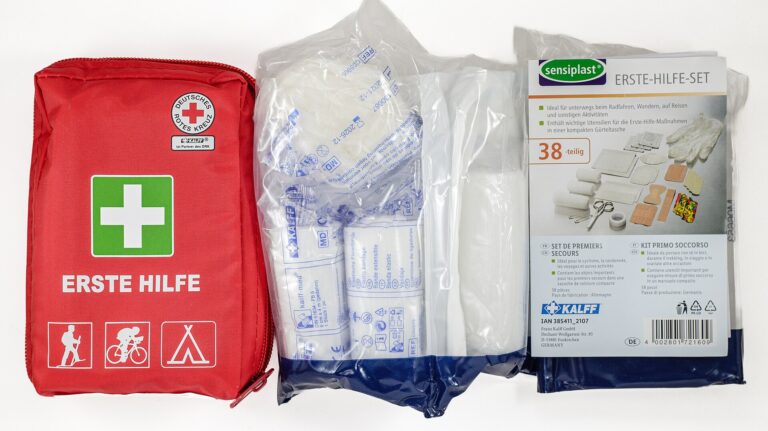
Priority 5: First Aid
A bug-out bag first aid kit should go beyond Band-Aids. Focus on life-threatening injuries first, then common ailments.
- Stop-the-bleed kit — a North American Rescue CAT tourniquet ($30), a pack of QuikClot hemostatic gauze ($18), and nitrile gloves. Bleeding out from a laceration is a real evacuation scenario, especially in vehicle accidents while bugging out.
- Israeli bandage or pressure dressing — handles large wounds before you reach medical care.
- Blister kit — Moleskin pads and a small tube of antibiotic ointment. If you are on foot for miles, blisters become serious fast.
- Medications: A 7-day supply of any prescription medications, sealed in original packaging or pharmacy-labeled bags. Add ibuprofen, Benadryl, anti-diarrhea tablets (Imodium), and electrolyte packets.
- Copies of prescriptions — printed, laminated, and stored in your documents pouch. In an emergency, pharmacies in other states can sometimes fill refills with a printed prescription copy.
Priority 6: Communication and Navigation
Getting found — or finding your way without cell service — requires dedicated gear that does not depend on a working grid.
- Hand-crank emergency radio — the Midland ER210 ($35) or Eton FRX3+ ($50) receives NOAA weather alerts, AM/FM, and can charge your phone via USB. It runs on batteries, solar, or hand crank.
- Paper map of your county and state — download and print from the US Geological Survey (USGS) topo map viewer for free, then laminate it. Cell service is the first thing that fails in disasters.
- Suunto A-10 baseplate compass — $20 and bombproof. Practice triangulating your position on the paper map before you need it.
- Anker 10,000 mAh power bank — keeps your phone alive for navigation and communication. The Anker PowerCore Slim 10K runs about $25 and weighs 6.3 oz.
Tools, Lighting, and Documents
Tools
- Leatherman Wave+ or Gerber Suspension-NXT multi-tool — pliers, knife blade, screwdrivers, can opener, and more in one package. The Gerber runs about $35; the Leatherman Wave+ is $110 but built to last a lifetime.
- Black Diamond Spot headlamp — hands-free lighting is essential. The Spot 400 puts out 400 lumens on three AAA batteries and costs about $40. Carry a spare set of batteries rubber-banded to the outside of the headlamp.
- Extra batteries — a set of AAA batteries for the headlamp and AA batteries for the emergency radio. Use lithium batteries (Energizer L92) — they last 10 years in storage and perform in extreme cold where alkaline batteries fail.
- Duct tape — wrap 10 feet around a pencil to save space. Fixes pack straps, blisters, shelter gaps, and a hundred other field problems.
- Whistle — the Fox 40 pealess whistle ($8) can be heard over a mile away and requires no batteries. Clip it to your shoulder strap.
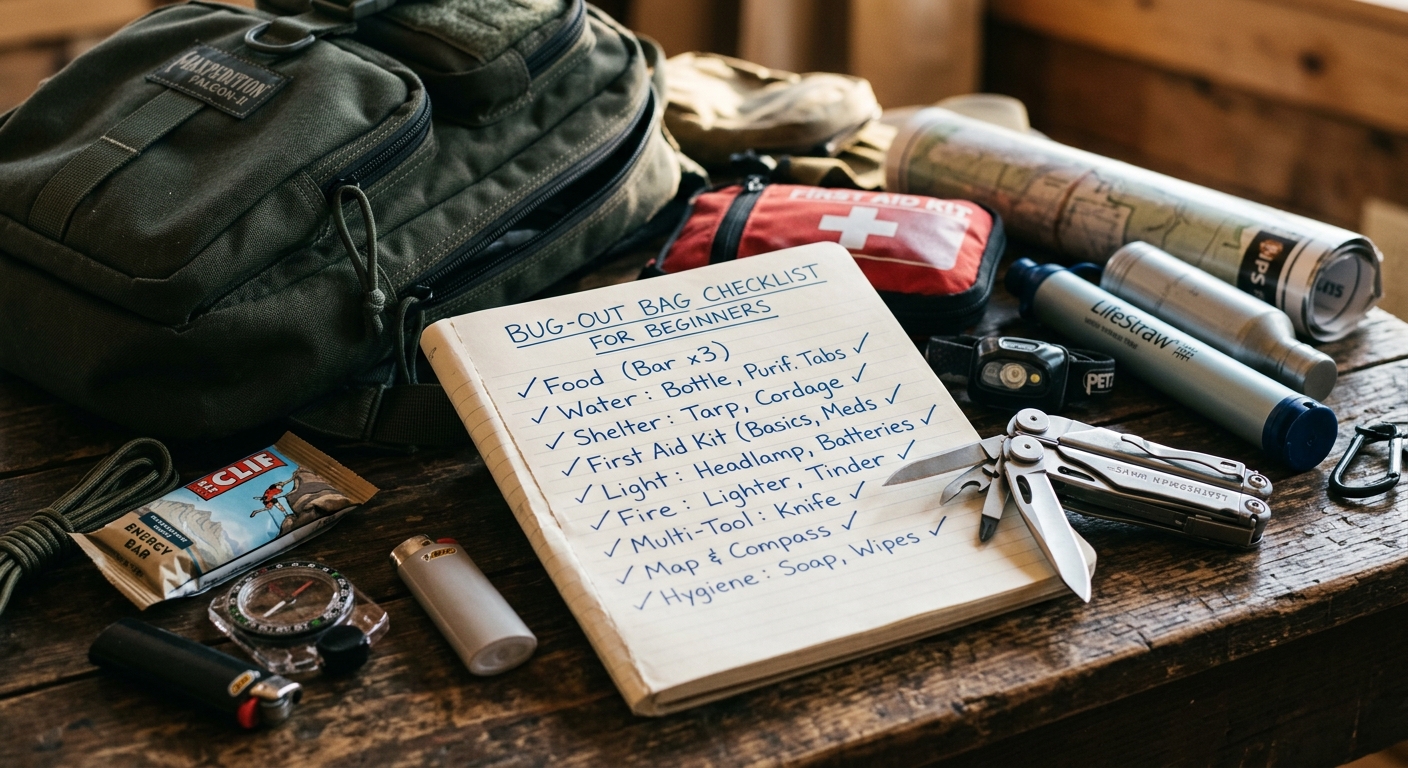
Documents and Cash
- Photocopies of IDs: driver’s license, passport, Social Security card, birth certificates for all family members. Laminate or seal in a small zip-lock bag.
- Emergency contact list: printed on paper. Phone numbers for family, out-of-state contacts, insurance companies, doctors. When phones die, numbers stored only in your phone are gone.
- Cash: $100 to $200 in small bills. ATMs and card readers fail during power outages. Small bills let you buy gas, food, or lodging without needing change.
- Insurance cards and any critical medical records (vaccination records for kids, recent EKG if you have a heart condition).
Bug-Out Bag Checklist: Complete Reference Table
| Category | Item | Recommended Product | Approx. Cost | Weight |
|---|---|---|---|---|
| Water | Water filter | Sawyer Squeeze | $30 | 3 oz |
| Water | Purification tablets | Aquatabs (30-pack) | $6 | 0.5 oz |
| Water | Collapsible bottle (2L) | Platypus SoftBottle | $12 | 1.5 oz |
| Food | Emergency food bars | DATREX 3,600 cal x2 | $16 | 25 oz |
| Food | Spork | Light My Fire Spork | $8 | 0.5 oz |
| Shelter | Emergency bivy | SOL Emergency Bivvy | $18 | 3.8 oz |
| Shelter | Tarp (6×8 ft) | Aqua Quest Guide Tarp | $40 | 14 oz |
| Shelter | Paracord (50 ft) | Rothco 550 Cord | $6 | 3.5 oz |
| Fire | Lighter (x2) | BIC Classic | $3 | 1 oz |
| Fire | Ferro rod | Bayite 4-inch | $10 | 2 oz |
| Fire | Tinder kit | DIY cotton balls + Vaseline | $1 | 1 oz |
| First Aid | Tourniquet | NAR CAT Gen 7 | $30 | 2.7 oz |
| First Aid | Hemostatic gauze | QuikClot Sport | $18 | 2 oz |
| First Aid | Pressure bandage | Israeli Bandage 4-inch | $8 | 2 oz |
| First Aid | OTC medications | Ibuprofen, Imodium, Benadryl | $10 | 3 oz |
| Navigation | Paper map | USGS topo (laminated) | $0–$5 | 2 oz |
| Navigation | Compass | Suunto A-10 | $20 | 1.2 oz |
| Navigation | Power bank | Anker 10,000 mAh | $25 | 6.3 oz |
| Communication | Emergency radio | Midland ER210 | $35 | 9.5 oz |
| Tools | Multi-tool | Gerber Suspension-NXT | $35 | 7.4 oz |
| Tools | Headlamp | Black Diamond Spot 400 | $40 | 3.2 oz |
| Tools | Extra batteries | Energizer Lithium AAA + AA | $10 | 3 oz |
| Documents | ID copies + cash + contacts | Laminated, zip-lock sealed | $100–$200 cash | 2 oz |
How to Choose the Right Pack
Gear means nothing without a pack that fits and holds up. For a 72-hour kit targeting 20 to 25 pounds of gear, look for a 40- to 55-liter backpack. Good options at different price points:
- Budget pick: 5.11 Tactical Rush 24 ($80) — rugged, molle-compatible, carries 37L with excellent organization.
- Mid-range: Osprey Farpoint 40 ($130) — comfortable hipbelt, TSA-friendly zip, designed for all-day carry.
- Premium: Mystery Ranch 3-Day Assault Pack ($260) — used by military and SAR teams, built for decades of hard use.
Whatever pack you buy, make sure the shoulder straps are padded, there is a sternum strap to stabilize the load, and you can tighten a hipbelt to transfer weight off your shoulders. Load 20 pounds into the pack and walk a mile before buying — sizing matters more than brand name.
Weight Guidelines: The 15% Rule
A common rookie mistake is overpacking. A bag you cannot carry for six hours is not a bug-out bag — it is a pile of gear you will abandon at mile two. The military uses a 35% body-weight threshold for short hauls with training, but for untrained civilians, 15% of body weight is the practical ceiling for sustained movement.
| Body Weight | Max Bag Weight (15%) |
|---|---|
| 120 lbs | 18 lbs |
| 140 lbs | 21 lbs |
| 160 lbs | 24 lbs |
| 180 lbs | 27 lbs |
| 200 lbs | 30 lbs |
Building Bug-Out Bags for Families
Every family member needs their own bag — including kids. Children aged 6 and up can carry a small pack with their personal items, keeping parent bags from becoming impossibly heavy.
Kids’ Bug-Out Bags
A child’s bag should weigh no more than 10% of their body weight. A 60-pound child can carry a 6-pound pack. Practical items for a child’s bag include:
- A change of clothes and rain poncho
- Their own water bottle (filled, not collapsible)
- A snack they like — compliance matters when kids are stressed
- A small comfort item (stuffed animal or book) — mental health during evacuation is real
- A written card with their name, parent names, phone numbers, and blood type
Adults carry the shelter, filters, and first aid. Kids carry their own personal items and some food. This distribution makes the whole family mobile and keeps parents’ bags under the 15% threshold even with full gear loads.
Vehicle Bug-Out Bag vs. Foot Bag
If you are evacuating by vehicle, weight almost stops mattering — you can carry a cooler with three days of real food, 10 gallons of water, and a full sleeping bag setup in your trunk. A vehicle bug-out bag is essentially a mobile camp kit: heavier, more comfortable, and designed for a car trunk or truck bed.
The foot bag is a strict 72-hour survival kit under the 15% weight limit. The key difference is this: always build your foot bag first, then expand into a vehicle kit as a supplement. If your car breaks down or roads close, the foot bag must be able to carry you the rest of the way.
5 Beginner Mistakes That Gut a Bug-Out Bag
- Buying gear and never packing it. Your bag needs to be assembled, weighed, and test-carried before an emergency. Loose gear in Amazon boxes is not a bug-out bag.
- Ignoring water treatment. Carrying only bottled water gives you one day before you run dry. A filter and tablets cost under $40 and give you essentially unlimited water from any stream or puddle.
- Skipping medications. In almost every major natural disaster, people end up in emergency rooms not from the disaster itself but from missed doses of blood pressure meds, insulin, or seizure medications. A 7-day supply can be a literal lifesaver.
- Forgetting cash and printed contacts. Digital everything fails when the grid fails. Cash and a printed phone list are low-tech tools with high-stakes value.
- Never rotating stock. Food bars expire. Batteries corrode. Check your bag every six months — set a calendar reminder for January and July — and replace anything past its date. Takes 30 minutes twice a year.
The Bottom Line
A solid bug-out bag list for beginners does not require thousands of dollars or special forces training. The 72-hour kit essentials covered here — water filter, emergency food bars, bivy, tarp, paracord, fire-starting kit, stop-the-bleed first aid, navigation tools, emergency radio, multi-tool, headlamp, and documents — can be assembled for under $300 in a single afternoon. The 15% body-weight rule keeps it packable. The six survival priorities keep it organized. Build one bag per family member, test it on a real walk, and rotate the stock every six months. That is the whole system.
Have questions about your specific situation? Drop them in the comments below — we read every one. If this guide helped you, share it with someone planning their off-grid setup.
Marcus Reid
Founder & Editor, OffGridSage
Marcus founded OffGridSage to bring practical off-grid knowledge together in one place. Guides are built from official and expert sources (NREL, the EPA, the USDA and university extension services), manufacturer documentation and reader feedback, and are updated when information changes.