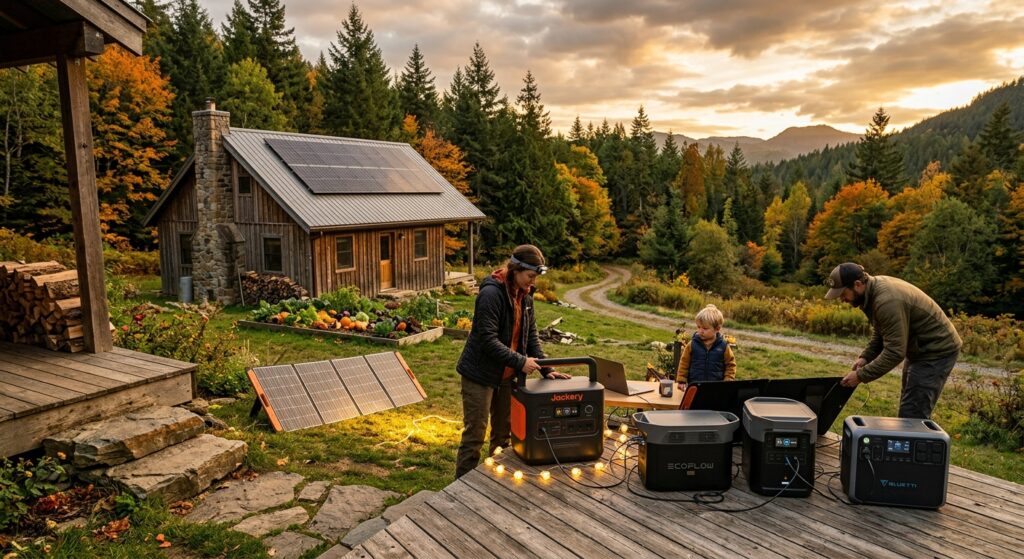
Best Solar Generators for Off-Grid Homes in 2026: Honest Reviews and Rankings
Picture this: it’s January, the temperature outside has dropped to 18°F, and your propane-powered backup generator sputters out at 2 a.m. You haul yourself out of bed, trek to the shed, and spend forty minutes troubleshooting a carburetor that last worked reliably sometime during the Obama administration. If you’ve lived off-grid for more than a season, you’ve had that night. It’s exactly why so many homesteaders are making the switch to solar generators — and never looking back.
The stakes are real. Choosing the wrong solar generator for an off-grid home means either running out of power during critical moments or spending thousands of dollars more than necessary on a unit that’s too large for your actual load. We’ve seen both scenarios play out, and neither is cheap. An undersized unit leaves you rationing power through cloudy weeks; an oversized one drains your bank account and still sits mostly idle. Getting the sizing and specs right on the front end saves you from an expensive do-over down the road.
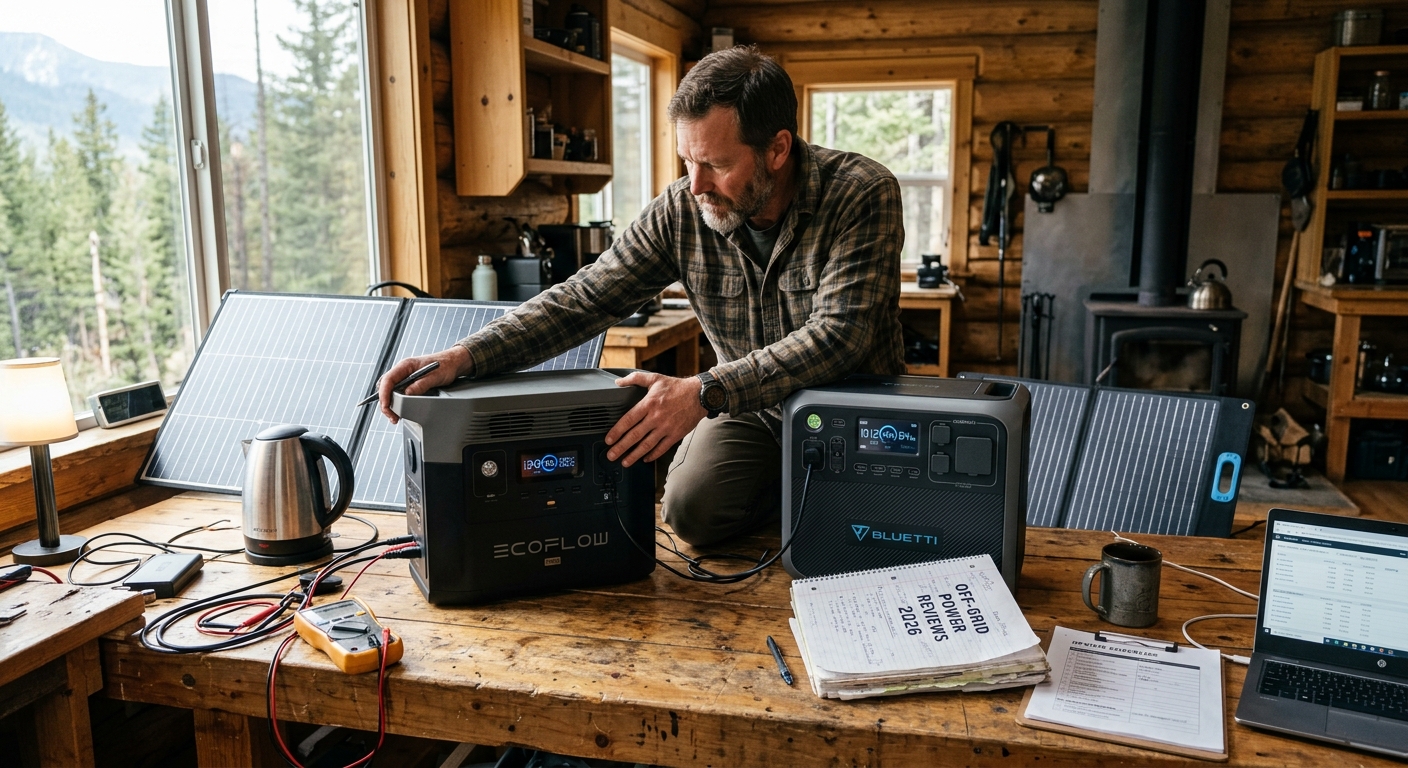
In this guide, we review the five best solar generators for off-grid use in 2026 — covering real specs, honest pros and cons, and the situations each unit handles best. We’ll walk through what to look for before you buy (battery chemistry, inverter wattage, solar input), compare the top models side by side in a full table, and give you clear verdicts: best overall, best for portability, and best for a full home. Let’s get into it.
Quick Answer: Best Solar Generators for Off-Grid Use in 2026
If you need a fast recommendation before diving into the full reviews, here’s where the top models land. Prices reflect mid-2026 market rates and can shift with promotions.
- Best Overall: EcoFlow Delta Pro 2 — 3.6kWh expandable to 25kWh, 3600W inverter, $2,799
- Best High-Power: Anker SOLIX F3800 — 3840Wh, 6000W inverter, $3,499
- Best Mid-Range Modular: Bluetti AC300+B300 — 3072Wh, 3000W, $2,199
- Best Portable Cabin/RV Option: Jackery Explorer 2000 Pro — 2160Wh, 2200W, $1,799
- Best Premium Brand: Goal Zero Yeti 3000X — 2982Wh, 2000W, $2,499
Why Solar Generators Beat Gas Generators for Off-Grid Homes
Gas generators have one job and they do it reasonably well: turn fuel into electricity. But for a permanent off-grid home, that single advantage comes loaded with compounding drawbacks that solar generators simply don’t have.
Silent Operation, No Carbon Monoxide Risk
A quality solar generator runs completely silently. There are no moving parts in the inverter or battery, and the only sound you’ll ever hear is a light fan hum during heavy loads. Compare that to a conventional generator’s 65–75 dB roar, which carries across a quiet rural property and ends any hope of a peaceful morning. More critically, gas generators produce carbon monoxide — a colorless, odorless gas that kills. Every year, people die from running generators indoors or in garages during storms. Solar generators produce zero emissions and can operate safely inside a cabin, basement, or utility room without ventilation concerns.
Zero Ongoing Fuel Cost
Gasoline for a mid-size generator runs $0.30–$0.50 per kWh of electricity produced when you factor in inefficiency and fuel storage costs. Solar input is free. A well-paired solar panel array on a sunny property can fully recharge a 3kWh unit in four to six hours at no cost whatsoever. Over a five-year period, a homesteader running a 5kW gas generator regularly might spend $4,000–$7,000 in fuel alone. That gap funds a very solid solar generator system.
Lower Maintenance, Longer Service Life
Gas generators need annual oil changes, air filter replacements, spark plugs, carburetor cleaning, and fuel stabilizer treatment when stored. Modern LiFePO4 solar generators have virtually zero maintenance requirements. The batteries in quality units like the EcoFlow Delta Pro 2 are rated for 3,500+ charge cycles before dropping to 80% capacity — that’s nearly a decade of daily use. You’re not dealing with small engines, fuel lines, or any of the mechanical failure points that make gas generators a constant maintenance project.
What to Look For Before You Buy the Best Solar Generator for Off Grid
Before comparing specific models, you need to understand the five specs that actually determine whether a solar generator fits your situation. Don’t let marketing language substitute for a real numbers check.
Battery Capacity (kWh)
This is the fuel tank — how much total energy the unit can store. It’s measured in watt-hours (Wh) or kilowatt-hours (kWh). A basic off-grid cabin running LED lighting, a laptop, a phone, and a small refrigerator might consume 1.5–2kWh per day. A full off-grid home with a chest freezer, water pump, washing machine, and entertainment system might consume 8–15kWh per day. Match your daily load, then add buffer for cloudy days. Portable units in the 2,000–4,000Wh range work for light-to-moderate use; serious homesteads need expandable systems that can scale to 10kWh or more.
Inverter Wattage (Continuous vs. Peak)
The inverter converts stored DC power to AC power your appliances use. Two numbers matter: continuous wattage (what it sustains indefinitely) and peak or surge wattage (what it can briefly deliver to start motors). A refrigerator compressor starting up may briefly pull 3–4x its running wattage. If your inverter can’t handle that surge, the unit shuts down. Look for continuous inverter ratings of at least 2,000W for a modest setup; 3,000–6,000W for a full home with major appliances.
Solar Input Wattage and Charging Speed
This tells you how fast the unit can recharge from solar panels. A unit with a 3kWh battery but only 400W of solar input will take 7–8 hours of full sun to recharge. A unit with 1,500W solar input refills in 2–3 hours. For off-grid use where cloudy days are a real concern, faster recharge capability is not a luxury — it’s critical for maintaining power reserves.
Battery Chemistry: LiFePO4 vs. NMC
Lithium Iron Phosphate (LiFePO4) batteries are the gold standard for stationary off-grid use. They’re thermally stable (much lower fire risk), rated for 3,000–5,000 cycles, and handle deep discharge better than Nickel Manganese Cobalt (NMC) batteries. NMC cells offer higher energy density (lighter weight for the same capacity), which is valuable for pure portability. For a permanent off-grid home installation, always prioritize LiFePO4 chemistry. For a backpack-portable unit, NMC’s weight advantage may be worth the trade-off.
Expandability and Pass-Through Charging
Pass-through charging lets you run appliances from the unit while it’s simultaneously charging — essential for continuous off-grid use. Expandability means you can add battery packs later as your needs grow without buying an entirely new system. Both features are critical for a permanent off-grid setup and should be non-negotiable requirements when shopping.
The 5 Best Solar Generators for Off-Grid Homes: Full Reviews
1. EcoFlow Delta Pro 2 — Best Overall Solar Generator for Off Grid
The EcoFlow Delta Pro 2 is the unit most serious off-gridders are landing on in 2026, and for good reason. It ships with 3.6kWh of LiFePO4 capacity and a 3,600W continuous inverter — powerful enough to run a full-size refrigerator, water pump, and general household loads simultaneously. What separates it from the competition is its expandability: add up to six additional battery packs to reach 25kWh of total storage. That’s enough to weather multiple cloudy days without rationing power on a moderately sized homestead.
Solar input is rated at 1,600W, meaning you can fully recharge from empty in roughly 2.5 hours of strong sun with adequate panels. EcoFlow’s X-Stream fast charging technology via AC reaches 80% in 1.2 hours, which matters when you have grid access or a generator backup. The unit includes smart home integration via the EcoFlow app, allowing you to monitor state of charge, set charge limits to protect battery longevity, and track historical consumption data. At roughly 122 lbs, it’s not portable in the casual sense — but it rolls on wheels and installs cleanly in a utility room. LiFePO4 chemistry with a 3,500-cycle rating makes it genuinely long-term equipment. Price: approximately $2,799.
2. Anker SOLIX F3800 — Best High-Power Solar Generator
The Anker SOLIX F3800 is the heavy hitter of this list. Its 6,000W continuous inverter is the highest of any unit we reviewed, and it handles the kind of whole-home loads — well pumps, HVAC units, electric ranges — that would trip most competitors. The 3,840Wh LiFePO4 battery is expandable up to 26.9kWh with additional packs, putting it in legitimate competition with the EcoFlow Delta Pro 2 for whole-home setups.
Solar input reaches 2,400W, the fastest recharge rate on this list. Anker includes Smart Generator Autostart, which automatically fires up a paired gas generator when the battery drops below a set threshold — a practical feature for homesteads in low-sun climates who want a hybrid backup strategy. At 132 lbs, it’s similar in weight to the EcoFlow. The SOLIX F3800 runs a premium $3,499 base price, but for anyone running serious loads or operating in a demanding climate, it’s the most capable unit available. Price: approximately $3,499.
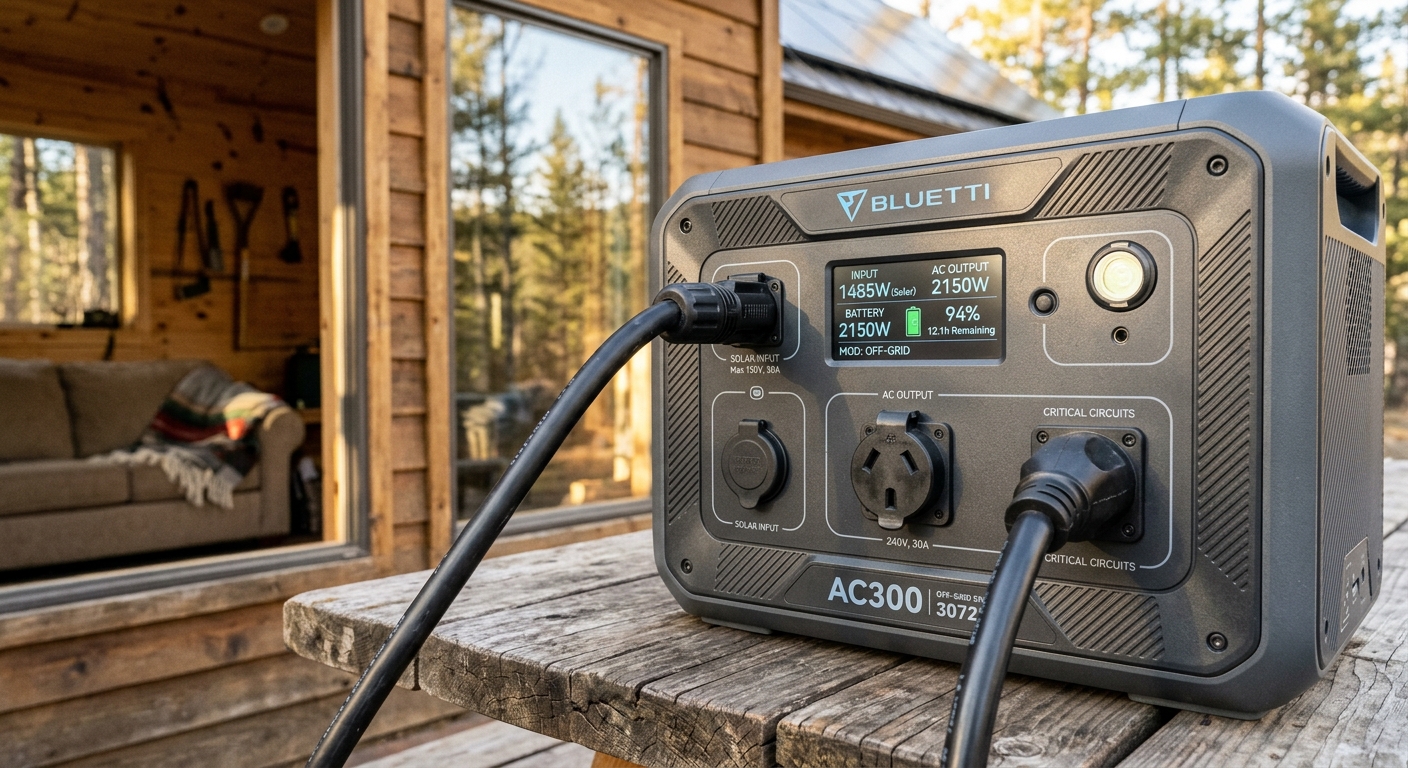
3. Bluetti AC300+B300 — Best Modular Mid-Range Option
Bluetti’s AC300+B300 takes a genuinely clever approach to scalability. The AC300 is the inverter/management unit (no built-in battery), and the B300 is a 3,072Wh LiFePO4 battery module. You can connect up to four B300 modules for 12.2kWh total. This modular design means you can start with one battery pack, prove out your system, and add capacity as your budget allows rather than buying everything upfront.
The 3,000W continuous inverter covers most homestead loads comfortably, and solar input is rated at 2,400W across dual MPPT charge controllers. The system supports pass-through charging and integration with a smart home panel for whole-home backup. Build quality is excellent — Bluetti has earned a strong reputation for durable hardware and responsive customer support. At $2,199 for the base AC300+B300 combo, it’s the most cost-effective entry point for a scalable off-grid power system on this list. Price: approximately $2,199.
4. Jackery Explorer 2000 Pro — Best for Cabins and RV Use
The Jackery Explorer 2000 Pro is the most portable legitimate off-grid option we reviewed. At 43 lbs, it’s the only unit here a single person can comfortably carry, and its 2,160Wh NMC battery and 2,200W inverter handle the loads a cabin or weekend retreat realistically demands: a 12V refrigerator, LED lighting, phone and device charging, a fan, and a small appliance or two.
Solar input is rated at 1,400W through Jackery’s SolarSaga panels, and the unit reaches full charge from solar in about 2.5 hours under ideal conditions. The Explorer 2000 Pro does use NMC chemistry rather than LiFePO4, which means a lower cycle count (approximately 1,000 full cycles to 80% capacity). For a cabin used seasonally, that’s not a critical concern — you’ll get many years of use. For a daily-use permanent home, the LiFePO4 options above offer better long-term value. Jackery’s app is clean and functional, and the brand’s track record on reliability is solid. Price: approximately $1,799.
5. Goal Zero Yeti 3000X — Best Premium Brand With Heritage
Goal Zero has been in the portable power space longer than most competitors, and the Yeti 3000X reflects that accumulated expertise in build quality and ecosystem depth. The 2,982Wh NMC battery pairs with a 2,000W continuous (3,500W surge) inverter and accepts up to 600W of solar input — the lowest solar input spec on this list, which is the unit’s primary weakness for serious off-grid use.
What Goal Zero delivers is integration: the Yeti 3000X connects to the Goal Zero Home Integration Kit, allowing it to serve as a backup power source for household circuits. The app is mature and polished, and the build quality feels genuinely premium. At $2,499, it’s the most expensive unit per watt-hour of storage on this list, and the 600W solar input limitation means recharge times lag the competition significantly in off-grid scenarios. For a cabin with modest loads or as a grid-tied emergency backup, it’s excellent. As a standalone daily-driver for an off-grid home with high power demand, the EcoFlow and Anker options offer better overall value. Price: approximately $2,499.
Solar Generator Comparison Table: All 5 Models Side by Side
| Model | Capacity (Wh) | Inverter (W) | Max Solar Input | Weight (lbs) | Price (approx.) | LiFePO4? | Best For |
|---|---|---|---|---|---|---|---|
| EcoFlow Delta Pro 2 | 3,600 (exp. to 25,000) | 3,600W | 1,600W | 122 lbs | $2,799 | Yes | Best overall off-grid home |
| Anker SOLIX F3800 | 3,840 (exp. to 26,900) | 6,000W | 2,400W | 132 lbs | $3,499 | Yes | High-power loads, HVAC, pumps |
| Bluetti AC300+B300 | 3,072 (exp. to 12,288) | 3,000W | 2,400W | 130 lbs | $2,199 | Yes | Budget-conscious modular setup |
| Jackery Explorer 2000 Pro | 2,160 | 2,200W | 1,400W | 43 lbs | $1,799 | No (NMC) | Cabins, RVs, portable use |
| Goal Zero Yeti 3000X | 2,982 | 2,000W | 600W | 69.7 lbs | $2,499 | No (NMC) | Premium brand, ecosystem buyers |
Common Buying Mistakes — and How to Avoid Them
Mistake 1: Buying Capacity Without Calculating Your Load
The single most expensive mistake off-gridders make with solar generators is guessing at what size they need. A 2,000Wh unit sounds like a lot until you run the numbers: a standard refrigerator consumes 1–1.5kWh per day, a well pump might use 0.5–1kWh daily, and once you add lighting, device charging, and any heating or cooling, you’re easily at 5–8kWh per day for a modest home. Buy before you calculate, and you’ll be shopping again within a year.
Mistake 2: Ignoring Solar Input Wattage
Battery capacity tells you how much energy you can store; solar input tells you how fast you can refill it. A unit with a 3kWh battery and 400W of solar input is essentially crippled for off-grid use in anything but ideal conditions. Always check the maximum solar input spec and pair it with enough panels. For a permanent off-grid setup, aim for solar input that can fully recharge the battery in 4–5 hours of peak sun minimum.
Mistake 3: Overlooking Battery Chemistry for Permanent Installs
NMC batteries offer better energy density by weight — which is a genuine advantage for portable use. But for a fixed installation, LiFePO4’s 3,500+ cycle life and thermal stability are far more important than saving 30 lbs. Over a decade of daily cycling, you’ll thank yourself for choosing LiFePO4 chemistry. The Goal Zero Yeti 3000X and Jackery Explorer 2000 Pro are fine products, but their NMC chemistry is a real consideration for anyone planning year-round daily off-grid use.
Mistake 4: Skipping Expandability Planning
Your power needs tend to grow, not shrink, as you develop an off-grid property. A water system gets added; a chest freezer replaces a cooler; an electric tool setup fills the workshop. Buying a unit that can’t accept additional battery packs locks you into a complete system replacement when your needs evolve. The EcoFlow Delta Pro 2, Anker SOLIX F3800, and Bluetti AC300 are all designed to grow with you — that’s a major part of why they dominate serious off-grid builds.
Extending Your Battery’s Life
Regardless of which unit you choose, proper battery management adds years to your system. Keep LiFePO4 batteries between 20% and 90% charge for daily cycling rather than running them to zero and charging to 100% every cycle. Store units at 50–60% charge if unused for extended periods. Avoid sustained exposure to temperatures below 14°F or above 113°F. Some off-gridders also explore battery reconditioning techniques to maintain and extend the service life of older battery banks — the EZ Battery Reconditioning program covers practical methods for restoring and maximizing the life of lead-acid and lithium battery systems, which can be genuinely useful for managing a larger off-grid battery bank over time.
⚡ Before You Buy Any Generator
Choosing the wrong size solar generator is the most expensive mistake off-gridders make. This power system sizing guide shows you exactly how to calculate your load, pick the right inverter capacity, and avoid buying a 2,000Wh unit when you actually need 5,000Wh.
*Affiliate link — we may earn a commission at no cost to you.
The Bottom Line
The best solar generator for off-grid living is the one correctly matched to your actual daily load, climate, and plans for expansion. For most serious off-grid homesteads, the EcoFlow Delta Pro 2 is the right starting point: 3.6kWh of expandable LiFePO4 storage, a 3,600W inverter, fast solar recharge, and a proven ecosystem for scaling up. The Anker SOLIX F3800 is the better choice if you’re running heavy loads like well pumps or climate systems that demand the 6,000W inverter headroom. The Bluetti AC300+B300 is the most financially accessible path into a modular, expandable setup. The Jackery Explorer 2000 Pro is the best option for cabins, RV use, or anyone who genuinely needs portability. And the Goal Zero Yeti 3000X earns its place for buyers who value the brand’s long track record and mature ecosystem, despite its higher price-per-watt-hour.
Before you commit to any unit, do the math on your daily load — it takes thirty minutes and saves you from a multi-thousand-dollar mistake. If you want a structured framework for that calculation, this power system sizing guide walks you through every step, from appliance load inventory to inverter sizing to solar panel pairing, with enough specificity to handle any real off-grid scenario.
Have questions about your specific situation? Drop them in the comments below — we read every one. If this guide helped you, share it with someone planning their off-grid setup.