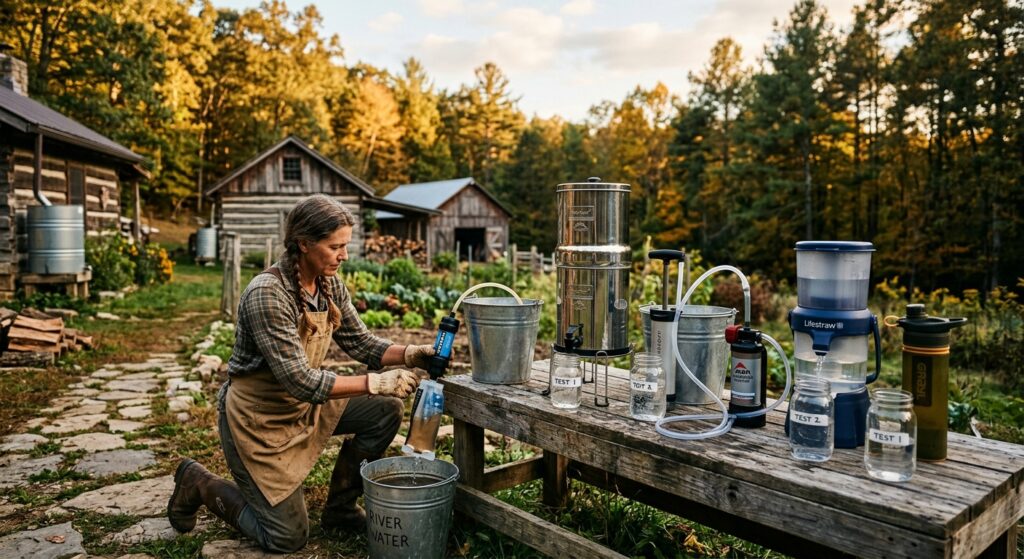
Best Water Filter for Off-Grid Living: 6 Options Tested and Compared
You move out to your land, drill a well or tap a spring, and feel good about your water source — until a heavy rain muddies the creek, or your neighbor mentions the old mine upstream. Suddenly « clean enough to drink » becomes a very serious question. Finding the best water filter for off grid use is not the same as picking something for a weekend camping trip. You need something that handles daily household volume, works without grid power, and removes the specific contaminants in your water source.
Most off-gridders make one of two mistakes: they buy an ultralight backpacking filter that cannot keep up with cooking, drinking, and washing for a family of four — or they spend hundreds on a gravity filter without knowing whether it actually removes the viruses or heavy metals present in their well. Either way, they end up with a system that fails them at the worst possible moment, or one that gives a false sense of security against contaminants it was never designed to stop.
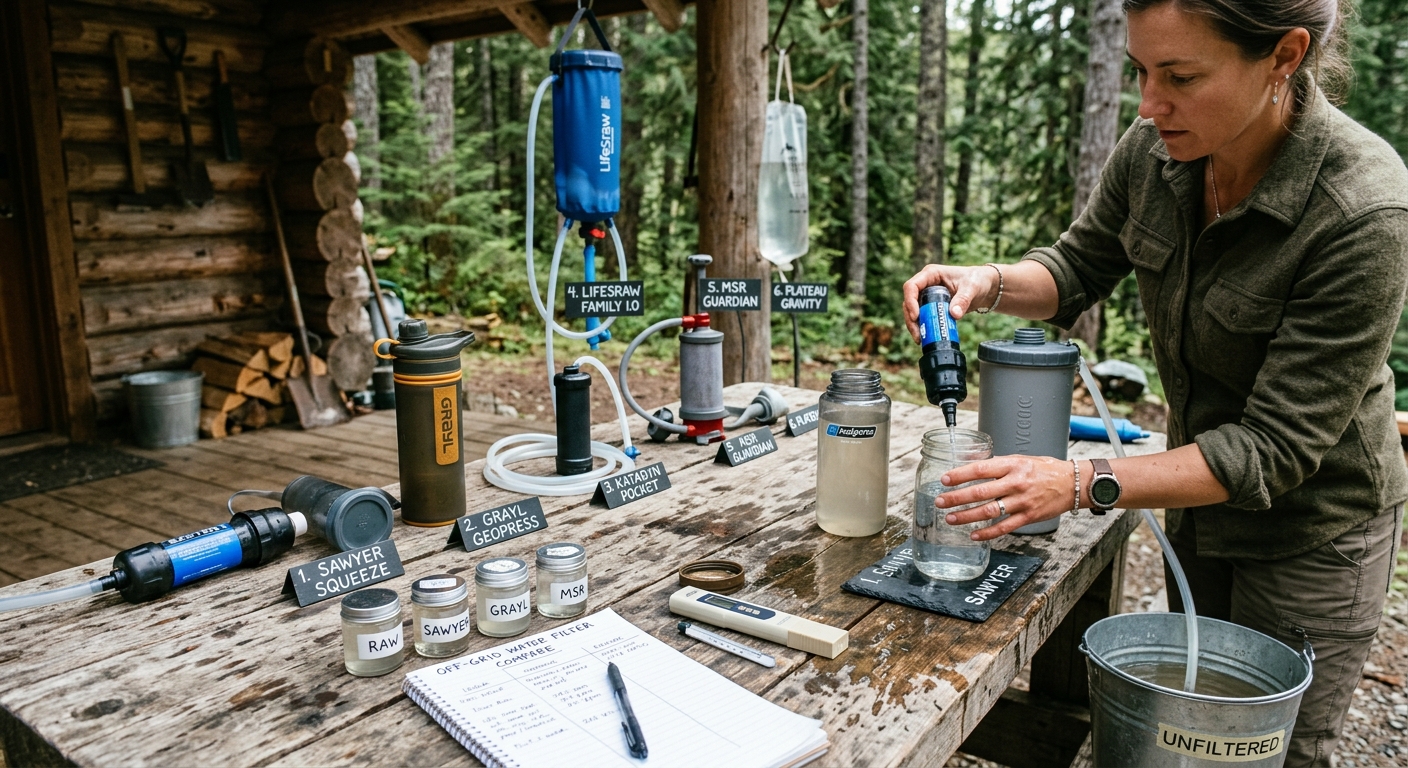
In this guide, you will get a clear breakdown of off-grid water contaminants, a plain-English explanation of filtration methods, in-depth reviews of six of the most popular filters for homestead and off-grid use, and a side-by-side comparison table so you can match the right filter to your actual situation. By the end, you will know exactly what to buy and what to pair it with for genuinely safe water every day.
Quick Answer: Best Water Filters for Off-Grid Use
If you need a fast answer, here are the top picks by category. Prices are approximate retail as of mid-2026.
- Best overall gravity filter: Berkey Big Berkey — $350, 2.25 gal/hour, removes bacteria and viruses
- Best certified alternative to Berkey: ProOne Big+ — $280, independent NSF-style lab testing
- Best budget gravity filter: LifeStraw Home Gravity — $70, NSF 42/53 certified
- Best for preppers and large households: Alexapure Pro — $250, high-capacity gravity system
- Best for well water with heavy metals: AquaTru Counter — $450, reverse osmosis, requires power
- Best portable/backup filter: Sawyer Squeeze — $35, 100,000-gallon rated lifespan
Off-Grid Water Contaminants: What You Are Actually Filtering
Before you spend a dollar on any filter, you need to know what is in your water. Off-grid sources — wells, springs, creeks, rainwater — carry very different threats than municipal tap water. There is no one-size-fits-all filter because no single technology removes every category of contaminant.
Bacteria and Protozoa
These are the most common biological threats in surface water and shallow wells. Bacteria like E. coli, Salmonella, and Campylobacter cause serious gastrointestinal illness. Protozoa — Giardia and Cryptosporidium — form cysts that are highly resistant to chlorine but physically large enough to be captured by most quality filters. Almost every gravity filter, pump filter, and squeeze filter on this list handles bacteria and protozoa effectively.
Viruses
Viruses — Norovirus, Hepatitis A, Rotavirus — are far smaller than bacteria, measuring 20–200 nanometers. Most standard hollow-fiber filters (including the Sawyer Squeeze) do not remove viruses. If you are collecting rainwater, drawing from water with potential fecal contamination, or living in an area where viral waterborne illness is a concern, you need a gravity filter rated for virus removal (Berkey, ProOne) or a UV purifier as a second stage.
Heavy Metals and Chemicals
Well water, especially near agricultural land, old mining operations, or areas with naturally occurring mineral deposits, can contain arsenic, lead, nitrates, fluoride, and pesticides. Standard hollow-fiber filters do not touch these. Activated carbon reduces chlorine, some pesticides, and volatile organic compounds (VOCs), but it is slow to act on heavy metals. Reverse osmosis is the most thorough solution for chemical and heavy metal contamination — which is why the AquaTru is on this list despite requiring electricity.
Filtration Methods Explained
Gravity-Fed Filters
Gravity filters are the workhorse of the off-grid kitchen. You fill the upper chamber, gravity pulls water through a filtration element — usually ceramic, activated carbon, or a combination — and clean water collects in the lower reservoir. No power, no pressure, no moving parts. Flow rate is slower than a faucet, typically 1–3 gallons per hour, but for most households you fill the upper chamber in the morning and evening and always have clean water ready. The Berkey, ProOne, LifeStraw Home, and Alexapure all use this method.
Pump Filters
Pump filters push water through a filtration element using manual force. They are fast and work well for filling containers from a stream, but they require physical effort and are better suited to backcountry trips than daily household use. Most off-gridders keep one as an emergency backup rather than a primary system.
Squeeze Filters
The Sawyer Squeeze uses a hollow-fiber membrane that you squeeze water through. It is incredibly lightweight, rated for 100,000 gallons, and at $35 it is the most cost-efficient filter per gallon in the world. But it is a field filter, not a household system. It belongs in your go-bag, mounted inline on a gravity drip, or kept as a backup when your primary filter needs maintenance.
UV Purifiers
Ultraviolet light destroys the DNA of bacteria, protozoa, and viruses — making it highly effective as a final stage in a multi-barrier system. A UV pen like the SteriPen treats one liter in about 90 seconds. UV does not remove chemicals or turbidity, and it requires batteries or a power source, so it is almost always used as a secondary treatment paired with a gravity filter that has already removed particles and sediment.
Reverse Osmosis (RO)
RO forces water through a semi-permeable membrane under pressure, removing virtually everything — bacteria, viruses, heavy metals, nitrates, arsenic, fluoride. It is the most thorough filtration method available outside of a lab. The tradeoff: RO systems require water pressure (or a pump), produce wastewater at roughly a 3:1 ratio, and the AquaTru specifically requires a power outlet. For off-gridders with solar power and well water with chemical concerns, it is a serious option.
In-Depth Reviews: 6 Best Water Filters for Off-Grid Living
1. Berkey Big Berkey — Best Overall Gravity Filter for Off-Grid Use
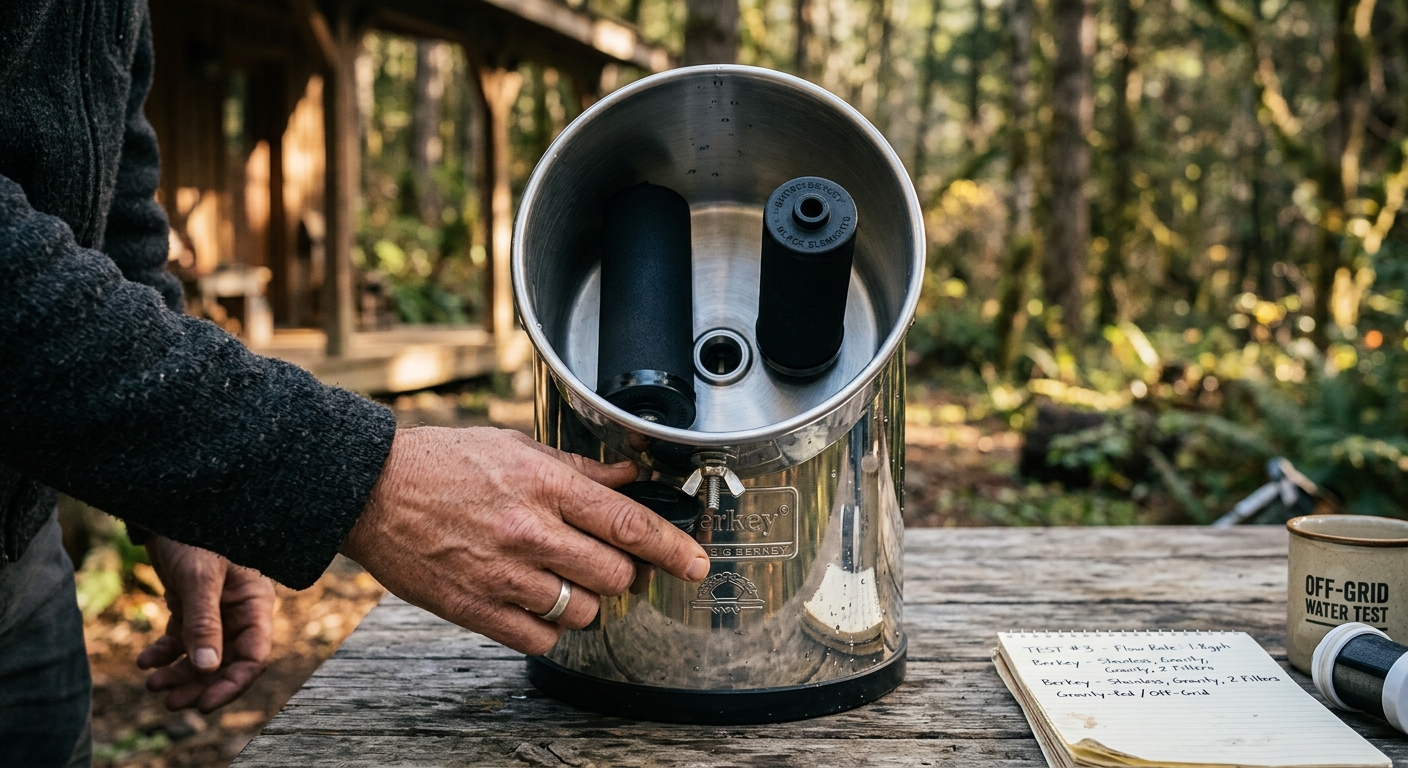
The Berkey has been the go-to gravity filter for homesteaders, preppers, and off-gridders for years — and for good reason. The Big Berkey holds 2.25 gallons of filtered water and filters at roughly 2.25 gallons per hour with two Black Berkey elements installed. It is stainless steel, built to last decades, and can be upgraded with fluoride-reduction filters in the lower chambers.
Berkey claims the Black Berkey elements remove 99.9999% of bacteria, 99.9% of viruses, and a wide range of chemicals, heavy metals, and pharmaceuticals. Those are impressive numbers — but here is the important caveat that Berkey’s own marketing often buries: the Black Berkey elements are not certified by NSF International, which is the independent third-party testing body most water professionals trust. Berkey conducts and funds its own testing. Independent lab tests have generally confirmed good performance, but if NSF certification is a requirement for your household, look at the ProOne Big+ instead.
At $350, the Berkey is an investment. Replacement Black Berkey elements (a set of two) run around $130 and are rated for 6,000 gallons, which for a family of four drinking two gallons a day is roughly four years of use. Long-term cost per gallon is extremely low.
Best for: Off-grid homes wanting a no-power, high-volume system with broad-spectrum filtration. Price: ~$350.
2. Sawyer Squeeze — Best Portable and Backup Filter
The Sawyer Squeeze is a hollow-fiber membrane filter that removes 99.99999% of bacteria and 99.9999% of protozoa. It does not remove viruses or chemicals — but at $35 and rated for 100,000 gallons, it is the most versatile and affordable piece of any off-grid water toolkit.
Use it in-line attached to a gravity drip system for supplemental filtration, carry it in your bug-out bag, or keep it as a backup when your primary filter is being cleaned. The Squeeze is also the only filter on this list you can backflush to restore flow rate, which means proper maintenance literally costs you nothing but a few minutes.
Its limitation as a primary off-grid filter is volume: squeezing water bag by bag is not practical for household use. But as a second element in a gravity system or a standalone emergency filter, nothing beats its price-to-performance ratio.
Best for: Backup, go-bag, and supplemental filtration. Price: ~$35.
3. LifeStraw Home Gravity — Best Affordable Gravity Filter
The LifeStraw Home is a 7-cup gravity pitcher filter that punches well above its price point. At $70, it is NSF 42 and NSF 53 certified, which means independent testing has verified its claims for reducing chlorine taste/odor, lead, mercury, and other heavy metals. It uses a hollow-fiber membrane plus activated carbon and ion-exchange media, handling bacteria, protozoa, microplastics, and a broader chemical range than most gravity filters in its price class.
The catch is volume. A 7-cup capacity is fine for one or two people, but a family of four will find themselves refilling it constantly. Flow rate is slower than the big stainless steel systems. If you are a solo homesteader or a couple just starting out, the LifeStraw Home is an excellent first gravity filter — certified, affordable, and genuinely effective. Scale up to the Berkey or ProOne as your household grows.
Best for: Budget-conscious buyers, solo or couple households, renters preparing to go off-grid. Price: ~$70.
4. ProOne Big+ — Best Certified Berkey Alternative
If you want Berkey-class performance with the peace of mind of third-party lab testing, the ProOne Big+ is your answer. It uses ProOne G2.0 filter elements that have been independently tested to NSF/ANSI standards by a certified lab — not internal testing. The Big+ holds 2.5 gallons in the lower chamber and flows at a comparable rate to the Big Berkey.
ProOne elements remove bacteria, viruses, cysts, heavy metals, pharmaceuticals, VOCs, and fluoride without a separate add-on filter. The system is stainless steel and the filter elements are rated for 1,000 gallons each — lower than the Berkey’s 3,000 gallons per element, so replacement costs are higher over time. At $280 the unit price is lower than the Berkey, but you will spend more on elements over a decade of use. Still, for buyers who specifically want certified testing data, the ProOne is the most straightforward choice in this category.
Best for: Homesteaders who need certified third-party test data and want a Berkey-style gravity system. Price: ~$280.
5. Alexapure Pro — Popular Prepper and Large Household Choice
The Alexapure Pro is a stainless steel gravity filter that has built a strong following in the prepper community. It holds 2.25 gallons in the lower chamber and uses a hybrid ceramic shell with multiple internal filtration stages, claiming to remove over 200 contaminants including bacteria, viruses, cysts, heavy metals, and chemicals. Independent testing by the manufacturer shows strong results across most categories.
Like Berkey, Alexapure’s testing is conducted in partnership with labs rather than through full NSF certification, so take the « over 200 contaminants » marketing claim with appropriate scrutiny. In practice, user reports and independent reviews find performance comparable to the Berkey. The Alexapure Pro sells for around $250 and replacement filters run about $60–70 each, rated at 5,000 gallons. It is a solid choice if you find it on sale or prefer the slightly lower entry price versus the Berkey.
Best for: Large households, preppers, those wanting a Berkey-style system at a slightly lower price. Price: ~$250.
6. AquaTru Counter — Best for Well Water with Heavy Metals
If your well water tests positive for arsenic, lead, nitrates, or other chemical contaminants, no gravity filter on this list will fully solve your problem. The AquaTru Counter is a countertop reverse osmosis system that removes 83 contaminants per NSF/ANSI 58 certification — including arsenic, lead, chromium, nitrates, fluoride, chloramines, and PFAS. Its four-stage filtration process (pre-filter, RO membrane, carbon post-filter, and a VOC filter) is among the most thorough available in a consumer countertop unit.
The big limitation for off-grid use is power. The AquaTru requires a standard 120V outlet, making it practical only for homesteads with solar or generator power. It also produces about three gallons of wastewater for every gallon of filtered water — a real consideration if you are conserving a well or cistern. At $450, it is the most expensive filter on this list, with replacement filter sets running $70–100 annually. But if your water test shows chemical contamination, this is not a luxury — it is the right tool for the job.
Best for: Off-gridders with solar power and well water showing heavy metals or chemical contamination. Price: ~$450.
Side-by-Side Comparison Table
| Filter | Type | Flow Rate | Removes Viruses? | Capacity (lower) | Price | NSF Certified? | Best For |
|---|---|---|---|---|---|---|---|
| Berkey Big Berkey | Gravity | 2.25 gal/hr | Yes (self-tested) | 2.25 gal | ~$350 | No | Overall best gravity |
| ProOne Big+ | Gravity | ~2 gal/hr | Yes (lab tested) | 2.5 gal | ~$280 | Partially (NSF-style lab) | Certified Berkey alternative |
| LifeStraw Home Gravity | Gravity pitcher | ~0.5 gal/hr | No | 7 cups | ~$70 | Yes (NSF 42/53) | Budget / small household |
| Alexapure Pro | Gravity | ~2 gal/hr | Yes (self-tested) | 2.25 gal | ~$250 | No | Large household / preppers |
| AquaTru Counter | Reverse Osmosis | ~1 gal/hr | Yes | 1 gal | ~$450 | Yes (NSF 58) | Heavy metals / chemicals |
| Sawyer Squeeze | Hollow fiber | Variable | No | N/A | ~$35 | No | Backup / portable |
What You Also Need: Building a Real Off-Grid Water System
A filter alone is rarely enough for genuinely safe off-grid water. Think in terms of a multi-barrier system — each stage handles what the previous stage misses.
Pre-Filter for Turbid Water
If your water source runs cloudy after rain events — creek water, surface ponds, or a shallow well in clay soil — you need to remove sediment before it reaches your main filter. Turbidity clogs filter elements fast and shortens their lifespan dramatically. A simple 5-micron sediment pre-filter housing (available for under $30 at any hardware store) or even a first-flush diverter for rainwater collection will protect your primary filter and improve its effectiveness. This step is especially important for gravity filters, which have no back-pressure to slow sediment loading.
UV Pen as a Final Viral Stage
If you are using a gravity filter that does not claim virus removal — or if you want to add a second layer of assurance even with a Berkey or ProOne — a UV pen is the simplest and most reliable solution. The SteriPen Aqua UV runs about $50 and treats one liter in 90 seconds using a CR123 battery that lasts hundreds of treatments. Run it in your filtered water storage jug once a day as a final pass. This is especially valuable if you are collecting water from a source that has any risk of fecal contamination from wildlife or neighbors upstream.
Maintenance Schedule
Every filter on this list requires maintenance — ignore it and performance degrades quietly until you are drinking essentially unfiltered water without realizing it. Follow these basic rules:
- Gravity filter elements (Berkey, ProOne, Alexapure): Scrub ceramic elements monthly with a soft brush under clean water. Test flow rate quarterly — a significant slowdown means the element is loaded and needs cleaning or replacement.
- Sawyer Squeeze: Backflush with the included syringe after every significant use. Never let the hollow fibers freeze — ice crystals rupture the membranes and the filter becomes useless, with no visible sign of damage.
- LifeStraw Home: Replace filter every 26 gallons (roughly 100 liters) per manufacturer spec, or when flow slows noticeably.
- AquaTru: Replace the pre-filter every 6 months, the RO membrane annually, and the post-carbon and VOC filters every 2 years. Set a phone reminder — skipping the RO membrane replacement is the most common reason the system stops performing.
- All systems: Clean the storage containers (lower reservoir, pitchers, bottles) with diluted bleach or vinegar monthly. Biofilm can grow in clean containers if they are never sanitized.
Get Your Water Tested First
This is the step most off-gridders skip and later regret. Before buying any filter, send a water sample to a certified lab. National Testing Laboratories offers a WaterCheck Deluxe panel for about $150 that tests for over 100 contaminants including bacteria, nitrates, heavy metals, and pesticides. Your county health department may offer free or low-cost testing for basic bacterial contamination. The results tell you exactly what you are dealing with — and whether you need a gravity filter, an RO system, or both.
💧 Water Security Beyond the Filter
A good filter keeps you safe, but a complete off-grid water system means never running out — even in drought. This off-grid water security guide covers storage, collection, filtration, and backup options as a complete system.
*Affiliate link — we may earn a commission at no cost to you.
The Bottom Line
The best water filter for off grid living is the one matched to your actual water source, your household size, and your power situation. For most off-grid homesteads, a stainless steel gravity filter — the Berkey Big Berkey for proven performance or the ProOne Big+ for certified testing — is the right primary system. Pair it with a Sawyer Squeeze as a backup, add a UV pen if viruses are a concern, and install a sediment pre-filter if your source runs turbid. If a water test reveals heavy metals or chemical contamination, add the AquaTru to the setup. That layered approach covers the full spectrum of off-grid water risks. Budget buyers or solo homesteaders starting out will find the LifeStraw Home Gravity a genuinely capable entry point at $70 while they save toward a larger system.
If you want to go deeper than just filtration — storage capacity to survive a dry month, rainwater collection to supplement a well, and a backup system that works when your primary filter needs service — the SmartWaterBox off-grid water security guide is worth reading. Water is the one resource that cannot run out, and a complete system means never having to ration it.
Have questions about your specific situation? Drop them in the comments below — we read every one. If this guide helped you, share it with someone planning their off-grid setup.