You’ve probably Googled this question and landed on articles that either give you a vague range like « anywhere from 10 to 40 panels » — which isn’t helpful — or drown you in engineering jargon that assumes you already have an electrical engineering degree. Neither one actually helps you plan your off-grid solar system.
Here’s the truth: the number of solar panels you need depends on a handful of specific factors about your home and your lifestyle. Once you understand those factors, the math is surprisingly straightforward. No guesswork, no confusion — just clear numbers you can actually use.
In this guide, we’re going to walk through exactly how to figure out your off-grid solar system size, including a real worked example for a typical American 3-bedroom home. By the end, you’ll know not just a number, but why that number is right for your situation.
The Short Answer
If you just need a ballpark right now, here it is:
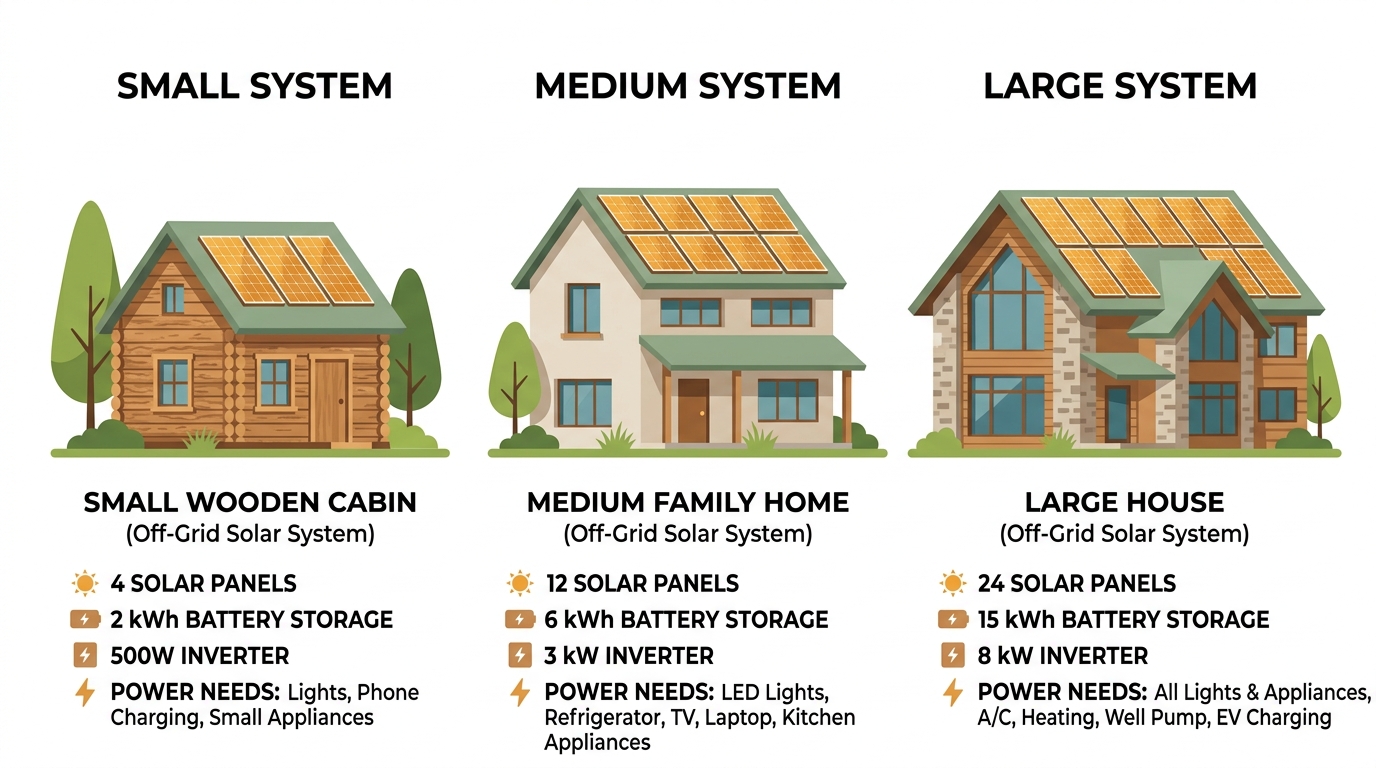
- Small cabin or seasonal retreat (1–2 rooms): 4–8 solar panels (1,600–3,200 watts)
- Medium off-grid home (2–3 bedrooms, energy-conscious): 12–20 panels (4,800–8,000 watts)
- Full-size family home (3–4 bedrooms, normal appliances): 20–35 panels (8,000–14,000 watts)
Most off-grid homes in the continental US land somewhere between 15 and 25 panels using modern 400-watt panels. That’s the sweet spot for a moderately efficient household trying to go fully off-grid.
But « most homes » isn’t your home. Keep reading to nail down your actual number — it takes about five minutes and the results are worth it.
What Determines How Many Solar Panels You Need?
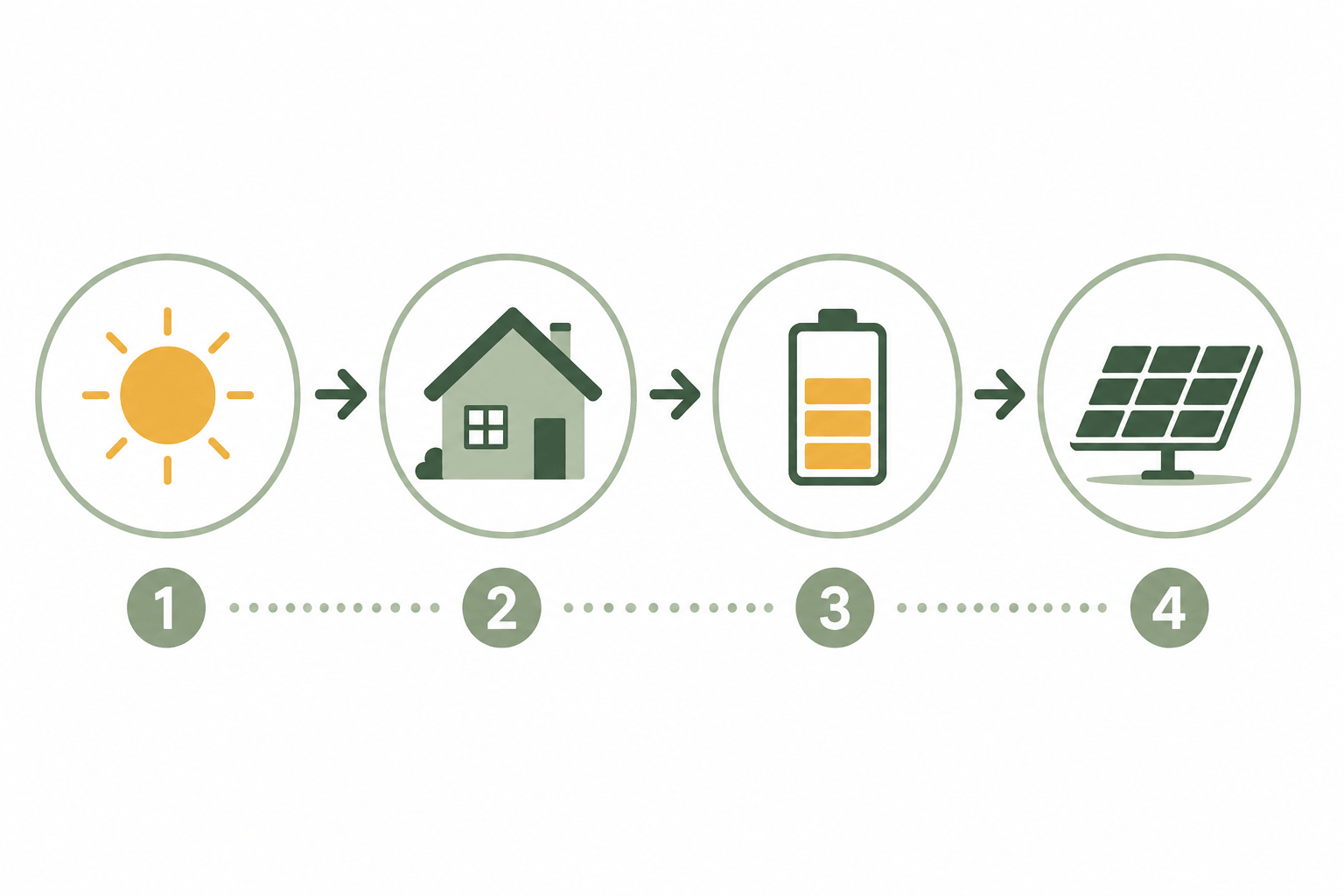
Think of your off-grid solar system as a water supply chain. The panels collect the water (energy), the batteries store it, and your appliances use it. Every link in that chain affects how many panels you need. Here are the five key factors:
1. Your Daily Energy Consumption (kWh)
This is the biggest variable, and it’s entirely in your control. Your daily energy consumption is measured in kilowatt-hours (kWh) — one kWh is the amount of energy used by a 1,000-watt appliance running for one hour.
The average American home uses about 30 kWh per day (roughly 900 kWh per month, according to the U.S. Energy Information Administration). But off-grid households that have made intentional efficiency upgrades typically use 10–20 kWh per day — sometimes even less.
To find your number, check your last 12 months of utility bills and calculate a daily average. Or, if you’re building new, list every appliance you plan to use, its wattage, and how many hours per day you’ll run it.
Quick reference — typical daily usage by appliance:
- Refrigerator (modern, efficient): 1.0–1.5 kWh/day
- LED lighting (whole house): 0.5–1.0 kWh/day
- Laptop + phone charging: 0.2–0.4 kWh/day
- Window AC unit (8 hrs): 2.0–3.5 kWh/day
- Electric water heater: 3.0–5.0 kWh/day
- Washer/dryer (per load): 2.0–4.0 kWh/load
- Well pump: 0.5–1.5 kWh/day
2. Peak Sun Hours at Your Location
Peak sun hours (PSH) is not the number of daylight hours — it’s the number of hours per day your location receives sunlight intense enough to generate rated power from a solar panel (equivalent to 1,000 watts per square meter). This number varies dramatically by location.
Approximate daily peak sun hours by US region:
- Southwest (Arizona, New Mexico, Southern California): 5.5–7.0 hours
- Southeast (Texas, Florida, Georgia): 4.5–5.5 hours
- Pacific Northwest (Oregon, Washington): 3.0–4.0 hours
- Midwest (Kansas, Missouri, Ohio): 4.0–5.0 hours
- Northeast (New York, Maine, Vermont): 3.5–4.5 hours
- Mountain West (Colorado, Utah): 5.0–6.5 hours
If you live in Arizona, you need fewer panels than someone in Vermont doing the same thing — the sun does more work for you. Always use your winter peak sun hours when sizing an off-grid system, because that’s your worst-case scenario and your batteries need to get through it.
3. Panel Wattage
Solar panel technology has improved dramatically. Budget panels from five years ago typically ran 250–300 watts. Today, standard residential panels are 350–420 watts, and premium panels push 500+ watts.
For most off-grid builds, 400-watt panels are the sweet spot — widely available, reasonably priced (around $200–$300 per panel), and physically manageable for installation. That’s the wattage we’ll use in our calculations below.
Using higher-wattage panels means fewer panels for the same output — which matters if you have limited roof space or are mounting on a ground rack.
4. Battery Bank and Inverter Losses (System Efficiency)
No off-grid solar system is 100% efficient. Energy is lost as it moves through your system — from panel to charge controller, from charge controller to battery, and from battery through your inverter (which converts DC battery power to the AC power your appliances use).
A well-designed modern system runs at roughly 80–85% overall efficiency. That means for every 100 watts your panels generate, about 80–85 watts actually reach your appliances.
Always factor this in by dividing your raw energy need by 0.80 (or 0.85 for premium components). If you skip this step, you’ll consistently run short on power — especially in winter.
5. Your Energy Goals: Full Off-Grid vs. Partial Backup
This factor shapes the entire system design:
- Full off-grid: You have no utility connection. The solar system must handle 100% of your needs, every single day, including cloudy stretches. This requires a larger array and a bigger battery bank.
- Grid-tied with battery backup: You stay connected to the utility grid. Solar covers your daily needs; the grid is your backup. You can get away with a smaller system.
- Hybrid/supplemental: Solar handles peak daytime loads and charges batteries for evening use. You still pull some power from the grid. Smallest system needed.
For the rest of this article, we’re focusing on full off-grid — no grid connection, solar and batteries are your only source of power.
Step-by-Step Calculation: A Real-World Example
Let’s run the numbers for a typical 3-bedroom off-grid home in the Midwest — say, a family of three in rural Missouri with energy-conscious habits but no extreme sacrifices (they have a refrigerator, lighting, washer, laptops, and a window AC unit they run in summer).
Step 1: Calculate Daily Energy Consumption
Here’s their appliance list:
- Refrigerator (efficient model): 1.2 kWh/day
- LED lighting (evenings): 0.6 kWh/day
- Washer (4 loads/week avg): 0.5 kWh/day
- Laptops + phones (3 people): 0.4 kWh/day
- Well pump: 0.8 kWh/day
- Chest freezer: 0.6 kWh/day
- Misc (TV, fans, small appliances): 0.9 kWh/day
Total daily consumption: 5.0 kWh/day
Note: They’ve already made smart choices — no electric water heater (propane instead), no electric dryer (line drying), and no central AC. These three swaps alone cut their needs by roughly 8–10 kWh/day compared to a typical US household.
Step 2: Account for System Inefficiency
Divide by system efficiency (0.80):
5.0 kWh ÷ 0.80 = 6.25 kWh of solar generation needed per day
Step 3: Factor In Peak Sun Hours
Missouri averages about 4.5 peak sun hours in winter (their worst-case scenario).
Required solar array output:
6.25 kWh ÷ 4.5 hours = 1.39 kW (1,390 watts) of panel capacity
Step 4: Divide by Panel Wattage
Using 400-watt panels:
1,390 watts ÷ 400 watts = 3.47 panels → round up to 4, then × 1.25 buffer = 5 panels
So this efficient Missouri family needs about 5–6 × 400-watt panels (a 2,000–2,400 watt array) to run their home fully off-grid year-round.
Common Off-Grid System Sizes
| Setup Type | Daily Usage | Panels (400W) | Battery Bank |
|---|---|---|---|
| Weekend cabin | 2–4 kWh | 2–4 panels | 5–10 kWh |
| Full-time cabin / tiny home | 4–8 kWh | 3–6 panels | 10–20 kWh |
| Efficient 2-bedroom home | 8–15 kWh | 6–11 panels | 20–30 kWh |
| 3-bedroom home, moderate | 15–25 kWh | 11–18 panels | 30–50 kWh |
| Large family home | 25–40 kWh | 18–28 panels | 50–80 kWh |
How to Reduce Your Panel Count
Every dollar you spend reducing your energy consumption saves you two to three dollars in solar equipment. These are the most impactful swaps:
- Switch to propane or solar thermal for water heating — saves 3–5 kWh/day
- Line dry instead of using an electric dryer — saves ~5 kWh/load
- Upgrade to a DC or Energy Star refrigerator — saves 0.6–1.4 kWh/day
- Use a mini-split heat pump — delivers 2–4× more heating/cooling per watt
- Switch all lighting to LED — saves 0.5–1.0 kWh/day
- Cook with propane or wood — eliminates high-draw electric stove/oven load
What About Battery Storage?
Solar panels only generate power when the sun shines. At night and during cloudy days, you rely entirely on your battery bank. Most off-grid systems are sized to store 2–3 days of energy consumption without solar input.
- Lithium iron phosphate (LiFePO4): Best long-term value — lasts 10+ years, 80–100% usable capacity, low maintenance.
- Lead-acid (flooded or AGM): Lower upfront cost, but only 50% usable capacity and shorter 3–7 year lifespan.
Battery sizing deserves its own deep dive — we cover it in detail in our guide to off-grid battery banks. For now, just know that your panels and batteries are a team: size one without the other and your whole system will underperform.
💡 Pro Tip — Cut Battery Costs in Half
New LiFePO4 batteries are expensive. Many off-gridders use this battery reconditioning method to restore used forklift or EV batteries to 90%+ capacity for a fraction of the price. Gravity 15.0 on ClickBank, consistently converts on solar/energy audiences.
*Affiliate link — we may earn a commission at no cost to you.
The Bottom Line
Here’s your 6-step framework:
- Calculate your daily kWh consumption — list every appliance honestly.
- Divide by 0.80 to account for system inefficiency.
- Divide by your location’s winter peak sun hours.
- Divide by your panel wattage (400W is the standard).
- Multiply by 1.25 to add a real-world buffer.
- Round up — that’s your starting point.
For the typical off-grid US home: expect 12–25 panels. Energy-efficient households can often get by with 6–12. Large homes with standard appliances may need 25–35.
The single most powerful thing you can do before buying panels is to cut your energy consumption first. Every kWh you eliminate shrinks your required array — and your total cost.
If you’re serious about going off-grid and want to avoid the expensive mistakes most beginners make — wrong system sizing, mismatched components, undersized battery banks — it pays to follow a proven step-by-step framework. A resource like the Power Grid Generator guide walks you through the entire planning and installation process in plain language, from calculating your load to wiring your first panel safely. It’s the kind of detailed roadmap that can save you thousands in do-overs.
Got questions about your specific situation? Drop them in the comments — we read every one. And if you found this guide useful, share it with someone thinking about making the switch to solar.