How to Store Water for Long-Term Emergencies: The Complete Guide
How to Store Water for Long-Term Emergencies: The Complete Guide
It was a Tuesday afternoon when a water main broke three blocks away and the municipal notice arrived: no tap water for 72 hours. Most households had maybe a case of bottled water in the pantry. By 6 p.m., every grocery store shelf within five miles was stripped bare. If that sounds familiar — or like something that could happen to you — this guide is exactly what you need before the next emergency hits.
Without a solid water storage plan, even a short disruption becomes a full-blown crisis. Dehydration sets in fast. Sanitation collapses. Cooking, cleaning, and medication preparation all grind to a halt. FEMA reports that water supply disruptions are among the top three most common consequences of natural disasters in the United States, yet the majority of American households store less than a three-day supply. The difference between a manageable inconvenience and a dangerous emergency often comes down to preparation done weeks — or months — in advance.
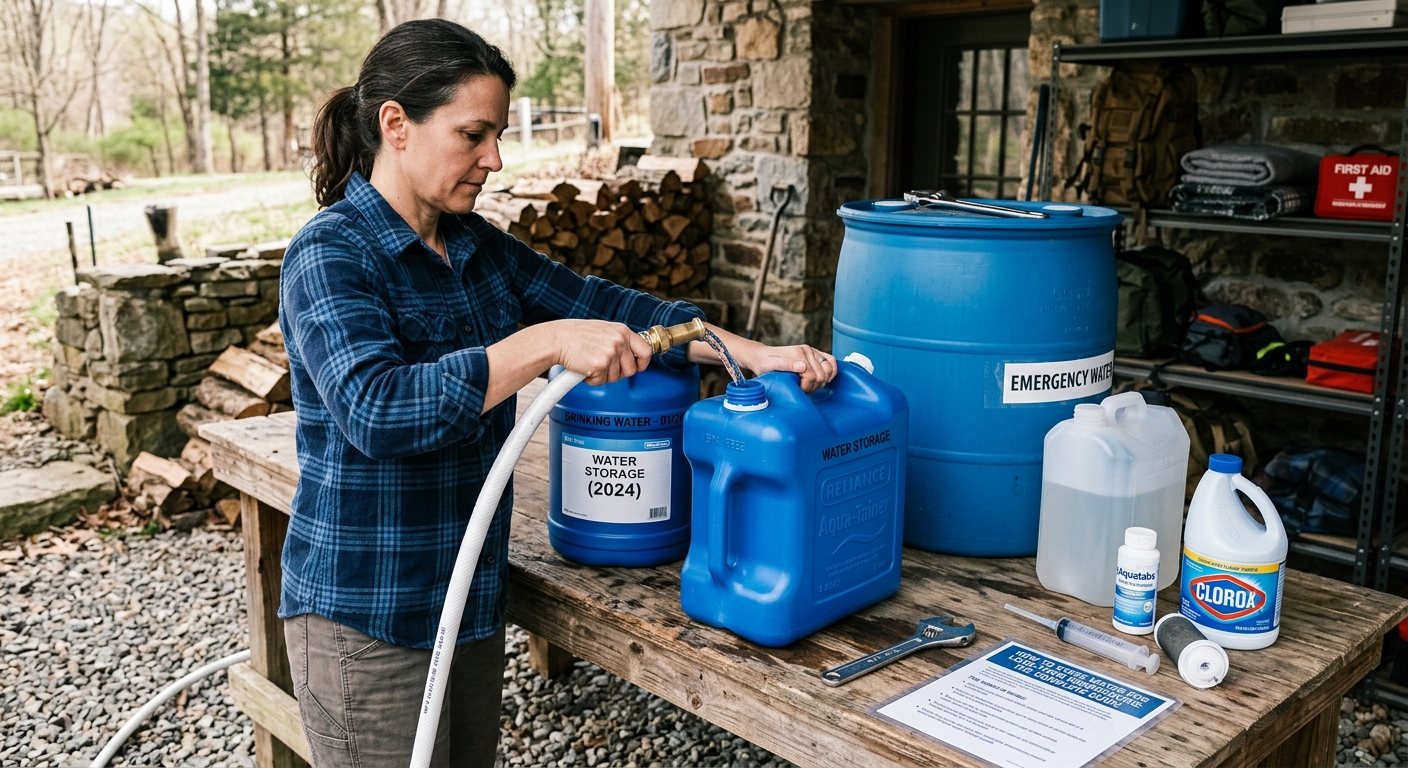
In this guide you will learn exactly how to store water for long term emergencies at home. We cover the one rule every household needs to know, the best container types and where to find them, where you should never store water, how to treat water before sealing it away, and a full rotation schedule to keep your supply fresh. We also include a family-size calculation table so you know precisely how many gallons you need for three days, two weeks, three months, or a full year.
The Quick Answer: How Much Water to Store Per Person
FEMA and the American Red Cross both recommend a minimum of one gallon of water per person per day — roughly half a gallon for drinking and half for basic sanitation. In hot climates, during physical labor, or for pregnant or nursing women, that number climbs to two gallons per person per day. Children, nursing mothers, and people who are ill need more than the baseline.
- Minimum baseline: 1 gallon per person per day (FEMA / Red Cross recommendation)
- Warm climate or active work: 2 gallons per person per day
- Pets: Add roughly 1 quart (0.25 gallons) per small dog or cat per day
- Short-term emergency (3 days): Absolute minimum recommended by federal agencies
- Recommended personal target: 2 weeks minimum; 3 months for serious off-grid preppers
Container Types for Long-Term Water Storage
The container you choose matters almost as much as the water inside it. Wrong materials leach chemicals, crack under temperature swings, or harbor bacteria. Here are the most practical options, ranked from largest to smallest.
55-Gallon Food-Grade Polyethylene Barrels
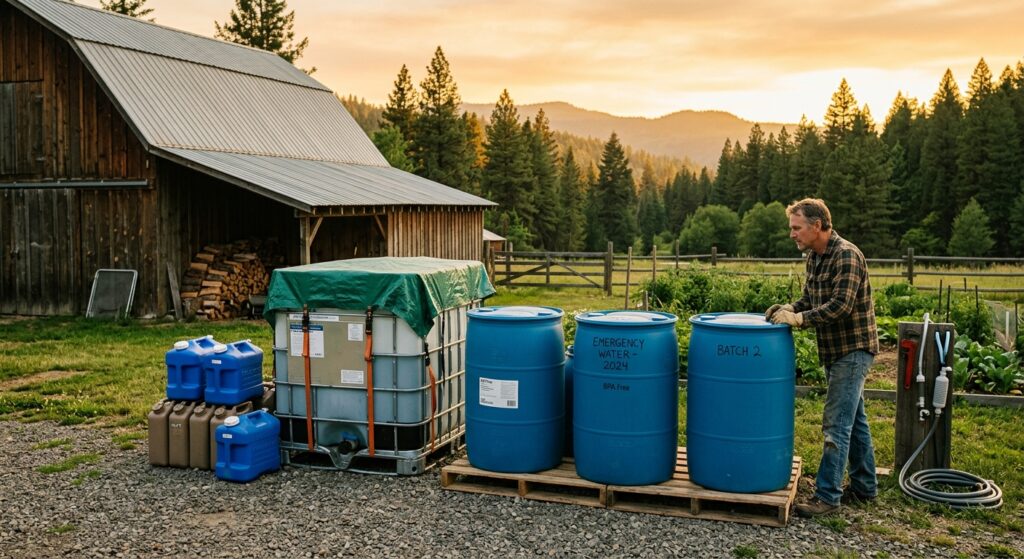
The 55-gallon blue HDPE barrel is the workhorse of serious emergency water storage. A single barrel holds enough water for one person for nearly two months at the FEMA baseline. They run roughly $50–$90 new from emergency supply retailers like Emergency Essentials or Costco, or $15–$30 used from food-industry suppliers (look for food-grade certification, never use a barrel that held non-food chemicals). You will need a hand-pump or siphon to draw water out — budget another $10–$20 for a dedicated barrel pump. One important caveat: a full 55-gallon barrel weighs approximately 460 pounds, so position it permanently before filling.
5-Gallon BPA-Free Jugs
Five-gallon food-grade jugs (look for the number « 2 » recycling symbol, indicating HDPE) are the most flexible option for most households. They weigh about 42 pounds when full — manageable for one adult — and stack efficiently on shelving. Brands like WaterStorageCube, Scepter, and Reliance Products make quality options available at Walmart, REI, and Amazon for $10–$20 each. Avoid repurposing milk jugs: the thin plastic degrades and the residual dairy proteins encourage bacterial growth even after thorough washing.
WaterBOB Bathtub Emergency Water Storage Bladder
The WaterBOB is a 100-gallon heavy-duty BPA-free plastic bladder that fits inside a standard bathtub. It sells for around $25–$35 and fills directly from the tap in about 20 minutes. It is a last-minute tool — ideal if you hear a hurricane warning and have a few hours to prepare — not a long-term storage solution you fill and forget. Once filled it should be used within 4 weeks. Keep one or two under the sink as a rapid-response backup.
Water Bricks
WaterBrick stackable containers hold 3.5 gallons each and are designed specifically for emergency storage. The rectangular shape lets them stack like building blocks, fitting under beds, in closets, and in corners where round barrels cannot go. A set of 8 bricks (28 gallons) costs around $175–$200 and handles storage for one person for about a month. They are BPA-free, have airtight seals, and include handle cutouts for carrying. If floor space is your constraint, WaterBricks are worth the premium.
Commercial Pre-Filled Water Pouches and Cans
DATREX emergency water pouches (125 mL each) and Puravai canned water have five-year shelf lives and require no treatment or rotation. They are more expensive per gallon — roughly $1.50–$2.50 per pouch — but work well as a grab-and-go layer of your plan or for vehicle emergency kits. Not practical as your primary long-term supply, but excellent as a no-maintenance backup.
Where NOT to Store Your Emergency Water Supply
Location is where many otherwise well-prepared households make costly mistakes. Even food-grade containers filled with treated water can become unsafe if stored in the wrong conditions.
Avoid Direct Sunlight
UV light degrades plastic containers over time, causing micro-cracks and accelerating chemical leaching. More importantly, sunlight warms the water, which accelerates bacterial and algae growth. Even HDPE containers that are rated for outdoor use will degrade significantly faster in direct sun. Store everything in a dark location or inside opaque containers.
Avoid Garages with Temperature Extremes
This is the most common mistake. Garages in most of the United States experience temperature swings from below freezing in winter to well above 100°F in summer. Freezing water expands and can crack containers, especially if filled to the very top. Extreme heat accelerates the off-gassing of plastic chemicals into the water. The ideal storage temperature is 50°F–70°F — a basement, interior closet, or climate-controlled storage room is far better than a garage.
Do Not Store on Bare Concrete
An older concern — largely debunked for modern HDPE containers — but still worth noting: store barrels on wooden pallets or shelving rather than directly on concrete floors. This improves air circulation, makes inspection easier, and protects containers from moisture wicking up from below.
Keep Away from Chemicals and Fuel
HDPE is permeable to certain volatile organic compounds. Gasoline, pesticides, paint thinner, and other solvents stored nearby can slowly permeate plastic walls and contaminate your water. Keep your water storage completely separate from any chemical storage area.
How to Purify Water Before Long-Term Storage
If you are filling containers from a treated municipal tap, the water already contains chlorine — but that chlorine dissipates over time. If you are filling from a well or any untreated source, you must treat the water before sealing it.
Using Unscented Liquid Chlorine Bleach
The CDC recommends adding unscented liquid chlorine bleach (6–8.25% sodium hypochlorite) at a rate of 8 drops per gallon if the water is clear, or 16 drops per gallon if it is cloudy. That translates to roughly 1/8 teaspoon per gallon. Use regular unscented Clorox or a store-brand equivalent — never scented bleach, color-safe bleach, or bleach with added cleaners. After adding bleach, seal the container and let it sit for 30 minutes before storing. The water should have a slight chlorine smell; if it does not, repeat the dosage and wait another 15 minutes.
Using Water Preserver Concentrate
Products like Aquatabs Water Preserver or Purogene Water Treatment extend safe storage life up to 5 years in sealed food-grade containers. A single bottle of Purogene (~$15) treats 110 gallons. If you want to fill barrels and not think about them for years at a time, a dedicated water preserver is worth the investment over bleach.
Filling From a Well
Well water should be tested before storage — contact your local cooperative extension office or use a home test kit ($15–$40 at hardware stores). If results are clean, treat with bleach as above. If the well shows coliform bacteria, boil the water first, then treat chemically before storing.
Water Storage Rotation Schedule
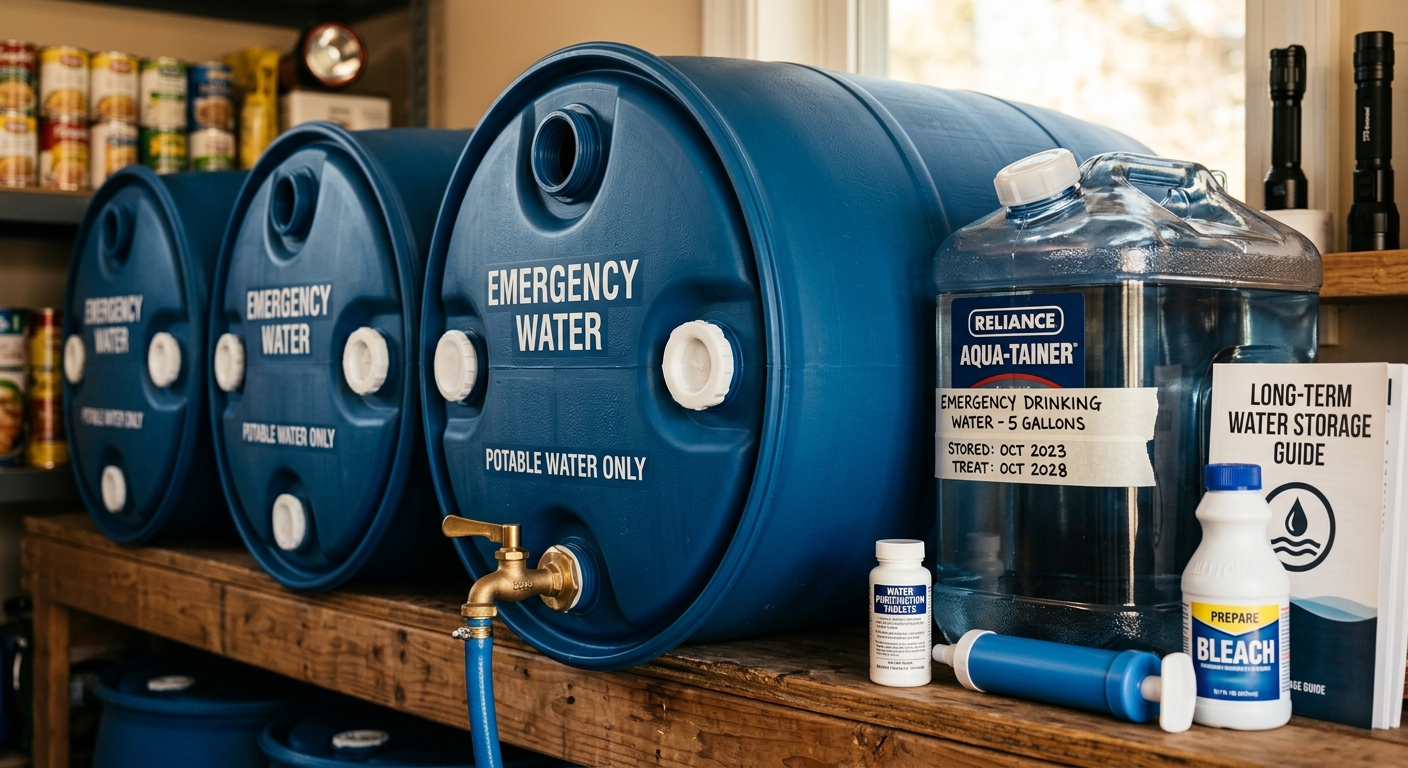
Even treated water does not last forever. The standard recommendation is to rotate (use and refill) your stored water every 6 to 12 months. Here is a practical schedule for a typical household:
- Every 6 months: Inspect all containers for cracks, discoloration, or unusual odor. Rotate municipally-sourced water treated with standard bleach.
- Every 12 months: Rotate well water or any water stored in a location with higher temperature fluctuation.
- Every 3–5 years: Water treated with commercial water preserver concentrate in sealed, food-grade containers in stable temperatures.
- Annually: Check and replace container lids and seals as needed. Inspect barrel bungs for tightness.
A simple system: mark each container with its fill date using a paint pen or waterproof label. Tie your rotation to an existing calendar event — daylight saving time changes in spring and fall are a common trigger for checking emergency supplies.
Emergency Water Storage Calculator: How Much Do You Need?
Use this table to find your target storage volume based on family size and desired supply duration, using the FEMA baseline of 1 gallon per person per day.
| Family Size | 3 Days (Min) | 2 Weeks | 3 Months | 1 Year |
|---|---|---|---|---|
| 1 person | 3 gallons | 14 gallons | 90 gallons | 365 gallons |
| 2 people | 6 gallons | 28 gallons | 180 gallons | 730 gallons |
| 4 people | 12 gallons | 56 gallons | 360 gallons | 1,460 gallons |
| 6 people | 18 gallons | 84 gallons | 540 gallons | 2,190 gallons |
Note: Double these figures for hot-climate households, physically demanding routines, or if anyone in the household has elevated needs. These numbers do not include water for gardening, livestock, or washing clothes.
Practical Tips and Common Mistakes to Avoid
Start Small and Scale Up
The biggest obstacle to emergency water storage is the feeling that you need to solve the entire problem at once. You do not. Start with a two-week supply for your household — that is 56 gallons for a family of four, achievable with a single 55-gallon barrel or eleven 5-gallon jugs. Once that is in place and funded, work toward three months. Rome was not built in a day, and neither is a robust off-grid water supply.
Do Not Forget Filtration as a Backup Layer
Stored water covers planned emergencies, but a quality gravity filter like a Berkey or a Sawyer filtration system gives you the ability to process questionable water sources — streams, rain catchment, or questionable well water — when your stored supply runs low. Think of stored water as your first line and filtration as your fallback. A countertop Berkey system runs $250–$350 and filters up to 6,000 gallons before element replacement.
Label Everything
Write the fill date, the treatment method used, and the source (tap vs. well vs. other) on every container. Use a permanent paint marker directly on the container or a laminated waterproof label. In an emergency, you will not remember which barrel you filled last spring and which one has been sitting for three years.
Consider Water Alternatives for Sanitation
During an extended outage, wet wipes, hand sanitizer, and waterless shampoo can dramatically reduce your sanitation water requirement — stretching your stored supply further. Keep a stash of these alongside your water storage. The Red Cross recommends storing at least one gallon per person per day specifically for sanitation; cutting that need with alternatives gives you more drinking margin.
Communicate the Plan With Everyone in the Household
Every adult — and older children — should know where the water supply is, how to access it (barrel pump location, siphon technique), and what the rotation schedule is. Emergency preparedness only works if the people who need it can actually execute it under stress, without needing to find instructions first.
Account for Cooking Water
The FEMA one-gallon baseline is survival-level minimum. It does not account for cooking rice, beans, pasta, or dehydrated food — all common staples in long-term emergency food supplies. Cooking these items requires an additional half-gallon to a full gallon per person per day depending on your menu. If your food storage is heavy in dried goods, adjust your water calculations accordingly.
The Bottom Line
Knowing how to store water for long term emergencies is one of the highest-leverage preparedness steps you can take. The materials are affordable, the knowledge is straightforward, and the payoff — the ability to stay calm and self-sufficient during any disruption — is enormous. Start with the FEMA baseline of one gallon per person per day, choose food-grade containers sized for your space, treat before sealing, store away from heat and sunlight, and rotate every six to twelve months. For a family of four, a two-week minimum supply means just 56 gallons — one 55-gallon barrel plus a small overflow container gets you there for under $100.
Build your supply in layers: short-term jugs you can grab and go, mid-term barrels for shelter-in-place scenarios, and a quality filtration system as your long-term fallback. Each layer you add increases the gap between you and a genuine crisis. The table above gives you the exact numbers — all that is left is to act on them before the next disruption arrives rather than after.
Have questions about your specific situation? Drop them in the comments below — we read every one. If this guide helped you, share it with someone planning their off-grid setup.
Marcus Reid
Founder & Editor, OffGridSage
Marcus founded OffGridSage to bring practical off-grid knowledge together in one place. Guides are built from official and expert sources (NREL, the EPA, the USDA and university extension services), manufacturer documentation and reader feedback, and are updated when information changes.